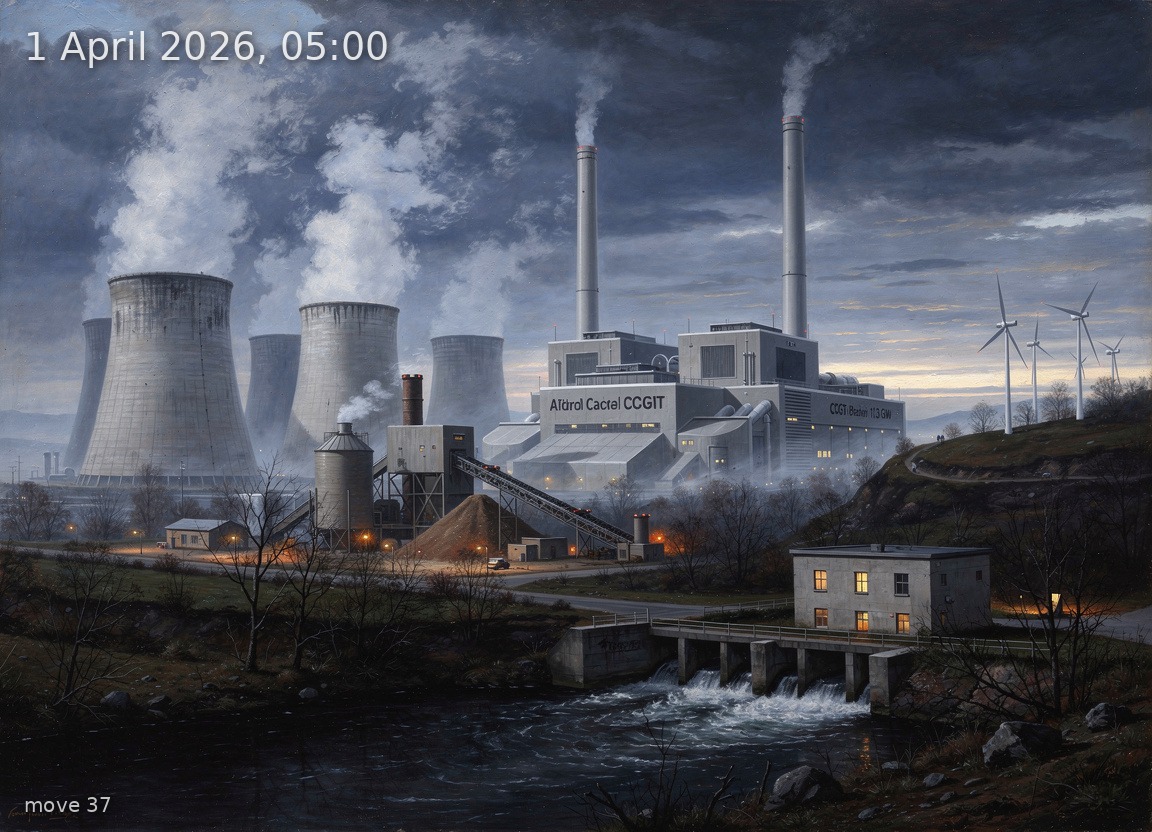
Gas, brown coal, and hard coal dominate a 34.3 GW domestic supply gap bridged by 16.6 GW net imports at pre-dawn.
Back
Generation mix
Wind onshore 5%
Wind offshore 0%
Biomass 12%
Hydro 4%
Natural gas 33%
Hard coal 18%
Brown coal 28%
20%
Renewable share
1.8 GW
Wind (on + offshore)
0.0 GW
Solar
34.3 GW
Total generation
-16.6 GW
Net import
149.1 €/MWh
Day-ahead price
3.1°C / 3 km/h
Temp / Wind speed
Open-Meteo, Kassel (51.3°N 9.5°E)
69% / 0.0 W/m²
Cloud cover / Radiation
530
gCO₂/kWh
Image prompt
Natural gas 11.3 GW dominates the centre-right as a cluster of large CCGT power stations with tall single exhaust stacks venting pale steam; brown coal 9.7 GW fills the left third as massive hyperbolic cooling towers with thick white plumes rising into the heavy sky; hard coal 6.2 GW appears as a pair of coal-fired stations with rectangular boiler houses and shorter stacks between the lignite and gas plants; biomass 4.0 GW is rendered as a medium-sized wood-chip burning facility with a conical fuel silo and a modest exhaust, positioned in the middle-left; onshore wind 1.8 GW appears as a small group of three-blade turbines on a low ridge in the far right background, rotors barely turning in the still air; hydro 1.2 GW is a modest run-of-river station with a weir and low concrete powerhouse near a dark river in the foreground. Time is 05:00 pre-dawn: the sky is deep blue-grey with the faintest pale hint of light along the eastern horizon, no direct sunlight, no warm glow — the landscape is mostly dark, lit by sodium-orange industrial lamps on the plant structures and faint amber windows. No solar panels anywhere. The atmosphere is oppressive and heavy, reflecting 149.1 EUR/MWh pricing: low overcast clouds at 69% coverage press down, and lingering mist threads through the river valley at 3°C. Bare early-spring trees with no leaves, patches of frost on fields. Transmission pylons with high-voltage lines recede into the murky distance, suggesting large cross-border power flows. Painted in the style of a highly detailed 19th-century German Romantic oil painting — rich dark palette of Prussian blue, raw umber, and lamp black, with warm sodium-light accents, visible impasto brushwork, atmospheric depth and sfumato in the mist, yet every cooling tower, turbine nacelle, lattice mast, and CCGT stack rendered with meticulous engineering accuracy. No text, no labels.