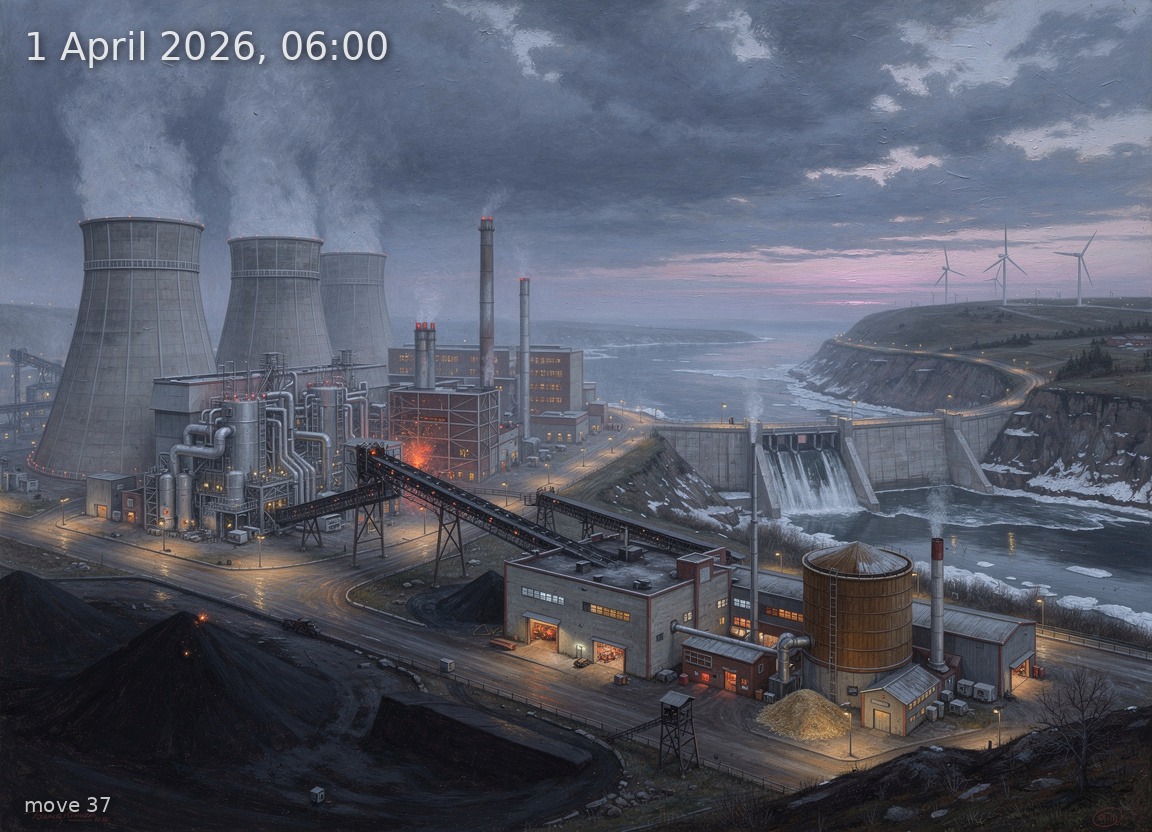
Coal and gas dominate at 28.9 GW combined as calm, cold pre-dawn conditions suppress renewables and drive 21.5 GW net imports.
Back
Generation mix
Wind onshore 4%
Solar 0%
Biomass 11%
Hydro 4%
Natural gas 36%
Hard coal 18%
Brown coal 28%
19%
Renewable share
1.3 GW
Wind (on + offshore)
0.0 GW
Solar
35.5 GW
Total generation
-21.5 GW
Net import
180.8 €/MWh
Day-ahead price
2.8°C / 4 km/h
Temp / Wind speed
Open-Meteo, Kassel (51.3°N 9.5°E)
79% / 0.0 W/m²
Cloud cover / Radiation
535
gCO₂/kWh
Records
#2
Fossil Hour
Image prompt
Brown coal 9.9 GW dominates the left third of the scene as a cluster of massive hyperbolic cooling towers with thick white-grey steam plumes rising into the heavy sky; natural gas 12.8 GW fills the centre-left as a sprawling CCGT complex with tall slender exhaust stacks emitting translucent heat shimmer; hard coal 6.2 GW appears centre-right as a coal-fired station with rectangular chimneys and conveyor belts feeding dark fuel; biomass 4.1 GW is rendered as a smaller industrial plant with a rounded wooden-chip silo and modest steam output at far centre-right; hydro 1.3 GW appears as a concrete dam structure with faintly lit spillway in the middle distance right; wind onshore 1.3 GW is visible as two or three lonely three-blade turbines on a distant ridge at far right, rotors barely turning. Pre-dawn lighting at 06:00 Berlin time: the sky is deep blue-grey transitioning to a faint cold lavender band along the eastern horizon, no direct sunlight, no solar panels anywhere. Temperature 2.8°C: frost coats the ground and bare early-spring branches, thin ice on puddles, dormant brown grass and leafless deciduous trees. Cloud cover 79%: a thick overcast ceiling presses down oppressively, reflecting the amber glow of sodium streetlights and the orange-red furnace glow from coal plant windows. The atmosphere feels heavy and dense, conveying the 180.8 EUR/MWh price tension — mist hangs low over the industrial valley, diffusing the artificial light into a sulphurous haze. High-voltage transmission lines on lattice pylons stretch from background to foreground, symbolizing the massive import flows. Highly detailed oil painting in the tradition of 19th-century German Romantic landscape painters such as Caspar David Friedrich and Carl Blechen — rich impasto brushwork, dramatic chiaroscuro between furnace glow and pre-dawn gloom, atmospheric depth with receding layers of industrial structures fading into misty distance. Meticulous engineering detail on all infrastructure: three-blade rotor nacelles with aviation lights, aluminium cooling tower ribbing, riveted steel stacks, concrete dam abutments. No text, no labels, no people in foreground.