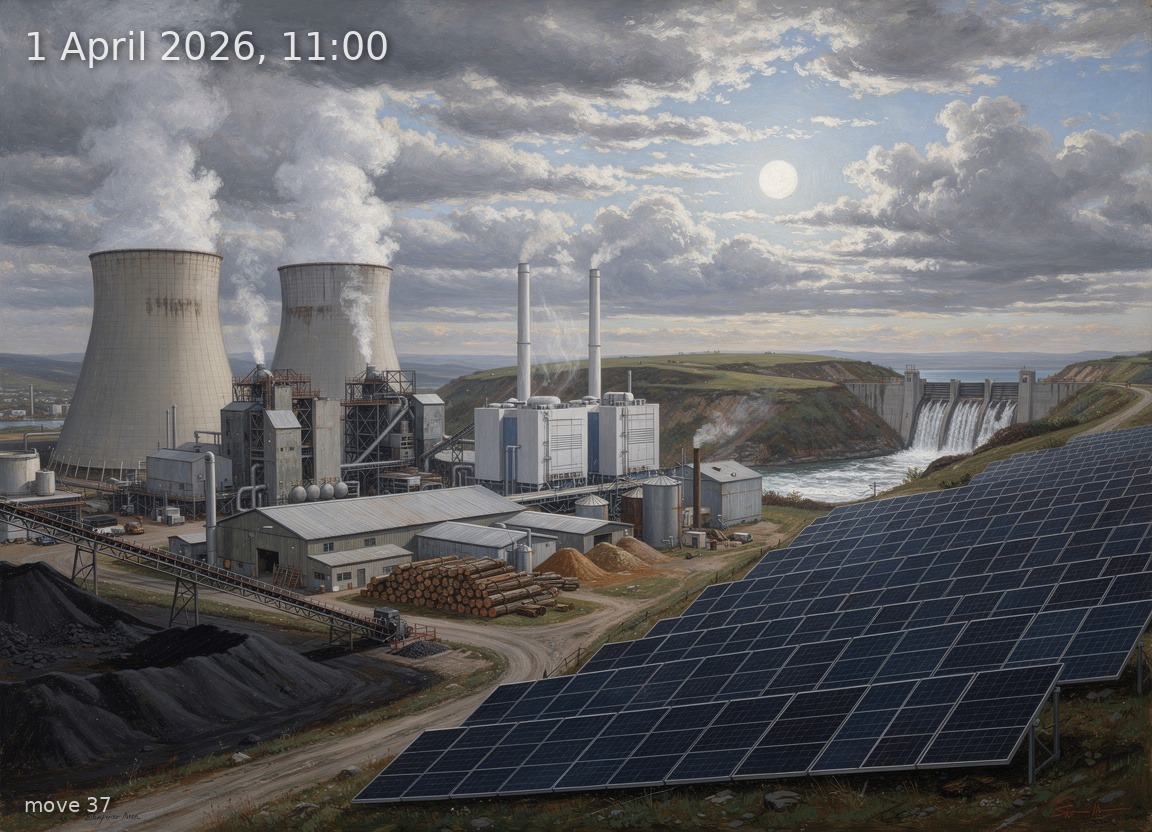
Strong solar and heavy coal and gas backstop a windless April midday, with 5.5 GW net imports filling the gap.
Back
Generation mix
Wind onshore 1%
Wind offshore 1%
Solar 53%
Biomass 7%
Hydro 2%
Natural gas 11%
Hard coal 11%
Brown coal 14%
64%
Renewable share
1.4 GW
Wind (on + offshore)
31.3 GW
Solar
58.8 GW
Total generation
-5.6 GW
Net import
128.1 €/MWh
Day-ahead price
5.7°C / 3 km/h
Temp / Wind speed
Open-Meteo, Kassel (51.3°N 9.5°E)
53% / 61.2 W/m²
Cloud cover / Radiation
249
gCO₂/kWh
Image prompt
Solar 31.3 GW dominates the right half of the scene as vast fields of aluminium-framed crystalline silicon PV panels stretching across gentle rolling hills, angled toward a hazy midday sun partially veiled by broken clouds. Brown coal 8.2 GW occupies the far left as a massive lignite power station with three hyperbolic cooling towers emitting thick white steam plumes rising into the overcast. Hard coal 6.4 GW sits left of centre as a coal plant with tall rectangular boiler houses, conveyor belts, and a coal stockpile. Natural gas 6.3 GW appears centre-left as two compact CCGT units with slender exhaust stacks releasing thin heat shimmer. Biomass 4.0 GW is a mid-ground cluster of smaller industrial buildings with a timber yard and a single modest smokestack. Hydro 1.1 GW is a small dam and spillway in a valley at the far right background. Wind onshore 0.7 GW is represented by just two distant three-blade turbines on a ridge, rotors barely turning. Wind offshore 0.7 GW appears as a faint silhouette of two offshore turbines on the horizon. The sky is a heavy, oppressive layer of broken stratocumulus at 53% cover, with patches of pale blue, a diffuse white sun disk visible through thin cloud — the light is bright but flat, typical of a cool early-April midday. The atmosphere feels weighty and pressured, reflecting the high electricity price. Vegetation is early spring: bare deciduous trees with the first pale-green buds, brown-green meadows, patches of last frost in shaded hollows — temperature near 6°C. Air is nearly still, no motion in grasses or flags. Rendered as a highly detailed oil painting in the tradition of 19th-century German Romantic landscape painters — rich layered colour, visible impasto brushwork, atmospheric depth and aerial perspective, dramatic tonal contrasts between the luminous solar fields and the brooding industrial smoke. Each technology rendered with meticulous engineering accuracy: turbine nacelles, lattice towers, cooling tower parabolic profiles, PV module grid patterns. The scene reads as a monumental industrial landscape masterwork. No text, no labels.