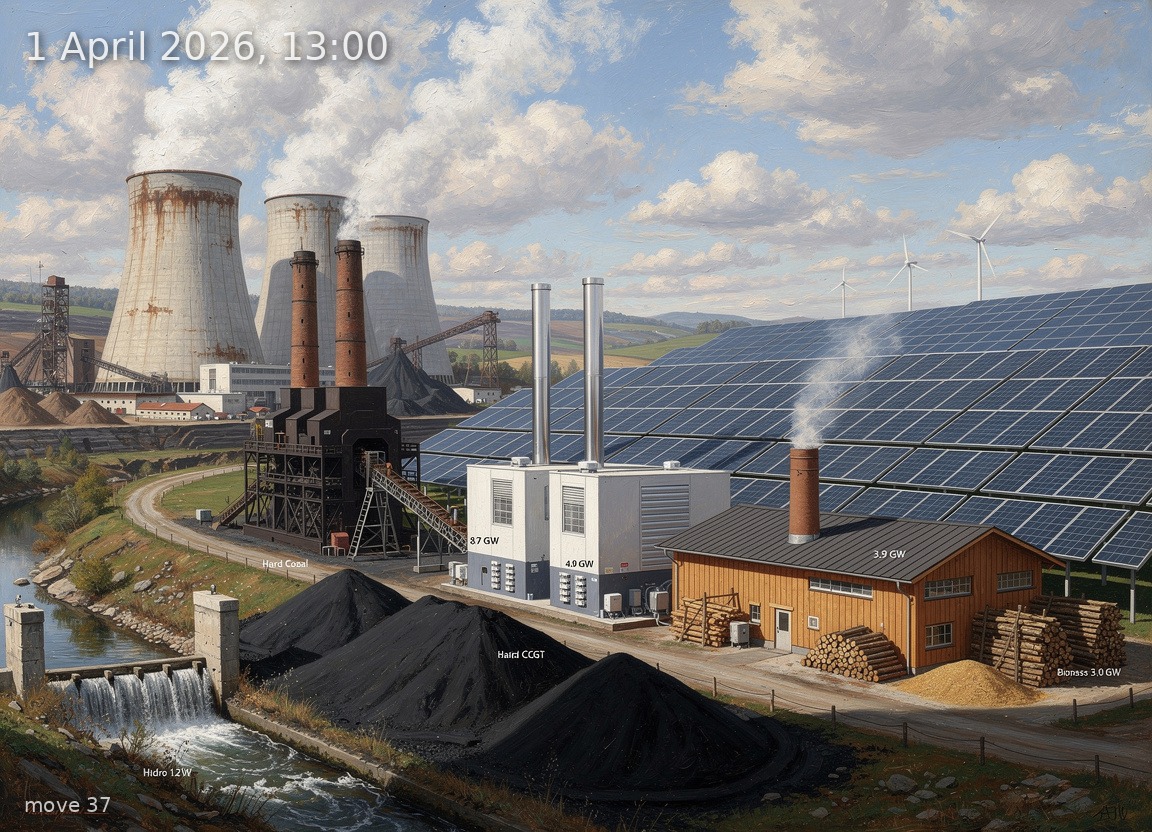
Solar at 37.9 GW leads generation while near-zero wind forces 17.7 GW of fossil thermal dispatch at midday.
Back
Generation mix
Wind onshore 1%
Wind offshore 2%
Solar 61%
Biomass 6%
Hydro 2%
Natural gas 8%
Hard coal 8%
Brown coal 13%
72%
Renewable share
1.9 GW
Wind (on + offshore)
37.9 GW
Solar
62.6 GW
Total generation
+1.3 GW
Net export
93.8 €/MWh
Day-ahead price
8.5°C / 0 km/h
Temp / Wind speed
Open-Meteo, Kassel (51.3°N 9.5°E)
58% / 367.8 W/m²
Cloud cover / Radiation
202
gCO₂/kWh
Image prompt
Solar 37.9 GW dominates the right two-thirds of the scene as an immense expanse of crystalline silicon photovoltaic panels stretching across gently rolling central German farmland, their aluminium frames glinting under midday spring light filtering through a partly cloudy sky; brown coal 8.0 GW occupies the far left as a massive lignite power station with four hyperbolic concrete cooling towers trailing thick white steam plumes; hard coal 5.0 GW appears just left of centre as a pair of tall brick chimneys atop a dark industrial boiler house with conveyor belts feeding black coal from a heap; natural gas 4.7 GW sits centre-left as two compact CCGT units with slender stainless-steel exhaust stacks emitting faint heat shimmer; biomass 3.9 GW is a modest timber-clad plant with a single squat smokestack and stacked wood-chip piles beside it, placed between the gas units and the solar field; hydro 1.2 GW appears as a small concrete dam and spillway tucked into a valley fold at the left edge; wind onshore 0.8 GW and wind offshore 1.0 GW are represented by just two or three distant three-blade turbines on lattice towers, their rotors nearly motionless against the sky. The sky is a complex April patchwork: roughly 58% covered in mid-level cumulus and alto-stratus clouds, with brilliant blue gaps allowing strong direct sunshine to strike the solar panels and cast defined shadows; the light is full midday brightness, sun nearly overhead and slightly south. The air feels cool at 8.5°C — bare deciduous trees are just beginning to bud, grass is fresh green but short, a few patches of old snow linger in shadows. The atmosphere carries a slightly heavy, oppressive haze near the thermal plants, referencing the elevated 93.8 EUR/MWh price — a faint amber-brown tint to the industrial horizon. Style: highly detailed oil painting in the tradition of 19th-century German Romantic landscape masters such as Caspar David Friedrich and Carl Blechen, with rich impasto brushwork, luminous atmospheric depth, dramatic chiaroscuro where cloud shadows sweep across the solar fields, and meticulous engineering accuracy in every turbine nacelle, panel junction box, and cooling-tower shell. No text, no labels.