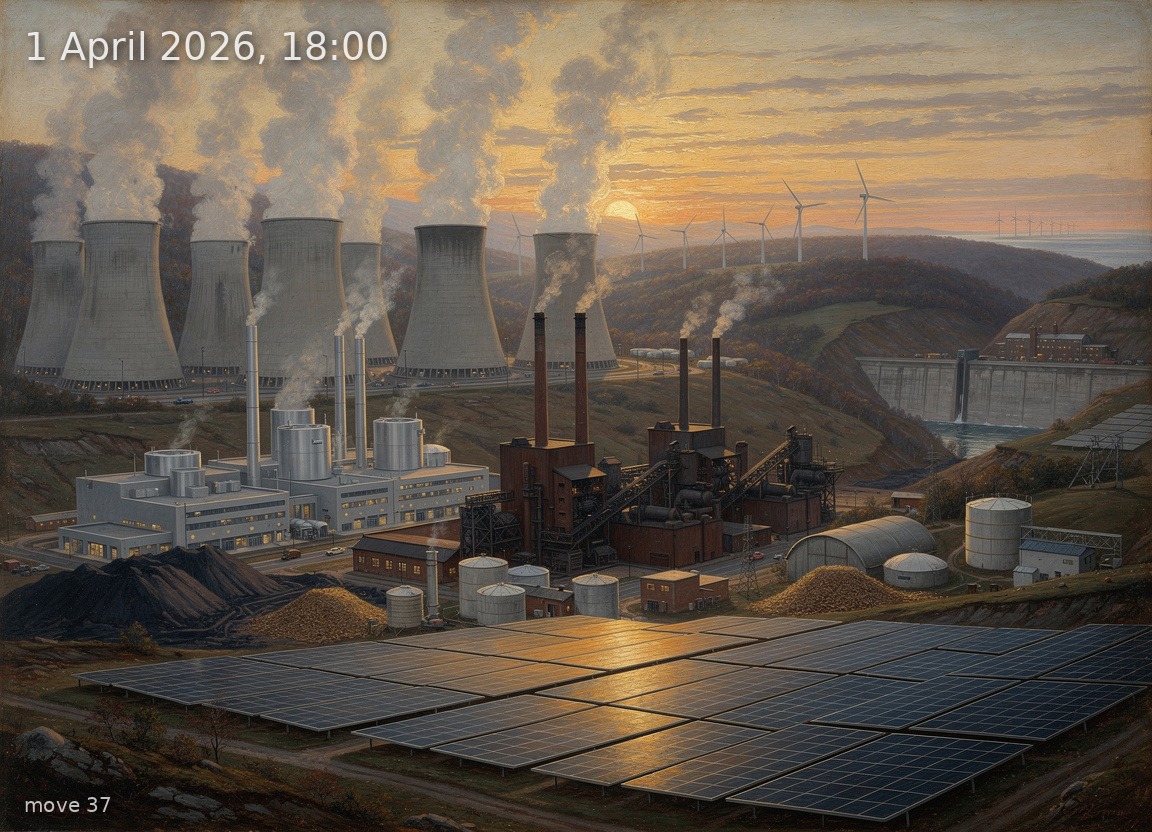
Coal and gas dominate as near-zero wind and fading solar force 15.4 GW of net imports at elevated prices.
Back
Generation mix
Wind onshore 2%
Wind offshore 2%
Solar 19%
Biomass 10%
Hydro 3%
Natural gas 26%
Hard coal 15%
Brown coal 23%
36%
Renewable share
1.7 GW
Wind (on + offshore)
8.4 GW
Solar
43.6 GW
Total generation
-15.4 GW
Net import
152.1 €/MWh
Day-ahead price
9.8°C / 4 km/h
Temp / Wind speed
Open-Meteo, Kassel (51.3°N 9.5°E)
10% / 218.2 W/m²
Cloud cover / Radiation
431
gCO₂/kWh
Image prompt
Brown coal 10.2 GW dominates the left third of the scene as a cluster of massive hyperbolic cooling towers with thick white-grey steam plumes rising into the sky; natural gas 11.1 GW fills the centre-left as a row of modern CCGT power plants with tall single exhaust stacks venting heat shimmer; hard coal 6.7 GW appears centre-right as older industrial coal-fired stations with square chimneys and conveyor belts feeding dark fuel; solar 8.4 GW is rendered in the right foreground as expansive fields of aluminium-framed crystalline silicon panels catching the last amber light of the setting sun; biomass 4.3 GW appears as a mid-ground cluster of smaller wood-chip fed power stations with modest stacks and biomass storage domes; hydro 1.3 GW is visible as a concrete dam and penstock in the far right distance against wooded hills; wind onshore 1.0 GW and wind offshore 0.7 GW appear as a sparse handful of three-blade turbines on distant ridgelines and a few offshore towers barely visible on the horizon, their blades nearly still in the calm air. The sky is a dusk scene at 18:00 in early April: the lower horizon glows deep orange-red fading to salmon, while the upper sky transitions rapidly to slate blue and deepening indigo, the sun just touching the horizon. The atmosphere is heavy and oppressive, with a warm haze hanging over the industrial facilities, reflecting the high electricity price. Vegetation is early spring — bare branches with the first pale green buds on trees, brown-green grass. Temperature around 10°C gives a cool, slightly misty feel near the ground. The air is nearly still, no motion in the sparse turbine blades. Painted in the style of a highly detailed 19th-century German Romantic oil painting — rich impasto brushwork, dramatic chiaroscuro lighting from the dying sunset illuminating the steam plumes in gold and amber, deep atmospheric perspective receding into haze, meticulous engineering detail on every nacelle, cooling tower, panel frame, and exhaust stack. The composition conveys the weight of industrial power shouldering the load of a windless spring evening. No text, no labels.