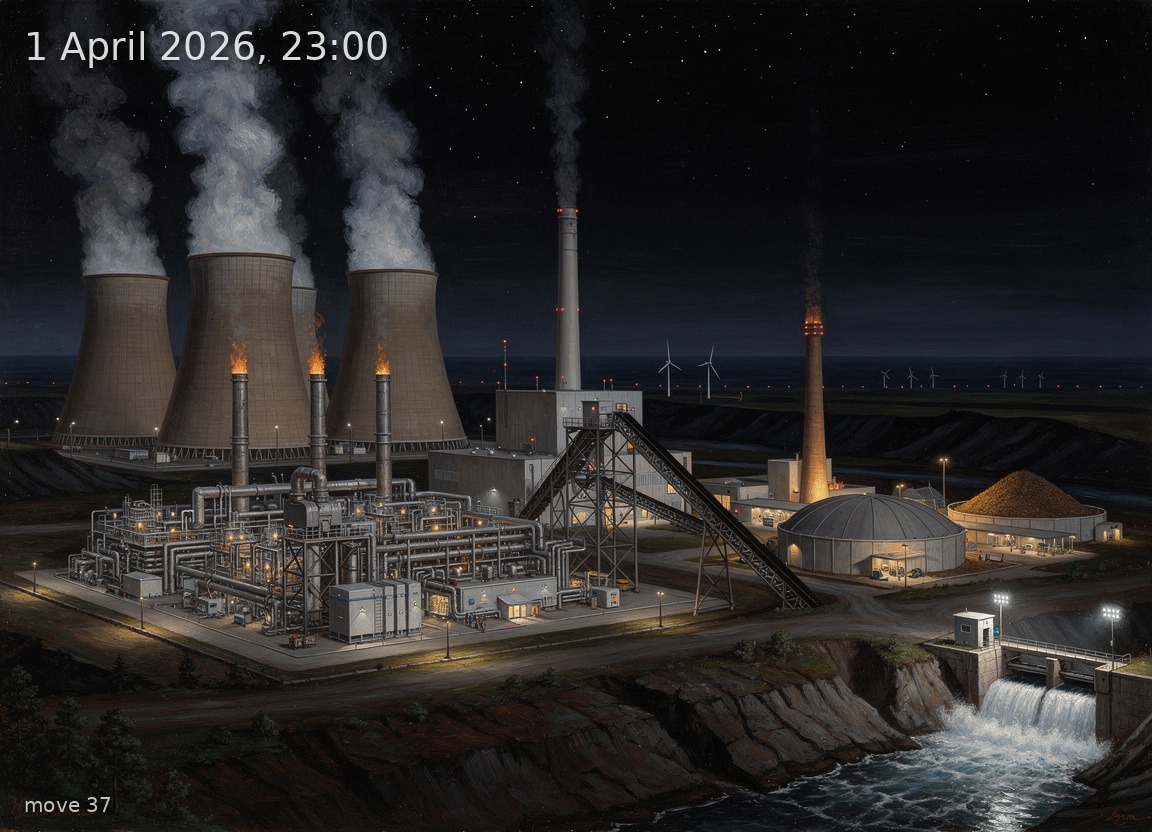
Coal and gas dominate a cold, windless spring night as Germany imports 12 GW to meet demand.
Back
Generation mix
Wind onshore 11%
Wind offshore 3%
Biomass 10%
Hydro 3%
Natural gas 30%
Hard coal 16%
Brown coal 27%
27%
Renewable share
5.5 GW
Wind (on + offshore)
0.0 GW
Solar
39.3 GW
Total generation
-12.2 GW
Net import
133.8 €/MWh
Day-ahead price
2.5°C / 3 km/h
Temp / Wind speed
Open-Meteo, Kassel (51.3°N 9.5°E)
0% / 0.0 W/m²
Cloud cover / Radiation
487
gCO₂/kWh
Image prompt
Brown coal 10.6 GW dominates the left third of the scene as a massive lignite power station with four hyperbolic cooling towers exhaling thick white steam plumes into the black sky; natural gas 11.7 GW fills the centre-left as a sprawling CCGT complex with tall slender exhaust stacks topped by orange-lit flare tips and visible heat shimmer; hard coal 6.2 GW appears centre-right as a coal-fired plant with a single large chimney emitting grey-white smoke and conveyor belts carrying dark fuel; wind onshore 4.3 GW is rendered as a modest row of three-blade turbines on a distant ridge, blades barely turning in the still air, red aviation warning lights blinking; wind offshore 1.2 GW is suggested by tiny turbine silhouettes on a far dark horizon line; biomass 4.1 GW appears as a mid-sized industrial facility with a wood-chip storage dome and a single smokestack glowing warmly; hydro 1.2 GW is a small dam structure at the far right edge with water cascading under floodlights. The sky is completely black with a deep navy tone near the horizon, scattered cold stars visible through perfectly clear sky with zero cloud cover, no moon. The temperature is near freezing: frost glistens on bare early-spring branches and dormant brown grass in the foreground. The air is dead still—no motion in smoke plumes, which rise straight upward. Sodium-orange streetlights line a road in the foreground, casting pools of amber light on wet tarmac. High-voltage transmission pylons with sagging cables recede into the background connecting the plants. The atmosphere feels heavy, oppressive, and costly despite the clear sky—a faint industrial haze diffuses the artificial lights. Rendered as a highly detailed oil painting in the tradition of 19th-century German Romantic landscape painting—rich impasto brushwork, dramatic chiaroscuro, atmospheric depth reminiscent of Caspar David Friedrich meeting industrial sublimity. Meticulous engineering detail on all turbine nacelles, cooling tower geometries, and plant structures. No text, no labels.