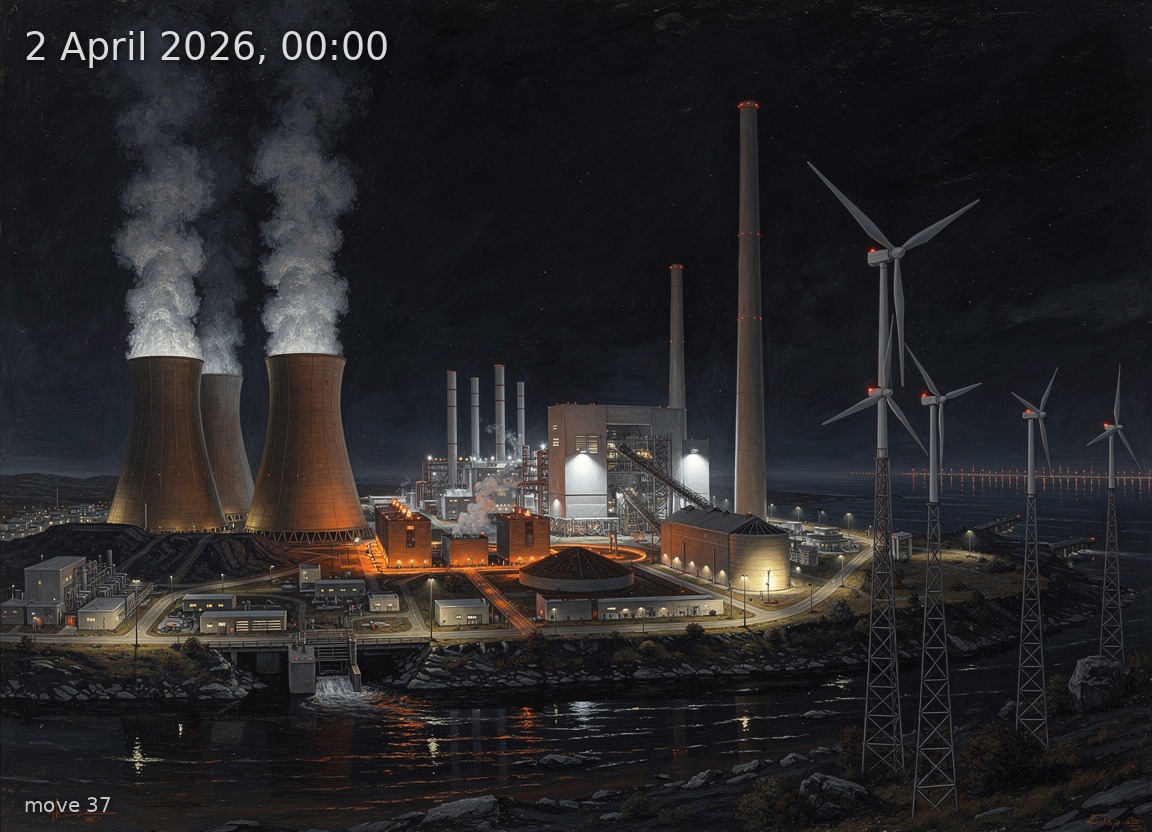
Brown coal, gas, and hard coal dominate overnight generation as calm, cold conditions suppress renewables and push prices above 127 EUR/MWh.
Back
Generation mix
Wind onshore 13%
Wind offshore 4%
Biomass 11%
Hydro 3%
Natural gas 26%
Hard coal 16%
Brown coal 28%
30%
Renewable share
6.0 GW
Wind (on + offshore)
0.0 GW
Solar
37.4 GW
Total generation
-11.4 GW
Net import
127.2 €/MWh
Day-ahead price
2.6°C / 2 km/h
Temp / Wind speed
Open-Meteo, Kassel (51.3°N 9.5°E)
0% / 0.0 W/m²
Cloud cover / Radiation
480
gCO₂/kWh
Image prompt
Brown coal 10.6 GW dominates the left third of the scene as a massive lignite power station complex with four hyperbolic cooling towers emitting thick white steam plumes rising into the night; natural gas 9.6 GW fills the centre-left as a cluster of modern CCGT plants with slim exhaust stacks and smaller rectangular cooling units, warm orange sodium light illuminating their steel structures; hard coal 6.1 GW appears centre-right as a classical coal-fired station with a single tall chimney and coal conveyor belts, lit by harsh industrial floodlights; wind onshore 4.7 GW occupies the right portion as a row of tall three-blade turbines on lattice towers, their rotors barely turning in the still air, faintly visible by red aviation warning lights on the nacelles; wind offshore 1.3 GW is suggested in the far distance right as tiny blinking red lights on the horizon line; biomass 4.0 GW appears as a modest wood-chip-fired plant with a rounded silo and low stack near the centre; hydro 1.1 GW is a small run-of-river station at the base of the scene beside a dark river reflecting industrial lights. The sky is completely black, a deep starless winter night at midnight, 2.6°C with still air — frost glistens on dormant bare-branched trees and brown stubble fields in the foreground. The atmosphere is heavy and oppressive, hazy with industrial moisture and faint particulate glow around the cooling towers, reflecting the high electricity price. No solar panels anywhere, no sunlight, no twilight. Highly detailed oil painting in the tradition of 19th-century German Romantic landscape painters such as Caspar David Friedrich — rich, dark palette of deep navy, charcoal, amber, and ochre; visible impasto brushwork; atmospheric depth with layers of industrial haze receding into darkness; meticulous engineering detail on every turbine nacelle, cooling tower profile, and exhaust stack. The composition conveys the immense thermal inertia of a fossil-heavy overnight grid. No text, no labels.