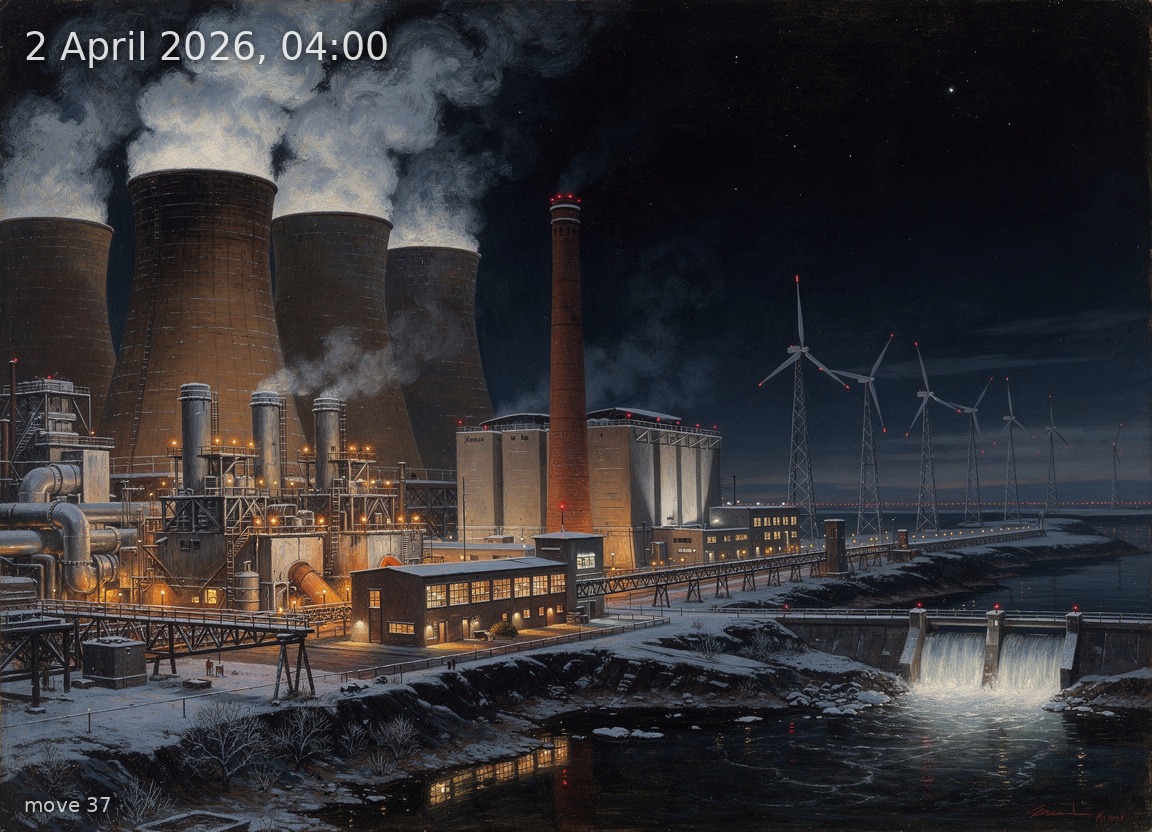
Brown coal, gas, and hard coal dominate overnight generation while 10.2 GW of net imports cover cold-weather demand.
Back
Generation mix
Wind onshore 14%
Wind offshore 6%
Biomass 10%
Hydro 3%
Natural gas 23%
Hard coal 16%
Brown coal 27%
33%
Renewable share
7.6 GW
Wind (on + offshore)
0.0 GW
Solar
38.3 GW
Total generation
-10.3 GW
Net import
107.4 €/MWh
Day-ahead price
0.0°C / 2 km/h
Temp / Wind speed
Open-Meteo, Kassel (51.3°N 9.5°E)
0% / 0.0 W/m²
Cloud cover / Radiation
461
gCO₂/kWh
Image prompt
Brown coal 10.5 GW dominates the left third of the scene as a massive lignite power station complex with four hyperbolic cooling towers emitting thick white steam plumes into the black night sky; natural gas 8.9 GW fills the centre-left as a cluster of combined-cycle gas turbine units with tall single exhaust stacks and glowing orange sodium lights along catwalks; hard coal 6.2 GW occupies the centre-right as a coal-fired station with rectangular mechanical-draught cooling towers and a tall brick chimney, coal conveyors faintly illuminated; wind onshore 5.4 GW appears in the right background as a row of three-blade turbines on lattice towers, their red aviation warning lights blinking against the darkness, blades barely turning in near-still air; wind offshore 2.2 GW is suggested by distant tiny red lights on the far-right horizon; biomass 3.9 GW is rendered as a modest wood-chip-fired CHP plant with a single stack and warm interior glow visible through high windows at centre; hydro 1.1 GW appears as a small illuminated dam spillway in the far distance. The sky is completely black with no twilight or sky glow, a deep navy-to-black firmament with faint cold stars visible where steam does not obscure them; the air temperature is freezing at 0 °C, with frost visible on bare ground, dormant early-spring vegetation, and patches of ice on puddles reflecting facility lights. The atmosphere feels heavy and oppressive, conveying the high electricity price — a dense, weighty stillness pressing down. No solar panels anywhere, no sunlight. Foreground shows frozen bare earth and dormant brown grass. Highly detailed oil painting in the tradition of 19th-century German Romantic landscape painters — rich, dark palette of deep blues, blacks, warm industrial oranges and sodium yellows, visible textured brushwork, atmospheric depth with steam merging into the dark sky. Meticulous engineering detail on every turbine nacelle, cooling tower shell, exhaust stack flange, and power line insulator. The scene evokes a masterwork industrial nocturne. No text, no labels.