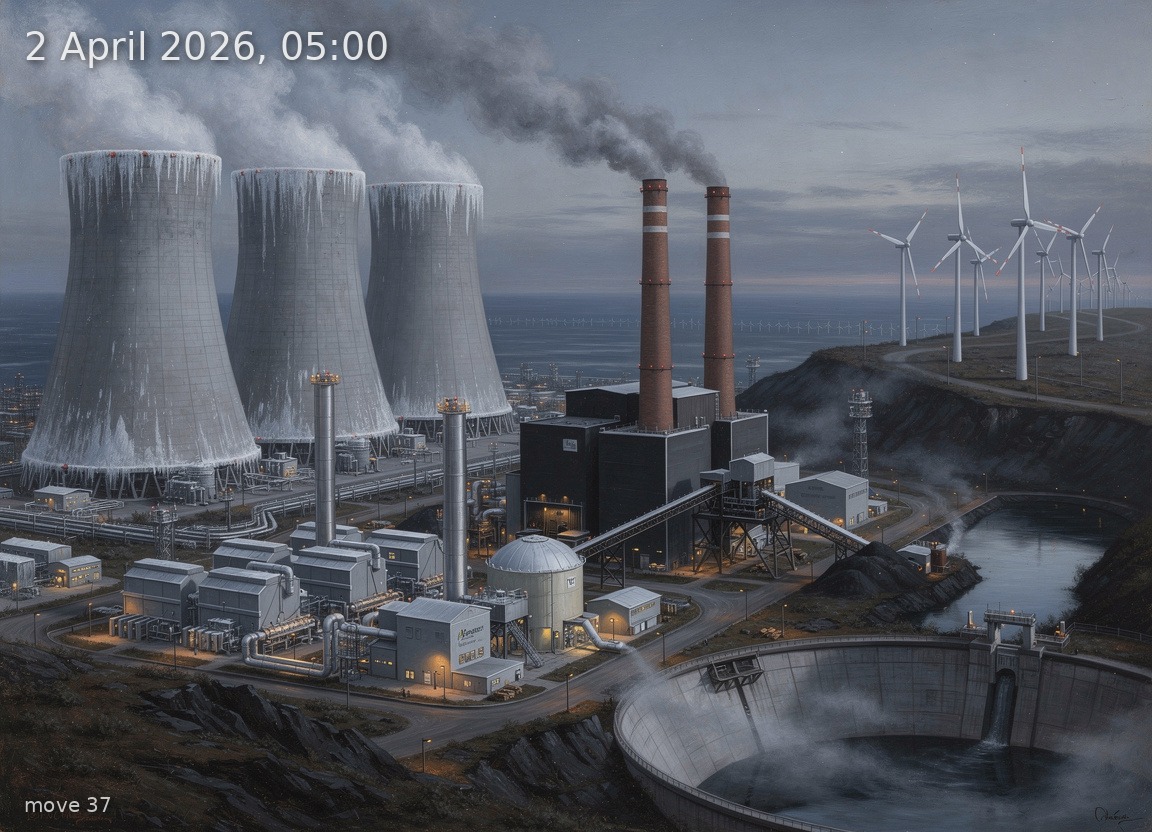
Brown coal, gas, and hard coal dominate pre-dawn generation as sub-zero temperatures and 13 GW net imports drive elevated prices.
Back
Generation mix
Wind onshore 14%
Wind offshore 6%
Biomass 10%
Hydro 3%
Natural gas 25%
Hard coal 16%
Brown coal 27%
32%
Renewable share
7.5 GW
Wind (on + offshore)
0.0 GW
Solar
39.0 GW
Total generation
-12.9 GW
Net import
119.3 €/MWh
Day-ahead price
-0.6°C / 2 km/h
Temp / Wind speed
Open-Meteo, Kassel (51.3°N 9.5°E)
0% / 0.0 W/m²
Cloud cover / Radiation
462
gCO₂/kWh
Image prompt
Brown coal 10.6 GW dominates the left third of the scene as a massive lignite power station with four hyperbolic cooling towers emitting thick white steam plumes into frigid air; natural gas 9.6 GW fills the centre-left as a row of compact CCGT plants with tall single exhaust stacks and glowing orange service lights; hard coal 6.2 GW appears centre-right as a classical coal-fired station with rectangular boiler houses, conveyor belts, and a pair of tall chimneys trailing grey smoke; wind onshore 5.3 GW occupies the right portion of the scene as a cluster of three-blade turbines on a distant ridge, their red aviation warning lights blinking; wind offshore 2.2 GW is suggested by tiny turbine silhouettes on the far horizon over a dark North Sea sliver; biomass 4.0 GW appears as a modest wood-chip-fired plant with a domed silo and single chimney near the centre; hydro 1.1 GW is a small dam and penstock visible in a valley fold at the far right. The time is 05:00 in early April — the sky is deep blue-black with only the faintest hint of pre-dawn grey along the eastern horizon, no direct sunlight, no twilight glow overhead. Stars are fading. The ground is dusted with frost on bare fields and leafless early-spring trees, temperature visibly sub-zero with rime on metal structures and frozen puddles reflecting sodium-orange industrial light. The air feels heavy and oppressive, hazy with stack emissions and moisture, evoking the high electricity price. Rendered as a highly detailed oil painting in the tradition of 19th-century German Romantic landscape painters — rich dark tones of Prussian blue, lamp black, and warm amber from industrial lighting, visible impasto brushwork, atmospheric aerial perspective fading into misty distance. Each power technology is painted with meticulous engineering accuracy: turbine nacelles, three-blade rotors on lattice towers, aluminium cooling tower shells with condensation cascading, CCGT exhaust stacks with heat shimmer. The composition has the grandeur and solemnity of a Caspar David Friedrich nocturne transposed onto an industrial landscape. No text, no labels.