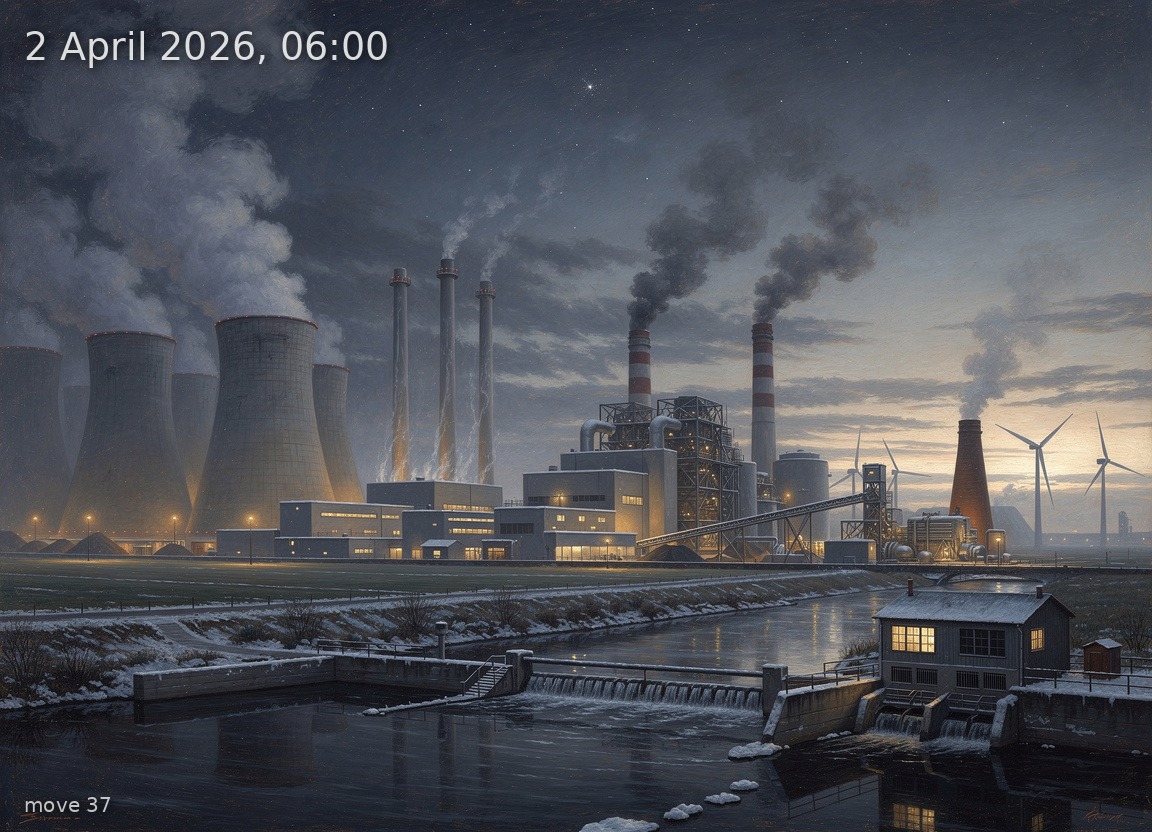
Brown coal, gas, and hard coal dominate a cold, windless pre-dawn hour requiring 17.9 GW net imports.
Back
Generation mix
Wind onshore 13%
Wind offshore 5%
Solar 0%
Biomass 10%
Hydro 3%
Natural gas 26%
Hard coal 16%
Brown coal 26%
32%
Renewable share
7.5 GW
Wind (on + offshore)
0.0 GW
Solar
39.9 GW
Total generation
-17.8 GW
Net import
152.1 €/MWh
Day-ahead price
-0.8°C / 1 km/h
Temp / Wind speed
Open-Meteo, Kassel (51.3°N 9.5°E)
0% / 0.0 W/m²
Cloud cover / Radiation
460
gCO₂/kWh
Image prompt
Brown coal 10.6 GW occupies the left third of the scene as a cluster of massive hyperbolic cooling towers with thick white-grey steam plumes rising into the sky; natural gas 10.2 GW fills the centre-left as a row of modern CCGT plants with tall single exhaust stacks emitting thin vapour trails; hard coal 6.3 GW appears centre-right as a large conventional coal plant with rectangular boiler houses, conveyor belts, and a pair of tall chimneys; wind onshore 5.3 GW is rendered as a modest line of three-blade turbines on a distant ridge, their rotors nearly motionless in the calm air; wind offshore 2.1 GW is suggested by a few smaller turbines barely visible on the far horizon; biomass 4.1 GW appears as a compact wood-fired CHP plant with a conical stack near the right edge; hydro 1.2 GW is a small run-of-river weir with a low concrete dam in the right foreground. The time is early dawn at 06:00 in April — the sky is deep blue-grey with the faintest pale luminescence along the eastern horizon, no direct sunlight, stars still faintly visible overhead. No solar panels appear anywhere. The landscape is flat northern German lowland with bare late-winter trees, frost-covered stubble fields, and patches of thin ice on puddles, temperature at minus one degree Celsius. The air feels heavy and oppressive, matching the high electricity price — a brooding, leaden atmosphere presses down on the industrial panorama. Transmission line towers with high-voltage cables stretch across the middle distance, symbolising the massive import flows. Style: highly detailed oil painting in the tradition of 19th-century German Romantic landscape painters — Caspar David Friedrich meets industrial sublime — rich deep blues, warm amber from sodium streetlights illuminating the plant structures, visible impasto brushwork, atmospheric depth and chiaroscuro. Each energy technology rendered with meticulous engineering accuracy: turbine nacelles and lattice towers, cooling tower parabolic profiles, CCGT heat-recovery steam generators. No text, no labels.