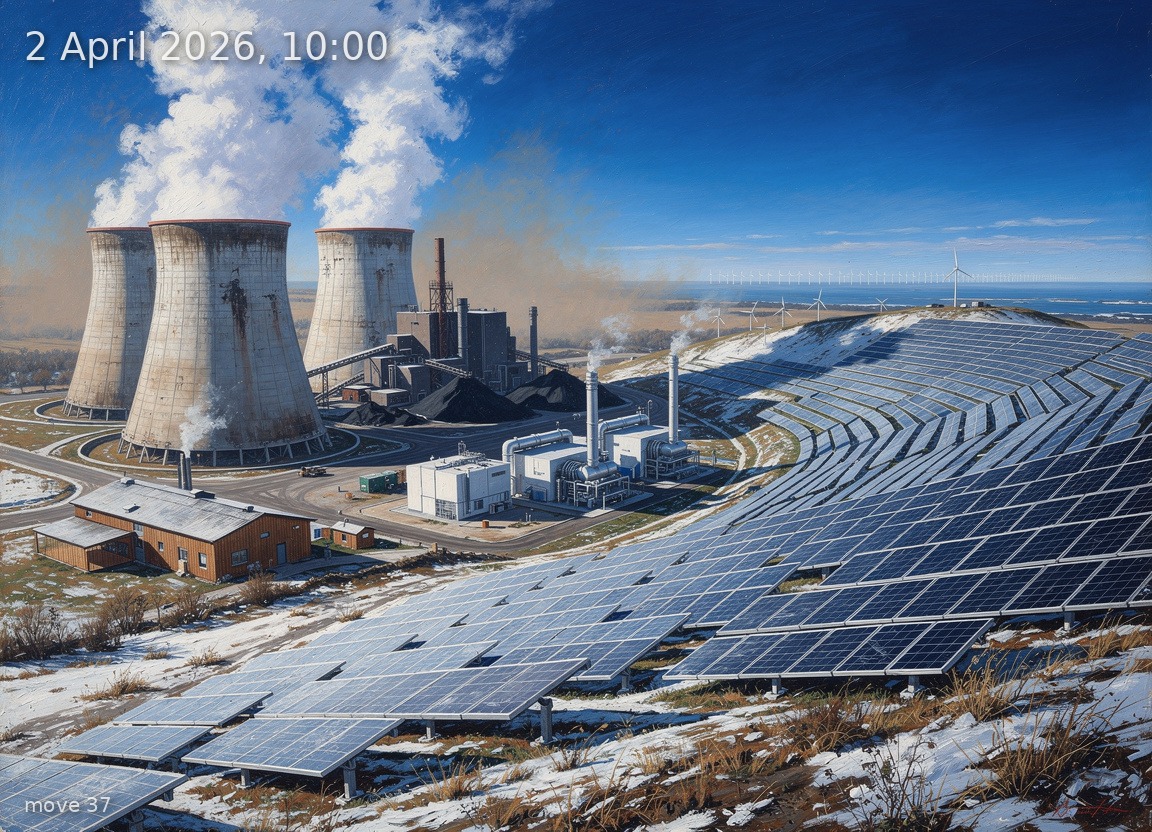
Strong solar at 35.2 GW leads generation, but cold temperatures and weak wind keep 20.3 GW of fossil plants online.
Back
Generation mix
Wind onshore 4%
Wind offshore 4%
Solar 54%
Biomass 6%
Hydro 2%
Natural gas 8%
Hard coal 9%
Brown coal 14%
69%
Renewable share
4.8 GW
Wind (on + offshore)
35.2 GW
Solar
65.3 GW
Total generation
+2.7 GW
Net export
90.7 €/MWh
Day-ahead price
2.8°C / 6 km/h
Temp / Wind speed
Open-Meteo, Kassel (51.3°N 9.5°E)
0% / 237.0 W/m²
Cloud cover / Radiation
221
gCO₂/kWh
Image prompt
Solar 35.2 GW dominates the scene as a vast expanse of crystalline silicon photovoltaic panels stretching across rolling hills in the right half and centre of the composition, their aluminium frames glinting under brilliant, unobstructed midday sunshine; brown coal 9.3 GW occupies the far left as a cluster of massive hyperbolic cooling towers emitting thick white steam plumes rising into the blue sky; hard coal 5.6 GW appears just right of the brown coal complex as a darker industrial plant with tall smokestacks and conveyor belts feeding fuel; natural gas 5.4 GW is rendered as two compact CCGT units with sleek single exhaust stacks and modest heat shimmer, positioned between the coal plants and the solar fields; wind onshore 2.4 GW appears as a small group of three-blade turbines with lattice towers on a distant ridge, their blades barely turning in the still air; wind offshore 2.4 GW is suggested by a faint line of turbines on a far northern horizon; biomass 4.0 GW is a modest wood-clad facility with a low smokestack near the coal plants; hydro 1.1 GW is a small dam and reservoir visible in a valley at the far right edge. The sky is perfectly clear, deep cerulean blue, with intense direct sunshine casting sharp shadows—yet the atmosphere feels heavy and oppressive, with a faint brownish industrial haze hanging low over the coal facilities, reflecting the high 90.7 EUR/MWh price. The season is early spring: bare deciduous trees with only the faintest buds, frost still visible on shadowed ground, dried winter grass, temperature near freezing. The lighting is full bright morning-to-midday daylight at 10:00 AM. Style: highly detailed oil painting in the tradition of 19th-century German Romantic landscape painters—Caspar David Friedrich meets industrial realism—rich saturated colour, visible impasto brushwork, atmospheric depth and aerial perspective, meticulous engineering accuracy on every turbine nacelle, every PV cell grid pattern, every cooling tower's parabolic curve. No text, no labels.