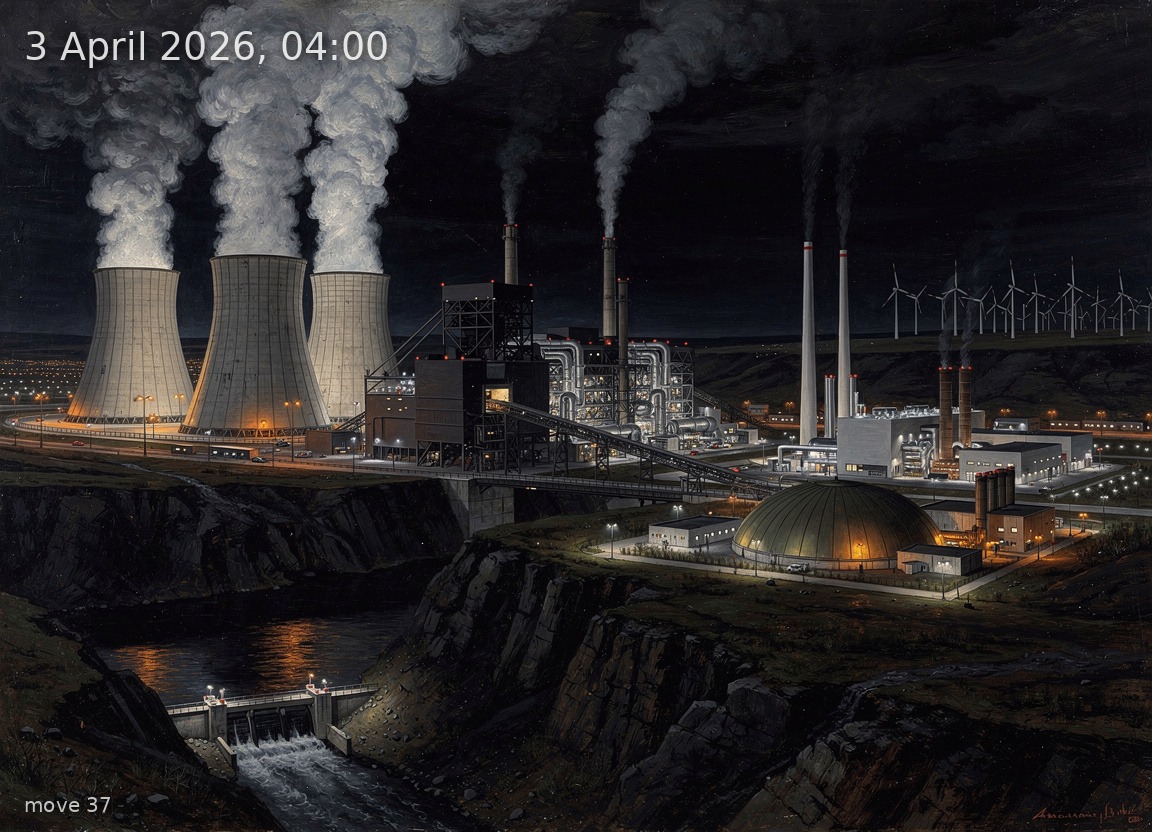
Wind and coal-gas thermal split generation nearly evenly at 4 AM; 8.8 GW net imports fill the gap.
Back
Generation mix
Wind onshore 26%
Wind offshore 6%
Biomass 12%
Hydro 3%
Natural gas 21%
Hard coal 15%
Brown coal 16%
48%
Renewable share
10.7 GW
Wind (on + offshore)
0.0 GW
Solar
33.3 GW
Total generation
-8.8 GW
Net import
120.2 €/MWh
Day-ahead price
5.6°C / 7 km/h
Temp / Wind speed
Open-Meteo, Kassel (51.3°N 9.5°E)
100% / 0.0 W/m²
Cloud cover / Radiation
349
gCO₂/kWh
Image prompt
Wind onshore 8.5 GW spans the right third of the scene as dozens of tall three-blade turbines on lattice towers, rotors turning slowly on a dark ridge; wind offshore 2.1 GW appears as a distant cluster of turbines on the far-right horizon over a faintly visible sea. Natural gas 6.9 GW occupies the centre-left as a bank of compact CCGT plants with tall single exhaust stacks emitting thin white plumes, lit by orange sodium lamps. Brown coal 5.4 GW dominates the far left as three massive hyperbolic cooling towers releasing thick columns of steam into the black sky, their concrete surfaces faintly illuminated by industrial floodlights. Hard coal 5.1 GW sits adjacent as a dark power station with tall chimneys and conveyor gantries, red aviation warning lights blinking. Biomass 4.1 GW appears as a mid-ground industrial facility with a rounded dome and short stacks glowing warmly. Hydro 1.1 GW is a small dam structure in a valley at lower-left, water faintly catching reflected light. The time is 4 AM in early April — the sky is completely black, no twilight, no sky glow, a deep navy-to-black firmament with heavy 100% overcast so no stars are visible, creating an oppressive, heavy ceiling above. The air temperature is near freezing: bare early-spring trees with only the faintest buds, patches of frost on the ground, wisps of ground fog between the installations. The mood is weighty and brooding, reflecting a high electricity price — the atmosphere feels dense and pressing. Painted in the style of a highly detailed 19th-century German Romantic oil painting — rich impasto brushwork, dramatic chiaroscuro between the blackness of the sky and the warm industrial sodium-orange and white lights below, atmospheric depth with smoke and steam dissolving into the dark overhead, meticulous engineering detail on every turbine nacelle, cooling tower ribbing, and exhaust stack. No text, no labels.