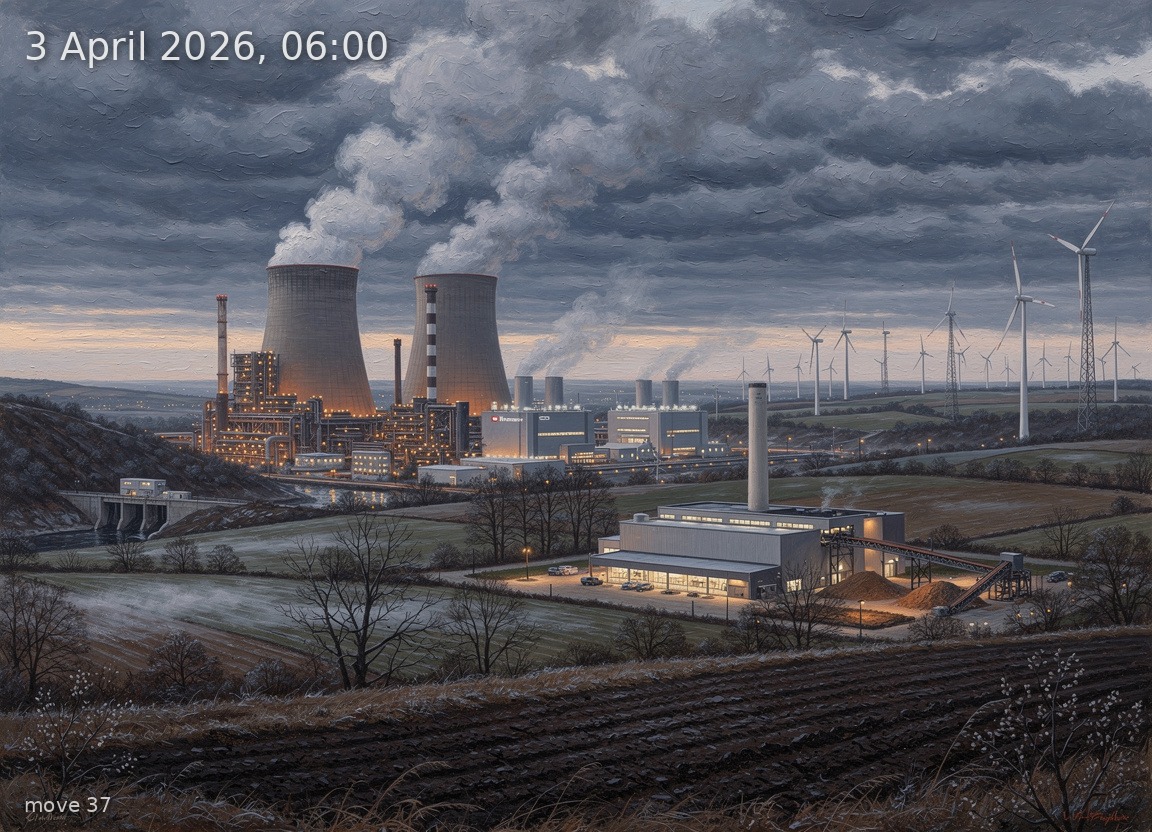
Coal, gas, and wind share generation under full overcast at dawn; 9 GW net imports fill the gap.
Back
Generation mix
Wind onshore 21%
Wind offshore 9%
Solar 0%
Biomass 13%
Hydro 3%
Natural gas 22%
Hard coal 16%
Brown coal 16%
46%
Renewable share
10.0 GW
Wind (on + offshore)
0.0 GW
Solar
33.4 GW
Total generation
-9.0 GW
Net import
133.1 €/MWh
Day-ahead price
4.9°C / 6 km/h
Temp / Wind speed
Open-Meteo, Kassel (51.3°N 9.5°E)
100% / 0.0 W/m²
Cloud cover / Radiation
358
gCO₂/kWh
Image prompt
Brown coal 5.4 GW occupies the left quarter as three massive hyperbolic cooling towers with thick white-grey steam plumes rising into heavy cloud; hard coal 5.4 GW sits just left of centre as a dense cluster of industrial buildings with tall square stacks trailing dark smoke; natural gas 7.2 GW fills the centre as two sleek CCGT plants with slender cylindrical exhaust stacks emitting faint heat haze; wind onshore 7.0 GW spans the right third as a staggered line of tall three-blade turbines on lattice and tubular towers turning slowly; wind offshore 2.9 GW is glimpsed far right on a distant grey horizon as smaller silhouettes of turbines standing in dark water; biomass 4.4 GW appears centre-right as a mid-sized industrial facility with a low rectangular boiler house, wood-chip conveyors, and a single moderately tall stack with pale exhaust; hydro 1.1 GW is a small concrete dam and powerhouse nestled in a valley fold at the far left edge. Time of day is early dawn at 06:00 in April—deep blue-grey sky with the faintest pale steel-blue lightening along the eastern horizon, no direct sunlight, no sun visible; the landscape is lit primarily by sodium-orange industrial lighting from the power plants and faint pre-dawn ambient glow. Absolutely no solar panels anywhere. The sky is entirely overcast with a low, heavy, oppressive blanket of stratus clouds pressing down, conveying the high electricity price. Temperature is near 5 °C: bare deciduous trees with only the first tiny buds, dormant brown grass with traces of frost, patches of mist in low-lying fields. Wind is light at 5.5 km/h—turbine blades turn lazily, steam plumes rise mostly vertically before slowly drifting. The foreground is a gently rolling central-German agricultural plain with ploughed dark earth. Style: highly detailed oil painting in the tradition of Caspar David Friedrich and Carl Blechen—rich impasto brushwork, deep atmospheric perspective, luminous treatment of industrial light against the brooding pre-dawn overcast, meticulous engineering accuracy on all turbine nacelles, cooling tower geometries, and stack structures. No text, no labels.