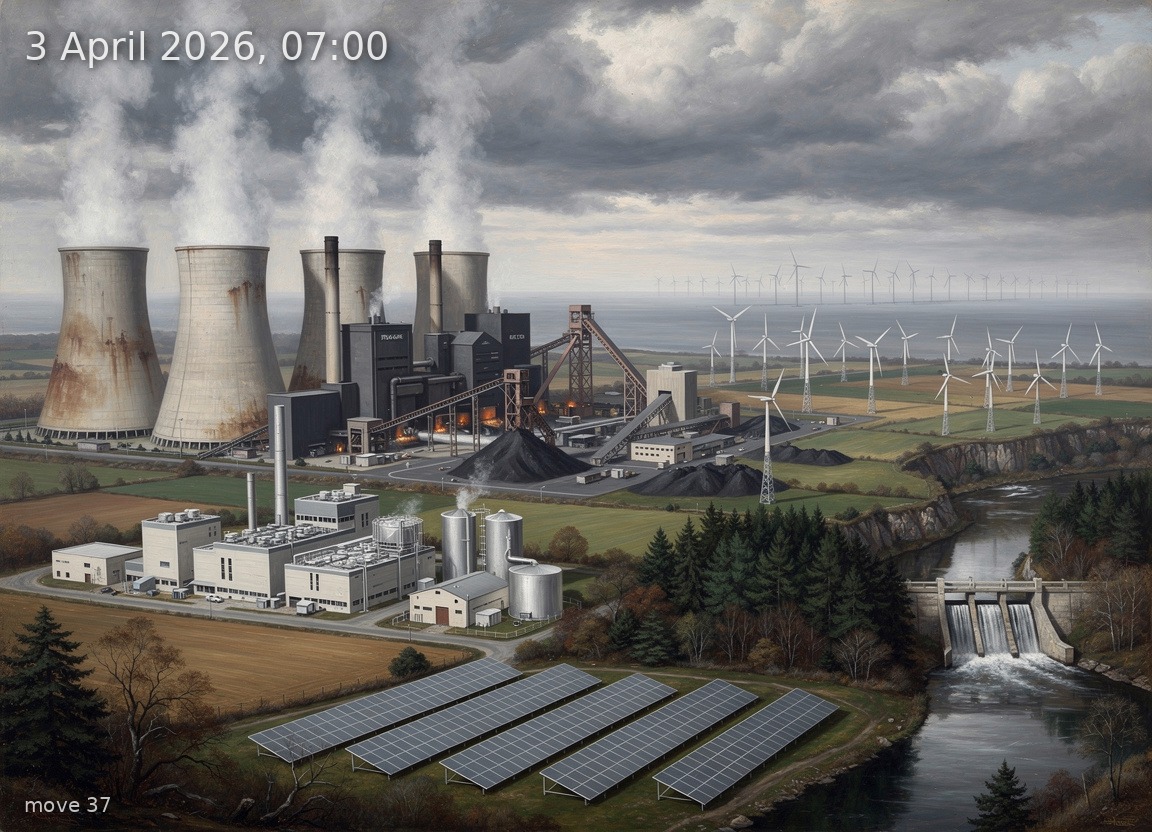
Gas, coal, and wind dominate as full cloud cover suppresses solar, driving high prices and 7.7 GW net imports.
Back
Generation mix
Wind onshore 17%
Wind offshore 10%
Solar 6%
Biomass 13%
Hydro 3%
Natural gas 21%
Hard coal 15%
Brown coal 15%
48%
Renewable share
9.6 GW
Wind (on + offshore)
2.0 GW
Solar
35.7 GW
Total generation
-7.7 GW
Net import
135.9 €/MWh
Day-ahead price
4.6°C / 5 km/h
Temp / Wind speed
Open-Meteo, Kassel (51.3°N 9.5°E)
100% / 0.0 W/m²
Cloud cover / Radiation
342
gCO₂/kWh
Image prompt
Brown coal 5.4 GW occupies the far left as a cluster of massive hyperbolic cooling towers with thick white steam plumes rising into heavy clouds; hard coal 5.4 GW sits adjacent as a dark industrial complex with tall smokestacks and conveyor gantries; natural gas 7.7 GW fills the centre-left as a row of compact CCGT power blocks with slender exhaust stacks emitting faint heat shimmer; wind onshore 5.9 GW stretches across the centre-right as dozens of three-blade turbines on lattice and tubular towers scattered across rolling farmland, rotors turning slowly in light breeze; wind offshore 3.7 GW appears in the far right background as a line of turbines rising from a grey North Sea horizon; biomass 4.6 GW is rendered as mid-ground industrial facilities with cylindrical wood-pellet silos and modest stacks; hydro 1.1 GW appears as a small concrete dam with spillway in a wooded valley at far right; solar 2.0 GW is shown as a small field of aluminium-framed crystalline silicon panels in the foreground reflecting only dull grey light, no sunshine whatsoever. The sky is entirely overcast with a thick, oppressive blanket of low stratus clouds in tones of slate grey and pewter, creating a heavy, brooding atmosphere reflecting the high electricity price. The time is early dawn at 07:00 in early April — a pale pre-dawn glow of cold blue-grey light seeps from the eastern horizon but no sun is visible; the landscape is dim, lit partly by sodium-orange industrial lighting still burning at the power stations. Bare trees and early spring grass at 4.6°C, patches of frost on the ground. Transmission pylons march across the midground connecting the stations. Highly detailed oil painting in the tradition of 19th-century German Romantic landscape painters — Caspar David Friedrich's atmospheric depth merged with industrial realism — rich colour palette of steel greys, warm ambers from furnaces, cool blues in the dawn sky, visible confident brushwork, dramatic atmospheric perspective. Meticulous engineering detail on every technology. No text, no labels.