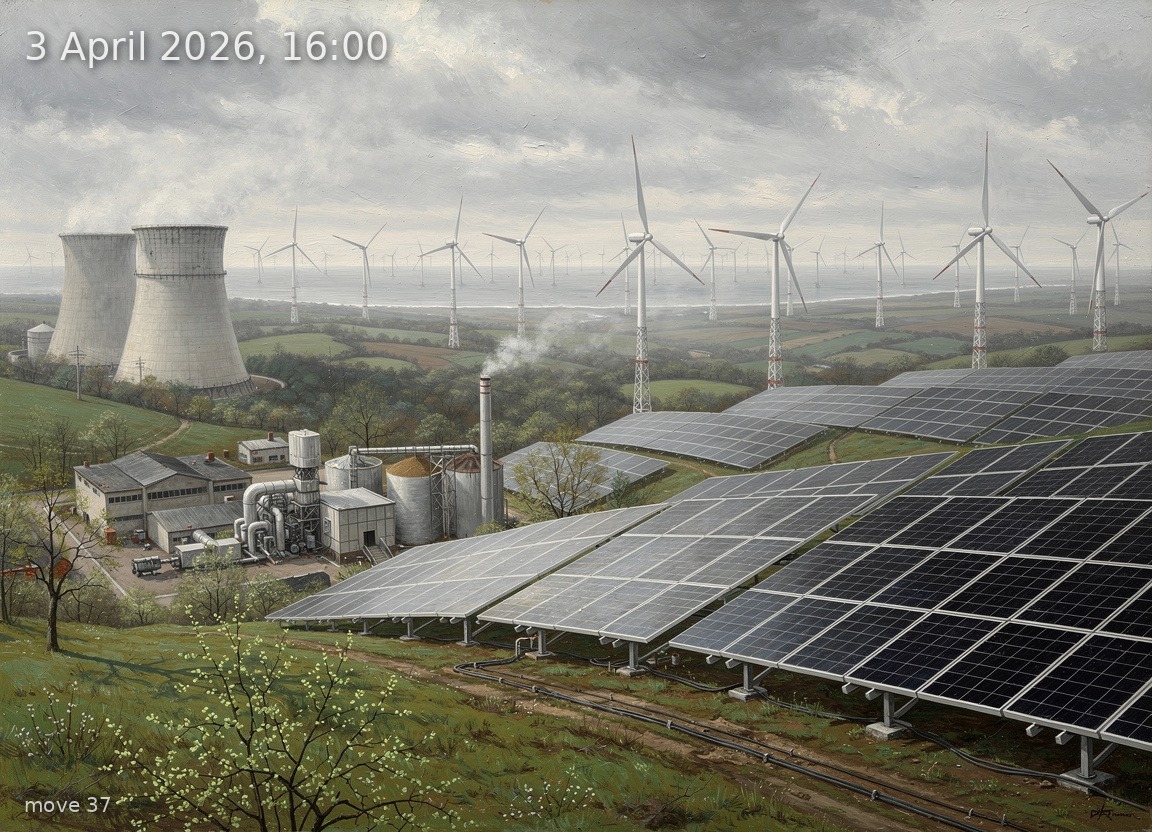
Wind and diffuse solar dominate at over 90% renewables, driving 11.3 GW net exports and low prices.
Back
Generation mix
Wind onshore 27%
Wind offshore 10%
Solar 44%
Biomass 8%
Hydro 2%
Natural gas 4%
Hard coal 1%
Brown coal 4%
91%
Renewable share
20.9 GW
Wind (on + offshore)
24.3 GW
Solar
55.9 GW
Total generation
+11.3 GW
Net export
23.9 €/MWh
Day-ahead price
11.3°C / 13 km/h
Temp / Wind speed
Open-Meteo, Kassel (51.3°N 9.5°E)
92% / 56.2 W/m²
Cloud cover / Radiation
62
gCO₂/kWh
Image prompt
Solar 24.3 GW dominates the centre and right as vast rolling fields of aluminium-framed crystalline silicon PV panels stretching to the horizon, their glass surfaces reflecting a flat pearl-grey overcast sky; wind onshore 15.2 GW fills the mid-ground and left as dozens of three-blade turbines on lattice and tubular towers with slowly turning rotors in moderate breeze; wind offshore 5.7 GW is glimpsed in the far distance as a line of taller turbines rising from a hazy grey sea on the horizon; biomass 4.2 GW appears as a cluster of modest industrial buildings with wood-chip silos and a single low smokestack with thin white exhaust at the left; brown coal 2.2 GW sits in the far left corner as two hyperbolic cooling towers with faint steam plumes; natural gas 2.2 GW is a compact CCGT plant with a single exhaust stack and barely visible heat shimmer beside the cooling towers; hydro 1.3 GW is a small concrete dam with spillway in a wooded valley at the far right edge; hard coal 0.7 GW is a single smaller stack partially obscured behind the lignite towers. Time of day is late afternoon at 16:00 in early April—full daylight but heavily overcast at 92% cloud cover, the sky a uniform luminous grey with no visible sun, diffuse flat light casting almost no shadows. Temperature is a cool 11°C; early spring vegetation with pale green buds on bare-branched deciduous trees and fresh grass. The atmosphere is calm and open, reflecting the low 23.9 EUR/MWh price—no oppressive haze, just tranquil grey clarity. Highly detailed oil painting in the tradition of 19th-century German Romantic landscape painters—Caspar David Friedrich meets industrial modernity—rich but muted colour palette of grey, sage green, steel blue, and earth tones, visible impasto brushwork, atmospheric depth with layered distances fading into misty grey. Every technology rendered with meticulous engineering accuracy: turbine nacelles, three-blade rotors, PV module grid patterns, cooling tower parabolic geometry, CCGT exhaust detail. No text, no labels.