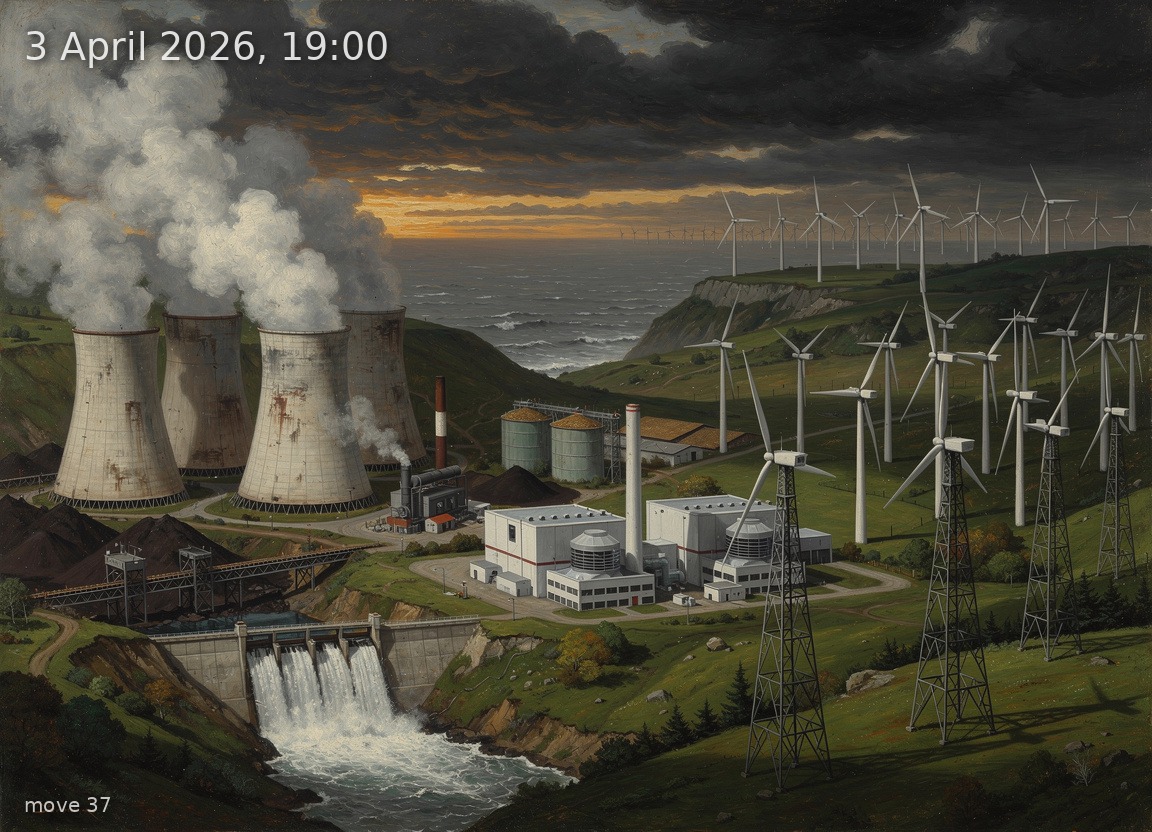
Strong onshore and offshore wind lead generation at dusk, but 5.8 GW net imports bridge the evening demand gap.
Back
Generation mix
Wind onshore 51%
Wind offshore 15%
Solar 2%
Biomass 11%
Hydro 3%
Natural gas 8%
Hard coal 2%
Brown coal 8%
82%
Renewable share
28.5 GW
Wind (on + offshore)
0.8 GW
Solar
43.0 GW
Total generation
-5.8 GW
Net import
99.4 €/MWh
Day-ahead price
11.8°C / 13 km/h
Temp / Wind speed
Open-Meteo, Kassel (51.3°N 9.5°E)
84% / 58.5 W/m²
Cloud cover / Radiation
122
gCO₂/kWh
Image prompt
Wind onshore 21.8 GW dominates the right two-thirds of the scene as vast rows of three-blade turbines on rolling green spring hills, their lattice towers and nacelles rendered in engineering detail, blades visibly turning in moderate wind; wind offshore 6.7 GW appears as a distant line of larger turbines on the horizon over a grey North Sea glimpsed through a valley gap; brown coal 3.6 GW occupies the left foreground as a cluster of massive hyperbolic cooling towers emitting thick white steam plumes, with conveyor belts carrying dark lignite; natural gas 3.4 GW sits just right of the coal plant as two compact CCGT units with tall single exhaust stacks releasing thin transparent heat shimmer; biomass 4.6 GW is represented as a mid-ground industrial facility with wood-chip storage silos and a modest smokestack with pale grey exhaust; hydro 1.3 GW appears as a small concrete dam with spillway in the mid-left valley; hard coal 0.9 GW is a single smaller stack behind the brown coal complex; solar 0.8 GW is rendered as a few barely visible aluminium-framed crystalline PV panels on a rooftop, dark and inactive, reflecting no light. TIME OF DAY: 19:00 in early April — late dusk, a narrow band of deep orange-red glow along the western horizon rapidly fading, the sky above transitioning from dark slate blue to near-black overhead, the first evening stars appearing. The atmosphere feels heavy and oppressive, haze and coal steam mixing into the darkening sky, suggesting the high electricity price. Spring vegetation: fresh pale-green grass and early leaf buds on scattered birch and oak trees. Cloud cover at 84% forms a thick overcast broken only at the horizon where the last light leaks through. Sodium streetlights beginning to glow amber along a small road in the foreground. Style: highly detailed oil painting in the tradition of 19th-century German Romantic landscape painters — Caspar David Friedrich meets industrial sublime — rich earth tones, visible confident brushwork, deep atmospheric perspective, dramatic chiaroscuro between the glowing western horizon and the looming dark sky, meticulous engineering detail on every turbine nacelle, cooling tower, and exhaust stack. No text, no labels.