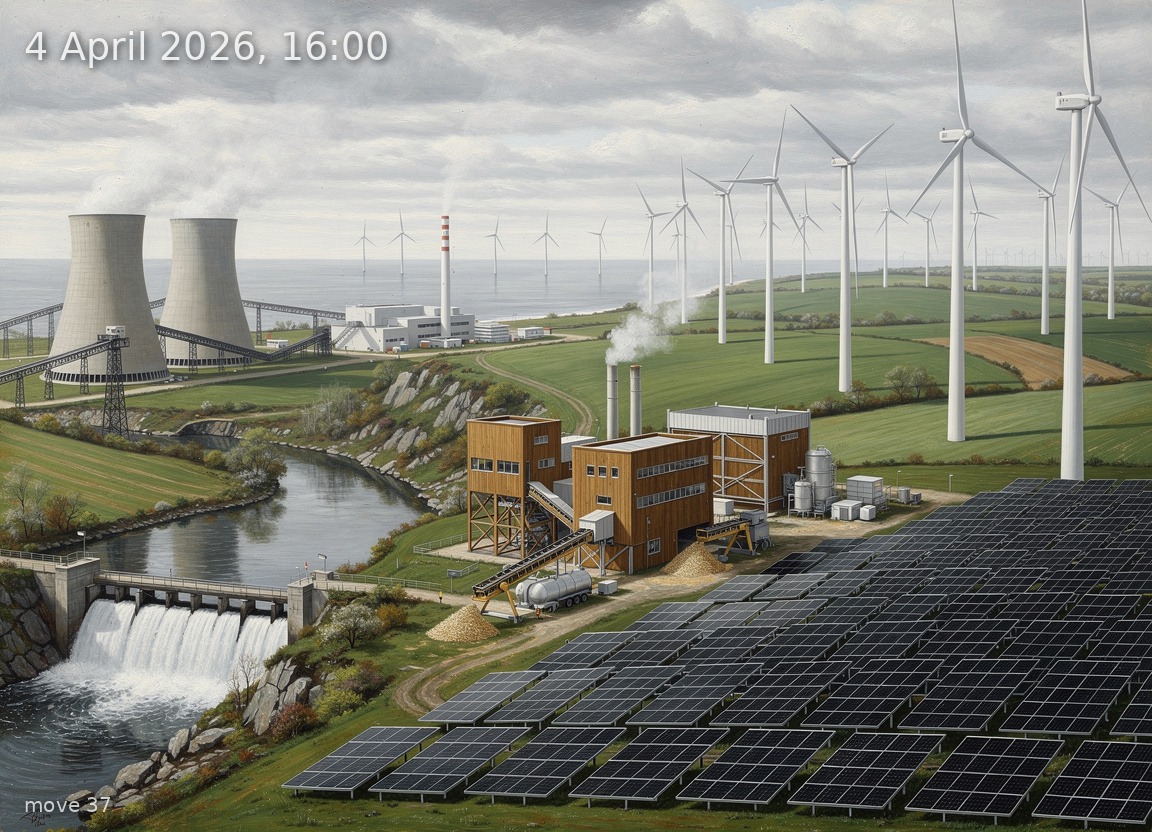
Onshore wind and diffuse solar dominate at over 37 GW combined, pushing prices low and exports outward on an overcast spring afternoon.
Back
Generation mix
Wind onshore 38%
Wind offshore 5%
Solar 36%
Biomass 8%
Hydro 2%
Natural gas 4%
Hard coal 1%
Brown coal 4%
91%
Renewable share
21.9 GW
Wind (on + offshore)
18.1 GW
Solar
50.1 GW
Total generation
+2.8 GW
Net export
10.7 €/MWh
Day-ahead price
13.0°C / 11 km/h
Temp / Wind speed
Open-Meteo, Kassel (51.3°N 9.5°E)
100% / 20.0 W/m²
Cloud cover / Radiation
62
gCO₂/kWh
Image prompt
Wind onshore 19.2 GW dominates the right half of the composition as dozens of tall three-blade turbines with white tubular towers and detailed nacelles stretching across rolling green spring farmland, blades turning in moderate breeze; solar 18.1 GW fills the centre-right foreground as vast arrays of aluminium-framed crystalline silicon PV panels on open fields, their surfaces reflecting soft grey-white diffuse light from the overcast sky; biomass 4.2 GW appears in the centre as a cluster of medium-scale biomass power stations with timber-clad facades, conveyor belts feeding wood chips, and thin exhaust plumes; wind offshore 2.7 GW is visible far in the background along a distant coastline as a line of offshore turbines rising from a grey North Sea horizon; brown coal 2.0 GW occupies the far left as two large hyperbolic cooling towers emitting modest steam plumes beside a lignite conveyor; natural gas 2.0 GW sits adjacent as a compact CCGT plant with a single tall exhaust stack and thin heat shimmer; hydro 1.2 GW appears as a small concrete dam with white spillway water in the left-middle distance; hard coal 0.7 GW is a single darkened smokestack barely active on the far left edge. The sky is entirely overcast at 100% cloud cover — a flat, luminous blanket of pale grey stratocumulus with no blue patches and no visible sun, but providing bright diffuse daylight consistent with 16:00 in early April. The landscape is early spring — fresh green grass, budding deciduous trees, scattered wildflowers, temperature around 13°C suggesting light jackets. The atmosphere is calm and tranquil reflecting the very low electricity price — open, spacious, unhurried. Rendered as a highly detailed oil painting in the tradition of 19th-century German Romantic landscape painters such as Caspar David Friedrich and Carl Blechen, with rich layered colour, visible confident brushwork, atmospheric aerial perspective, and meticulous engineering accuracy on every turbine nacelle, PV panel frame, cooling tower curve, and exhaust stack detail. No text, no labels, no people prominent.