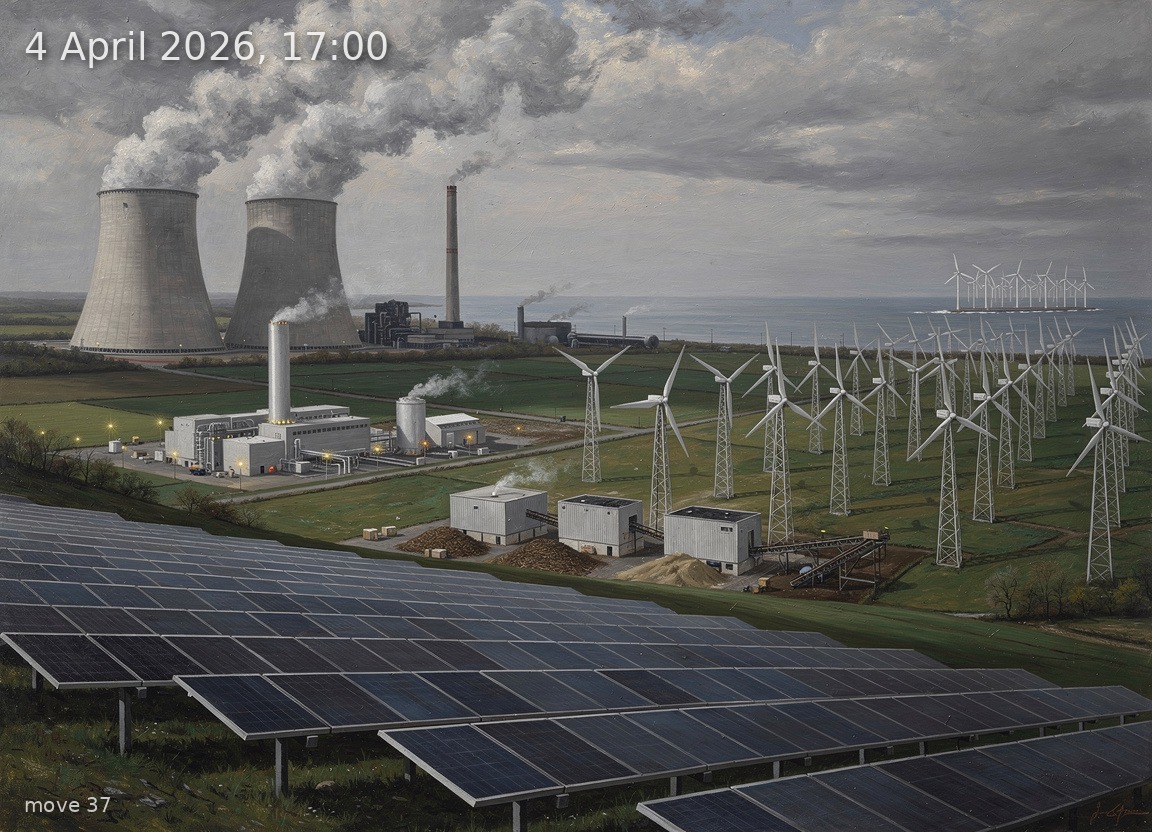
Wind leads at 18.8 GW with fading solar at 11.8 GW; 5.9 GW net imports cover the evening demand ramp.
Back
Generation mix
Wind onshore 40%
Wind offshore 6%
Solar 29%
Biomass 11%
Hydro 3%
Natural gas 5%
Hard coal 2%
Brown coal 5%
88%
Renewable share
18.8 GW
Wind (on + offshore)
11.8 GW
Solar
41.2 GW
Total generation
-5.9 GW
Net import
62.7 €/MWh
Day-ahead price
13.2°C / 7 km/h
Temp / Wind speed
Open-Meteo, Kassel (51.3°N 9.5°E)
100% / 54.8 W/m²
Cloud cover / Radiation
82
gCO₂/kWh
Image prompt
Wind onshore 16.4 GW dominates the right two-thirds of the scene as vast rows of three-blade turbines with white lattice towers receding across rolling green April fields; wind offshore 2.4 GW appears as a distant cluster of turbines on a grey horizon line over a sliver of North Sea; solar 11.8 GW fills the lower-left foreground as expansive arrays of aluminium-framed crystalline silicon PV panels on gently sloping farmland, their surfaces reflecting only diffuse grey light; biomass 4.4 GW is rendered as a mid-ground cluster of industrial wood-chip combustion plants with modest stacks and small steam wisps; natural gas 2.2 GW appears as a compact CCGT plant with a single tall exhaust stack and visible heat shimmer in the centre-left; brown coal 2.1 GW sits in the left background as two hyperbolic cooling towers releasing heavy white-grey steam plumes that merge into the overcast; hard coal 0.8 GW is a single smaller stack with a thin dark exhaust trail beside the brown coal plant; hydro 1.1 GW is suggested by a small concrete run-of-river weir along a stream in the lower foreground. TIME: 17:00 dusk in early April — the sky is entirely overcast at 100% cloud cover, a uniform steel-grey blanket with a faint orange-amber glow bleeding along the lowest horizon line to the west as the sun sets invisibly behind clouds; the light is dim, diffuse, and rapidly fading. Temperature 13°C: early spring vegetation, bright new-green grass, bare branches just beginning to bud. Wind speed is moderate at 6.9 km/h so turbine blades turn slowly and steam plumes drift gently. The atmosphere is heavy and slightly oppressive, reflecting the 62.7 EUR/MWh price — a brooding, weighty sky pressing down on the industrial landscape. Style: highly detailed oil painting in the tradition of 19th-century German Romantic landscape painters such as Caspar David Friedrich and Carl Blechen — rich impasto brushwork, deep atmospheric perspective, luminous treatment of overcast skies, meticulous engineering detail on every turbine nacelle, every PV cell edge, every cooling tower's parabolic curve. The palette is muted greens, slate greys, warm amber at the horizon, and industrial whites. No text, no labels.