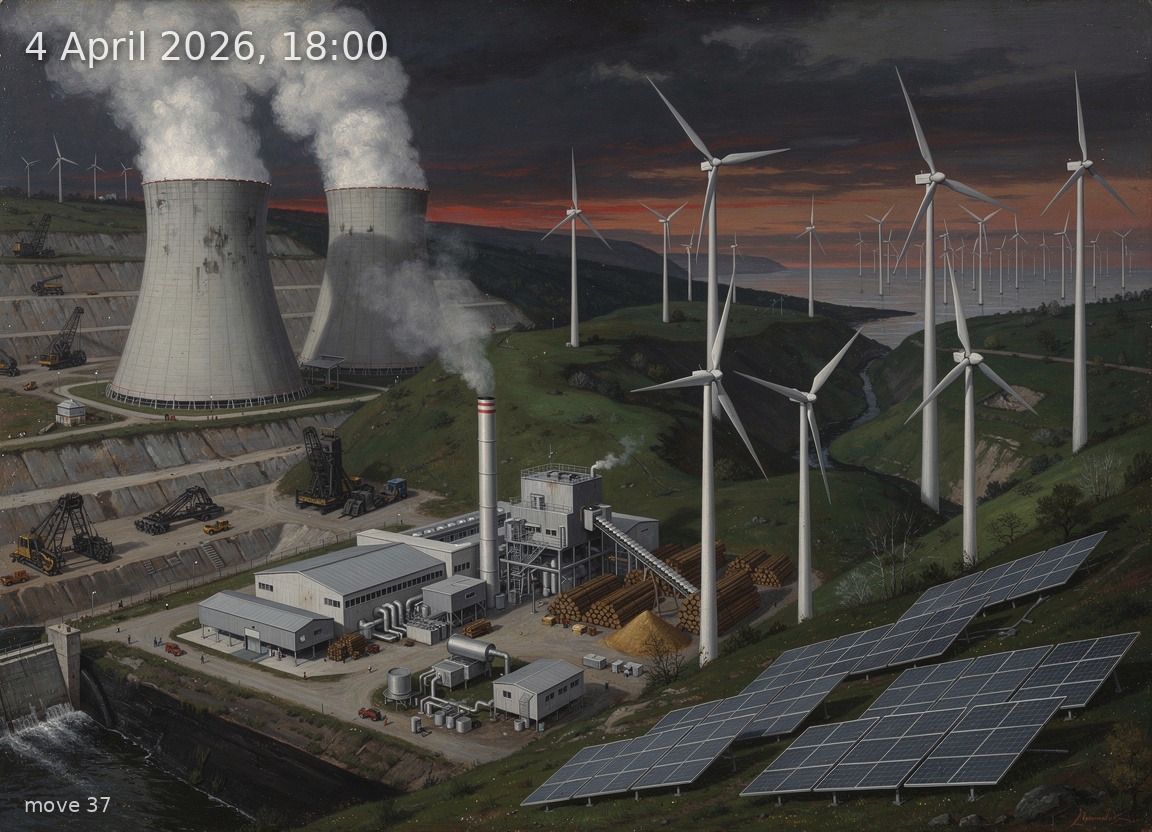
Onshore wind leads at 12.4 GW but 14.5 GW net imports are needed as overcast dusk tightens supply against 47.4 GW demand.
Back
Generation mix
Wind onshore 38%
Wind offshore 8%
Solar 16%
Biomass 14%
Hydro 4%
Natural gas 9%
Hard coal 2%
Brown coal 9%
79%
Renewable share
15.0 GW
Wind (on + offshore)
5.2 GW
Solar
32.9 GW
Total generation
-14.6 GW
Net import
109.6 €/MWh
Day-ahead price
14.0°C / 7 km/h
Temp / Wind speed
Open-Meteo, Kassel (51.3°N 9.5°E)
100% / 10.0 W/m²
Cloud cover / Radiation
139
gCO₂/kWh
Image prompt
Wind onshore 12.4 GW dominates the right half of the scene as dozens of three-blade turbines with white tubular towers and nacelles stretching across rolling green spring hills; wind offshore 2.5 GW appears in the far-right background as a cluster of turbines standing in a grey sea glimpsed through a valley gap; solar 5.2 GW occupies the centre-right foreground as several fields of aluminium-framed crystalline silicon panels angled on a hillside, reflecting only dull grey sky with no direct sunlight; biomass 4.6 GW sits in the centre as a medium-sized industrial plant with timber yards, a tall flue stack emitting pale vapour, and wood-chip conveyors; brown coal 3.1 GW fills the left portion as two massive hyperbolic concrete cooling towers releasing thick white steam plumes, beside open-pit mine terraces with bucket-wheel excavators; natural gas 3.0 GW appears in the centre-left as a compact combined-cycle gas turbine facility with a single tall exhaust stack and a visible heat-recovery steam generator; hydro 1.2 GW is a concrete dam with spillway nestled in a far-left valley; hard coal 0.8 GW is a single smaller smokestack facility with a coal bunker near the brown coal complex. Time is 18:00 in early April — dusk lighting with a rapidly fading orange-red glow barely visible along the low western horizon, the sky above already darkening to deep slate-grey and navy, complete 100% overcast with no break in the clouds, oppressive heavy atmosphere conveying expensive power. Temperature is 14°C: fresh spring green on grass and budding deciduous trees, but muted under the grey pall. The air feels dense and still at ground level. Painted in the style of a highly detailed 19th-century German Romantic oil painting — rich dark colour palette of umber, Prussian blue, and muted viridian, visible expressive brushwork, atmospheric depth with haze softening distant cooling towers, chiaroscuro from the last horizon light against the darkening industrial silhouettes. Meticulous engineering accuracy on every turbine blade, panel frame, and cooling tower. No text, no labels.