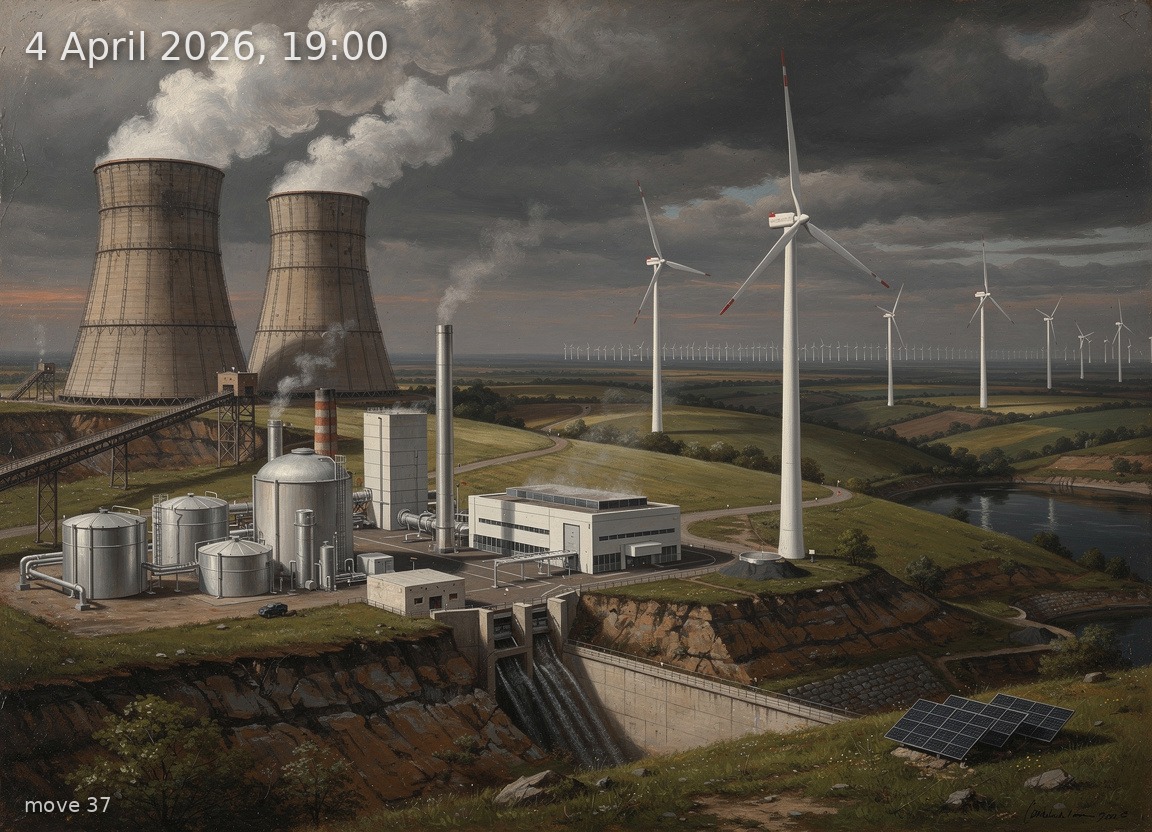
Wind leads at 12.6 GW but 19.8 GW net imports required as overcast evening drives prices to 150 EUR/MWh.
Back
Generation mix
Wind onshore 32%
Wind offshore 13%
Solar 3%
Biomass 17%
Hydro 5%
Natural gas 12%
Hard coal 4%
Brown coal 13%
71%
Renewable share
12.7 GW
Wind (on + offshore)
0.9 GW
Solar
27.6 GW
Total generation
-19.8 GW
Net import
149.9 €/MWh
Day-ahead price
13.8°C / 10 km/h
Temp / Wind speed
Open-Meteo, Kassel (51.3°N 9.5°E)
97% / 9.2 W/m²
Cloud cover / Radiation
198
gCO₂/kWh
Image prompt
Wind onshore 8.9 GW dominates the right half of the scene as dozens of tall three-blade turbines with white tubular towers and detailed nacelles stretching across rolling central-German hills with early spring grass. Wind offshore 3.7 GW appears in the far right background as a cluster of turbines on a distant grey horizon line above a sliver of dark sea. Brown coal 3.6 GW occupies the left foreground as two massive hyperbolic cooling towers releasing thick white steam plumes, beside a lignite conveyor and open-pit edge. Biomass 4.7 GW sits left of centre as a cluster of squat industrial biogas facilities with cylindrical digesters and small exhaust stacks emitting thin vapour. Natural gas 3.3 GW appears centre-left as a compact CCGT plant with a single tall exhaust stack and visible heat shimmer. Hard coal 1.2 GW is a smaller coal plant behind the gas facility with a single square chimney and coal stockpile. Hydro 1.3 GW is rendered as a concrete dam and penstock structure nestled in a valley in the centre-right middle distance. Solar 0.9 GW appears only as a tiny, barely visible array of dark aluminium-framed panels on a rooftop near the biomass facility, catching no light. The sky is dusk at 19:00 in April Berlin time: the upper sky is a deep slate-blue fading to darkness, with a narrow band of dim orange-red glow along the lower western horizon rapidly disappearing. The atmosphere is heavy, oppressive, and humid, reflecting the high electricity price — low thick clouds at 97% cover press down on the landscape. Temperature is a mild 13.8°C with early spring vegetation: fresh pale-green buds on deciduous trees, damp fields. Light wind at 9.8 km/h gently turns the turbine blades. Sodium streetlights begin to glow amber along a road in the foreground. Highly detailed oil painting in the tradition of 19th-century German Romantic landscape painters — Caspar David Friedrich's brooding atmosphere combined with meticulous industrial-engineering accuracy: visible turbine blade profiles, cooling tower reinforcement ribs, CCGT exhaust geometry. Rich layered colour, visible impasto brushwork, deep atmospheric perspective. No text, no labels.