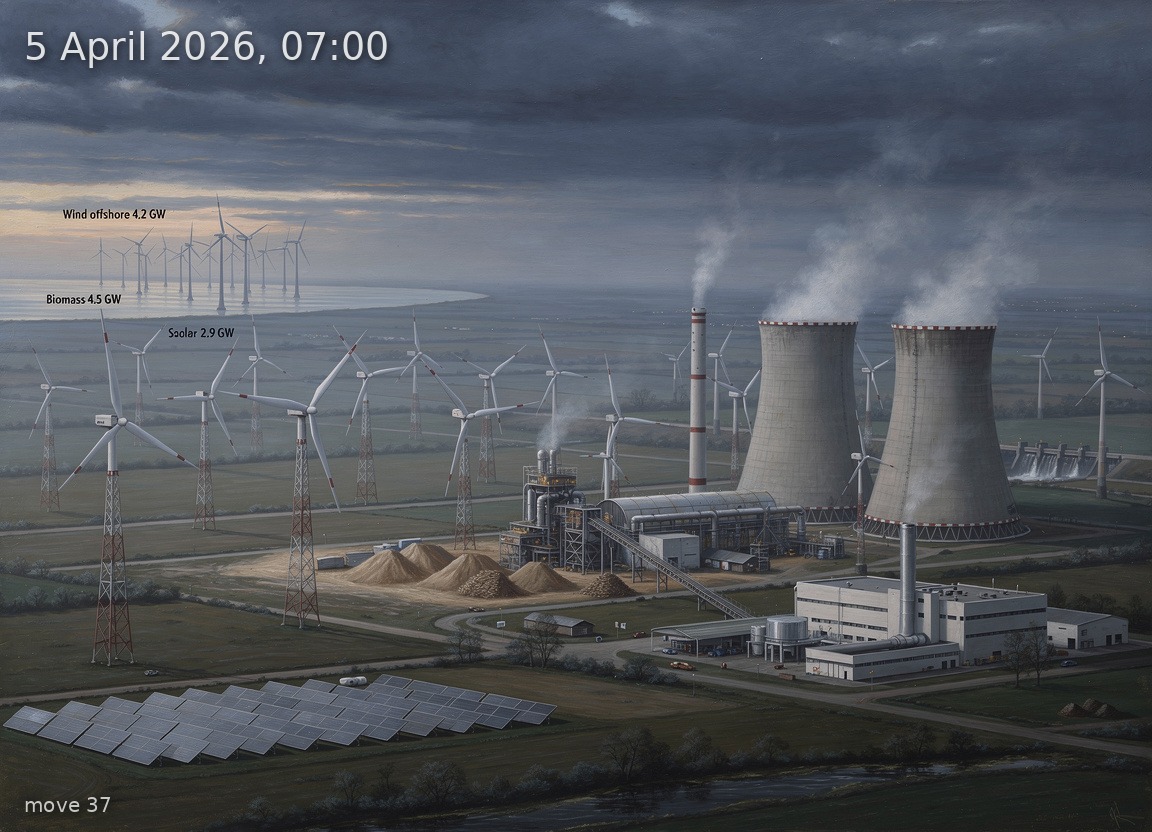
Onshore wind at 35.5 GW dominates a 90% renewable grid, pushing prices negative amid 10.3 GW net exports.
Back
Generation mix
Wind onshore 66%
Wind offshore 8%
Solar 5%
Biomass 8%
Hydro 2%
Natural gas 4%
Hard coal 2%
Brown coal 4%
90%
Renewable share
39.8 GW
Wind (on + offshore)
2.9 GW
Solar
53.5 GW
Total generation
+10.3 GW
Net export
-1.3 €/MWh
Day-ahead price
10.3°C / 15 km/h
Temp / Wind speed
Open-Meteo, Kassel (51.3°N 9.5°E)
100% / 0.0 W/m²
Cloud cover / Radiation
65
gCO₂/kWh
Image prompt
Wind onshore 35.5 GW dominates the scene, filling roughly two-thirds of the canvas as vast ranks of three-blade turbines on lattice and tubular towers stretching across a flat north-German plain, rotors spinning visibly in moderate wind. Wind offshore 4.2 GW appears as a distant cluster of larger turbines on the far-left horizon over a grey sea inlet. Biomass 4.5 GW is rendered as a mid-ground industrial plant with a woodchip yard and tall exhaust stack emitting pale steam. Solar 2.9 GW occupies a small foreground area as rows of aluminium-framed crystalline silicon panels, their surfaces dull and reflective-grey under the heavy clouds, producing almost nothing. Brown coal 2.2 GW appears as a pair of hyperbolic cooling towers with thin steam plumes rising to the right of centre. Natural gas 2.0 GW is a compact CCGT facility with a single sleek exhaust stack and minimal exhaust, set behind the cooling towers. Hydro 1.2 GW is a small dam and spillway visible in a river valley in the distant background. Hard coal 0.9 GW is a single squat smokestack with a faint wisp, barely visible at the far right edge. Time of day is early dawn at 07:00 in April: the sky is a deep blue-grey pre-dawn wash with the faintest pale luminosity along the eastern horizon, no direct sunlight, no warm tones—only cold steel-blue atmosphere. Cloud cover is total: a low, unbroken stratus ceiling presses down on the landscape. Temperature is mild at 10 °C; spring vegetation is emerging—fresh pale-green grass, bare-branched trees just beginning to bud. The negative electricity price creates a calm, open, almost serene atmosphere with no oppressive weight. Rendered as a highly detailed oil painting in the tradition of 19th-century German Romantic landscape painters—Caspar David Friedrich's atmospheric depth meets industrial realism—rich layered colour, visible confident brushwork, dramatic atmospheric perspective receding into misty distance, meticulous engineering detail on every turbine nacelle, every cooling tower's parabolic curve, every PV panel's aluminium frame. No text, no labels.