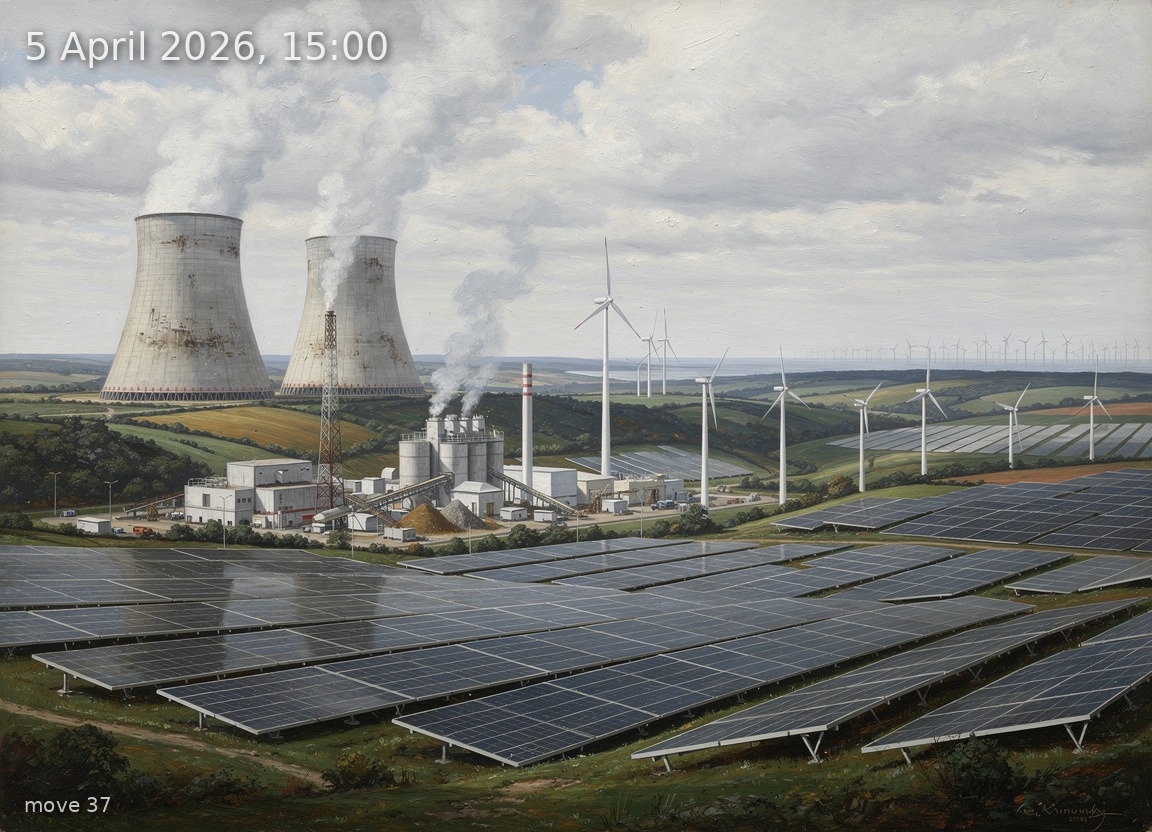
Solar at 25.1 GW and wind at 12.3 GW drive deep negative prices amid 5.0 GW net export.
Back
Generation mix
Wind onshore 23%
Wind offshore 3%
Solar 53%
Biomass 8%
Hydro 2%
Natural gas 4%
Hard coal 1%
Brown coal 5%
90%
Renewable share
12.3 GW
Wind (on + offshore)
25.1 GW
Solar
47.4 GW
Total generation
+5.0 GW
Net export
-66.9 €/MWh
Day-ahead price
15.5°C / 18 km/h
Temp / Wind speed
Open-Meteo, Kassel (51.3°N 9.5°E)
100% / 135.5 W/m²
Cloud cover / Radiation
69
gCO₂/kWh
Image prompt
Solar 25.1 GW dominates the centre and right of the scene as vast rolling fields of aluminium-framed crystalline silicon PV panels stretching toward the horizon, their glass surfaces reflecting a diffuse white-grey overcast sky; wind onshore 11.0 GW fills the middle distance as dozens of tall three-blade turbines on lattice and tubular towers, rotors turning steadily in moderate wind; wind offshore 1.3 GW appears as a faint cluster of turbines on a hazy far horizon; biomass 4.0 GW is rendered as a mid-ground collection of squat industrial buildings with wood-chip silos and thin exhaust flues trailing pale vapour; brown coal 2.4 GW occupies the far left as a pair of hyperbolic cooling towers with thick white steam plumes rising into the overcast; natural gas 1.8 GW sits beside them as a compact CCGT facility with a single tall exhaust stack and a thin heat shimmer; hydro 1.2 GW appears as a concrete dam face with spillway cascading into a green river valley at the left edge; hard coal 0.6 GW is a small dark boiler house with a single chimney barely visible behind the cooling towers. The sky is entirely overcast — a uniform blanket of pale grey-white stratus clouds with no blue, lit by full but diffused midday spring daylight from above, casting soft shadowless illumination across the landscape. The air is mild at 15.5 °C; vegetation is fresh spring green — young leaves on birches and beeches, bright grass, wildflowers in meadow strips between solar arrays. The atmosphere feels calm and almost weightless, reflecting deeply negative electricity prices — an open, spacious, unhurried quality to the air. Rendered as a highly detailed oil painting in the tradition of 19th-century German Romantic landscape painters such as Caspar David Friedrich and Carl Blechen — rich layered colour, visible impasto brushwork, atmospheric aerial perspective lending depth and grandeur, but with meticulous engineering accuracy in every turbine nacelle, every PV module busbar, every cooling tower's parabolic curve. No text, no labels.