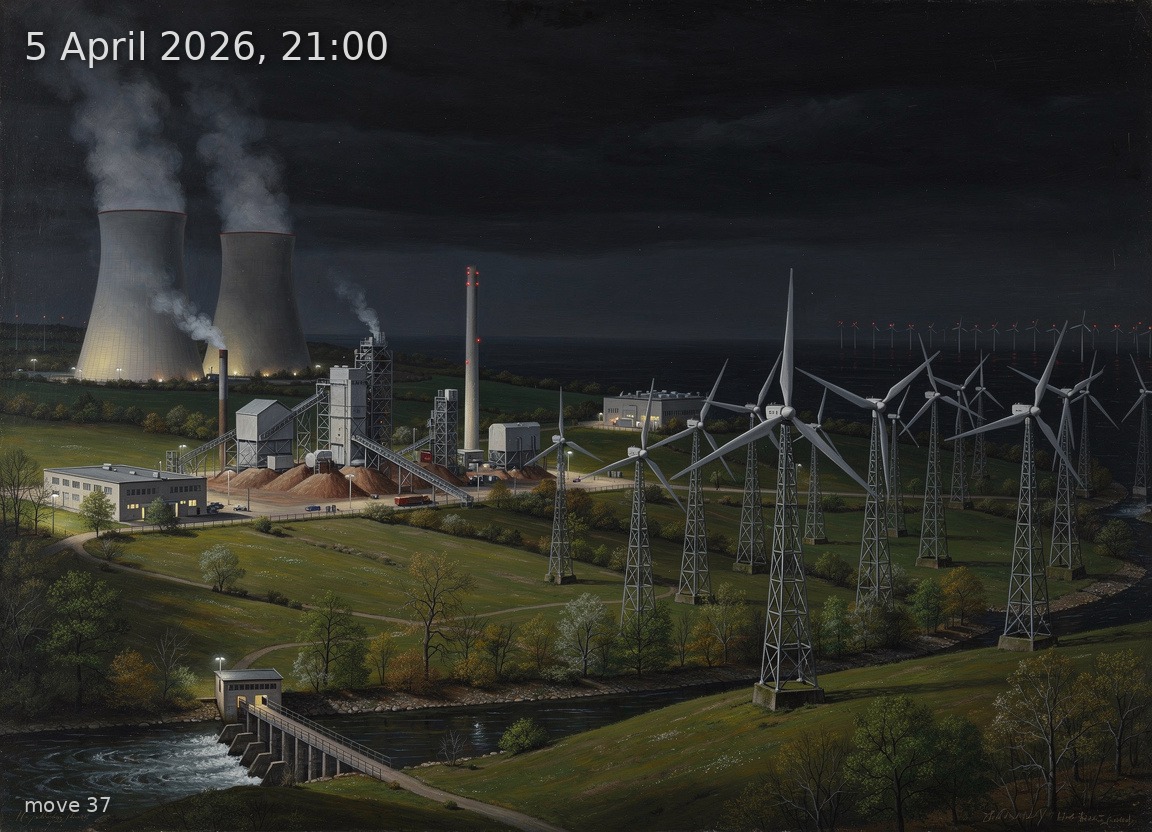
Strong onshore and offshore wind at 37.6 GW drives 87.5% renewable share on a dark, overcast spring evening.
Back
Generation mix
Wind onshore 61%
Wind offshore 15%
Biomass 9%
Hydro 2%
Natural gas 5%
Hard coal 2%
Brown coal 5%
88%
Renewable share
37.7 GW
Wind (on + offshore)
0.0 GW
Solar
49.6 GW
Total generation
+3.0 GW
Net export
30.2 €/MWh
Day-ahead price
9.9°C / 13 km/h
Temp / Wind speed
Open-Meteo, Kassel (51.3°N 9.5°E)
100% / 0.0 W/m²
Cloud cover / Radiation
83
gCO₂/kWh
Image prompt
Wind onshore 30.2 GW dominates the scene as vast ranks of three-blade turbines on lattice towers stretching across rolling central German hills, occupying roughly 60% of the canvas from centre to right; wind offshore 7.4 GW appears as distant turbines on the far-right horizon standing in dark water, roughly 15% of the scene; biomass 4.5 GW is rendered as a cluster of medium-scale industrial plants with wood-chip conveyors and small exhaust stacks emitting pale steam in the centre-left, occupying about 9% of the composition; natural gas 2.7 GW appears as a compact CCGT facility with a single tall exhaust stack and modest steam plume at centre-left, about 5%; brown coal 2.5 GW is shown as two hyperbolic cooling towers with lazy white steam plumes on the far left, about 5%; hydro 1.2 GW is a small run-of-river station with flowing water at the lower-left foreground; hard coal 1.0 GW is a single smaller power station with a chimney stack beside the brown coal towers. The sky is completely dark — it is 21:00, fully night, a black overcast sky with 100% cloud cover, no stars, no moon, no twilight glow whatsoever. All structures are lit only by sodium-orange and white industrial lighting — sodium streetlights line access roads, aviation warning lights blink red atop the wind turbines, the cooling towers are softly illuminated from below. The spring landscape shows early green grass and budding deciduous trees at roughly 10°C. Moderate wind is shown through bent grasses and spinning turbine blades with slight motion blur. The atmosphere is calm and undramatic, reflecting the moderate 30.2 EUR/MWh price — no oppressive clouds, just a quiet, deep-navy-to-black overcast night. Style: highly detailed oil painting in the tradition of 19th-century German Romantic landscape painting — rich, dark colour palette of Prussian blue, lamp black, and warm sodium-light oranges; visible impasto brushwork; atmospheric depth with subtle aerial perspective; meticulous engineering detail on turbine nacelles, three-blade rotors, cooling tower parabolic curves, and industrial pipework. The painting evokes Caspar David Friedrich's nocturnal moods merged with industrial realism. No text, no labels.