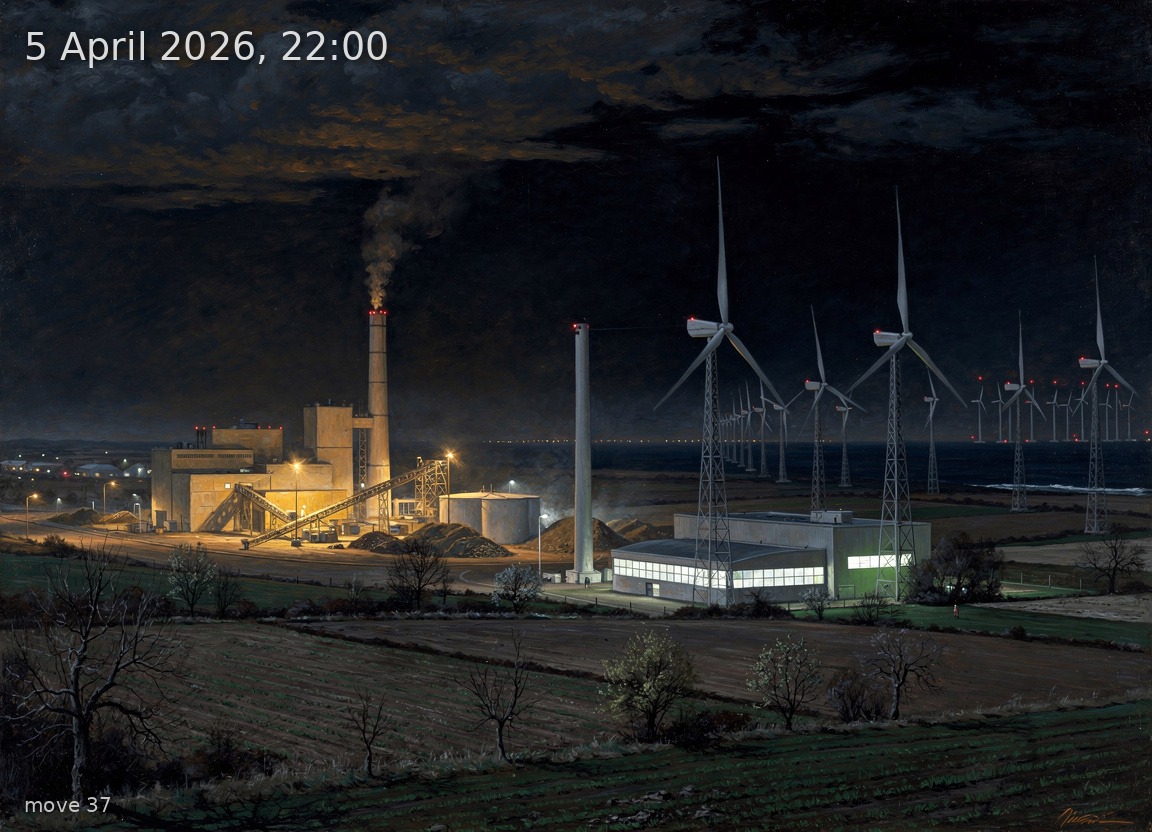
Strong onshore and offshore wind at 37.3 GW powers 87% renewable overnight generation under heavy cloud cover.
Back
Generation mix
Wind onshore 61%
Wind offshore 15%
Biomass 9%
Hydro 3%
Natural gas 6%
Hard coal 2%
Brown coal 5%
87%
Renewable share
37.3 GW
Wind (on + offshore)
0.0 GW
Solar
49.4 GW
Total generation
+4.4 GW
Net export
30.4 €/MWh
Day-ahead price
7.0°C / 17 km/h
Temp / Wind speed
Open-Meteo, Kassel (51.3°N 9.5°E)
97% / 0.0 W/m²
Cloud cover / Radiation
86
gCO₂/kWh
Image prompt
Wind onshore 30.0 GW dominates the scene, filling the right two-thirds of the composition as vast ranks of three-blade turbines on lattice towers stretching across rolling farmland into deep darkness, rotors visibly spinning in moderate wind; wind offshore 7.3 GW appears on the far right horizon as distant clusters of taller offshore turbines with red aviation warning lights blinking against a black sky over an implied North Sea coastline; biomass 4.3 GW occupies the left-centre as a mid-sized industrial plant with a tall stack emitting a faint warm exhaust plume, illuminated by sodium-yellow floodlights and surrounded by woodchip storage; natural gas 2.9 GW appears in the centre-left as a compact CCGT facility with a single slender exhaust stack, its turbine hall lit from within by fluorescent light spilling through high windows; brown coal 2.5 GW sits on the far left as a pair of hyperbolic cooling towers releasing thick white steam plumes into the night, lit from below by amber industrial lighting; hard coal 1.1 GW is a smaller facility just beside the brown coal plant, a single stack with a thin grey plume; hydro 1.3 GW is suggested by a small dam structure in the mid-ground with water catching faint reflected light. The sky is completely dark—deep navy to black—with 97% cloud cover forming a low, featureless overcast ceiling faintly lit from below by the warm industrial glow. No stars, no moon, no twilight whatsoever. The landscape is early-spring central German terrain: bare fields with the first green shoots, leafless trees just beginning to bud, temperature around 7°C suggesting a damp, cool atmosphere with wisps of ground mist. The moderate price is reflected in a calm, unhurried nocturnal atmosphere. Highly detailed oil painting in the tradition of 19th-century German Romantic landscape painters—Caspar David Friedrich's brooding darkness meeting industrial sublime—rich colour palette of deep blues, warm ambers, and cool greys, visible impasto brushwork, atmospheric depth and chiaroscuro. Every turbine rendered with correct nacelle housing and three-blade rotor geometry, cooling towers with accurate hyperbolic curves and reinforcement ribs. No text, no labels.