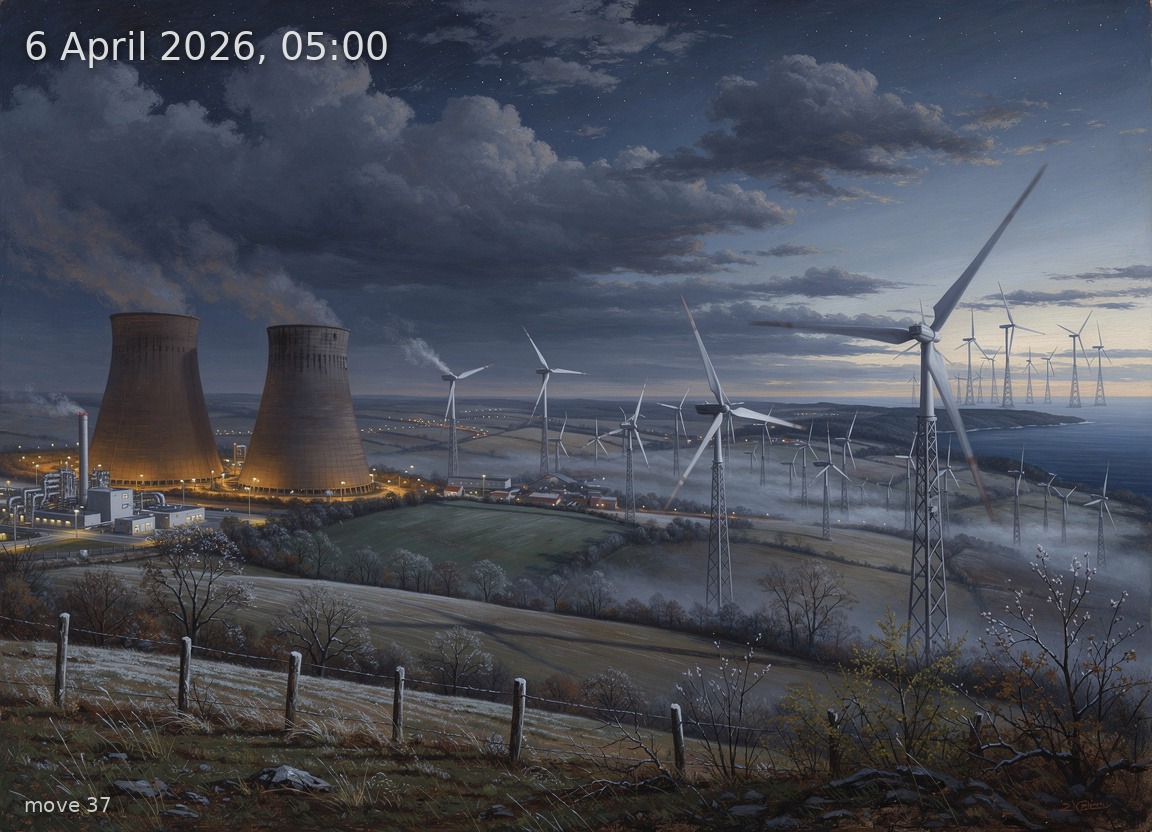
Wind dominates at 32.5 GW in a pre-dawn spring hour, driving net exports and near-zero prices.
Back
Generation mix
Wind onshore 57%
Wind offshore 18%
Biomass 10%
Hydro 3%
Natural gas 5%
Hard coal 3%
Brown coal 5%
87%
Renewable share
32.5 GW
Wind (on + offshore)
0.0 GW
Solar
43.5 GW
Total generation
+3.4 GW
Net export
2.1 €/MWh
Day-ahead price
6.2°C / 6 km/h
Temp / Wind speed
Open-Meteo, Kassel (51.3°N 9.5°E)
47% / 0.0 W/m²
Cloud cover / Radiation
87
gCO₂/kWh
Image prompt
Wind onshore 24.7 GW dominates the scene as vast ranks of three-blade turbines on lattice towers stretching across rolling central German hills, occupying roughly 57% of the composition from centre to right; wind offshore 7.8 GW appears as a distant cluster of taller turbines on the far-right horizon above a dark sea glimpsed through a valley, about 18% of visual weight; brown coal 2.1 GW sits at the far left as two hyperbolic cooling towers with thin steam plumes lit faintly from below, about 5% of the scene; natural gas 2.1 GW appears as a compact CCGT plant with a single tall exhaust stack beside the cooling towers, also about 5%; hard coal 1.4 GW is a smaller dark industrial block with a single squat chimney and a faint orange glow from its boiler house, 3%; biomass 4.2 GW is rendered as a mid-sized CHP facility with a wood-chip storage dome and gentle white exhaust, placed in the left-centre foreground, about 10%; hydro 1.3 GW appears as a small dam and penstock visible in the lower foreground stream, about 2%. Time is 05:00 in early April: the sky is deep blue-grey pre-dawn, no direct sunlight, the faintest pale grey-blue luminance on the eastern horizon only, stars still faintly visible overhead, no solar panels anywhere. Temperature is 6°C: early spring vegetation — bare branches with the first tiny buds, dormant brown-green grass, patches of lingering frost on fence posts and turbine bases. Wind speed at ground level is modest at 5.8 km/h so foreground grasses are mostly still, but high-altitude turbine blades show motion blur. Cloud cover is 47%: broken clouds drift across the deep pre-dawn sky, partially revealing stars. The day-ahead price is extremely low at 2.1 EUR/MWh: the atmosphere feels calm, open, spacious, unhurried. Style: highly detailed oil painting in the tradition of Caspar David Friedrich and Carl Blechen — rich, deep Romantic colour palette of Prussian blue, raw umber, and muted ochre; visible confident brushwork; atmospheric depth with layers of mist between the turbine rows; meticulous engineering detail on every nacelle, rotor hub, cooling tower fluting, CCGT stack, and dam spillway; the scene conveys the sublime scale of industrial landscape at the threshold of dawn. No text, no labels, no human figures.