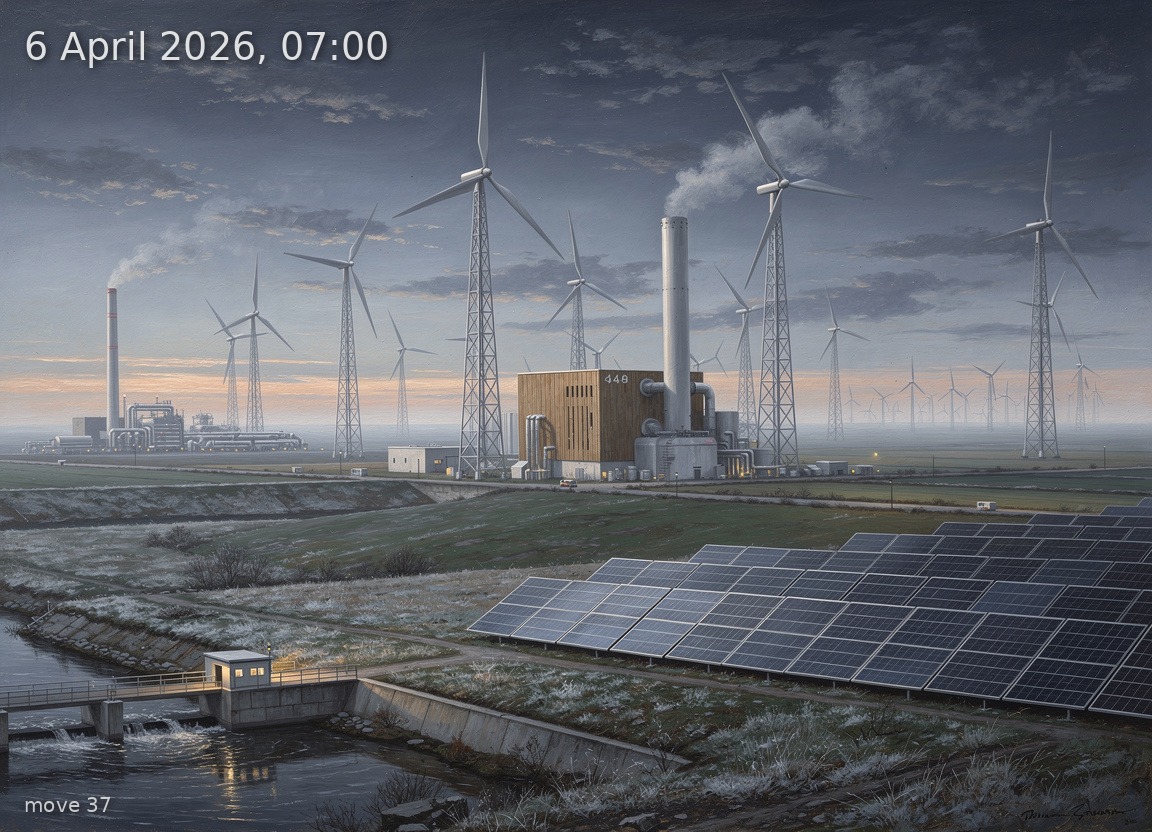
Strong onshore and offshore wind drives 87% renewables and near-zero prices on a cool April dawn.
Back
Generation mix
Wind onshore 51%
Wind offshore 15%
Solar 8%
Biomass 10%
Hydro 3%
Natural gas 5%
Hard coal 3%
Brown coal 5%
87%
Renewable share
29.3 GW
Wind (on + offshore)
3.8 GW
Solar
44.5 GW
Total generation
+2.6 GW
Net export
1.3 €/MWh
Day-ahead price
4.9°C / 6 km/h
Temp / Wind speed
Open-Meteo, Kassel (51.3°N 9.5°E)
33% / 0.0 W/m²
Cloud cover / Radiation
86
gCO₂/kWh
Image prompt
Wind onshore 22.6 GW dominates the scene, filling over half the canvas from centre to right as vast ranks of three-blade turbines on lattice towers stretching across a flat North German plain into atmospheric haze. Wind offshore 6.7 GW appears in the far-right background as a line of larger turbines rising from a grey North Sea horizon. Solar 3.8 GW occupies a modest foreground-left strip as rows of aluminium-framed crystalline silicon panels on a gently sloping field, their surfaces reflecting the faint pre-dawn glow. Biomass 4.4 GW is rendered as a mid-ground timber-clad biomass power station with a broad chimney emitting thin white steam. Hydro 1.3 GW appears as a small concrete run-of-river weir with a powerhouse nestled beside a narrow river in the lower-left corner. Natural gas 2.2 GW is a compact CCGT facility with a single tall exhaust stack and thin heat shimmer, placed in the mid-left background. Hard coal 1.4 GW is a small coal plant with a single rectangular stack and conveyor belt, partially obscured in the far left. Brown coal 2.1 GW stands as a pair of hyperbolic cooling towers with light steam plumes behind the coal plant, slightly larger in visual presence. Time of day is early dawn at 07:00 in April: the sky is deep blue-grey with the faintest pale salmon glow appearing at the eastern horizon, no direct sunlight yet, landscape still in cool shadow. Temperature is near 5°C — early spring vegetation, bare branches with the first pale green buds on trees, frost lingering on grass. Cloud cover 33% — scattered alto-cumulus clouds lit faintly from below by pre-dawn light, most of the sky clear dark blue. Low wind speed at ground level but turbine blades visibly turning at hub height. The atmosphere is calm, open, expansive — reflecting the extremely low electricity price. Style: highly detailed oil painting in the tradition of Caspar David Friedrich and Carl Blechen — rich, layered colour palette of slate blue, silver-grey, muted green and warm amber at the horizon, visible confident brushwork, deep atmospheric perspective. Every energy technology rendered with meticulous engineering accuracy: turbine nacelles, rotor pitch mechanisms, PV cell grid patterns, cooling tower parabolic profiles, CCGT exhaust geometry. The scene conveys the quiet industrial sublime of a modern German energy landscape at the threshold of daylight. No text, no labels.