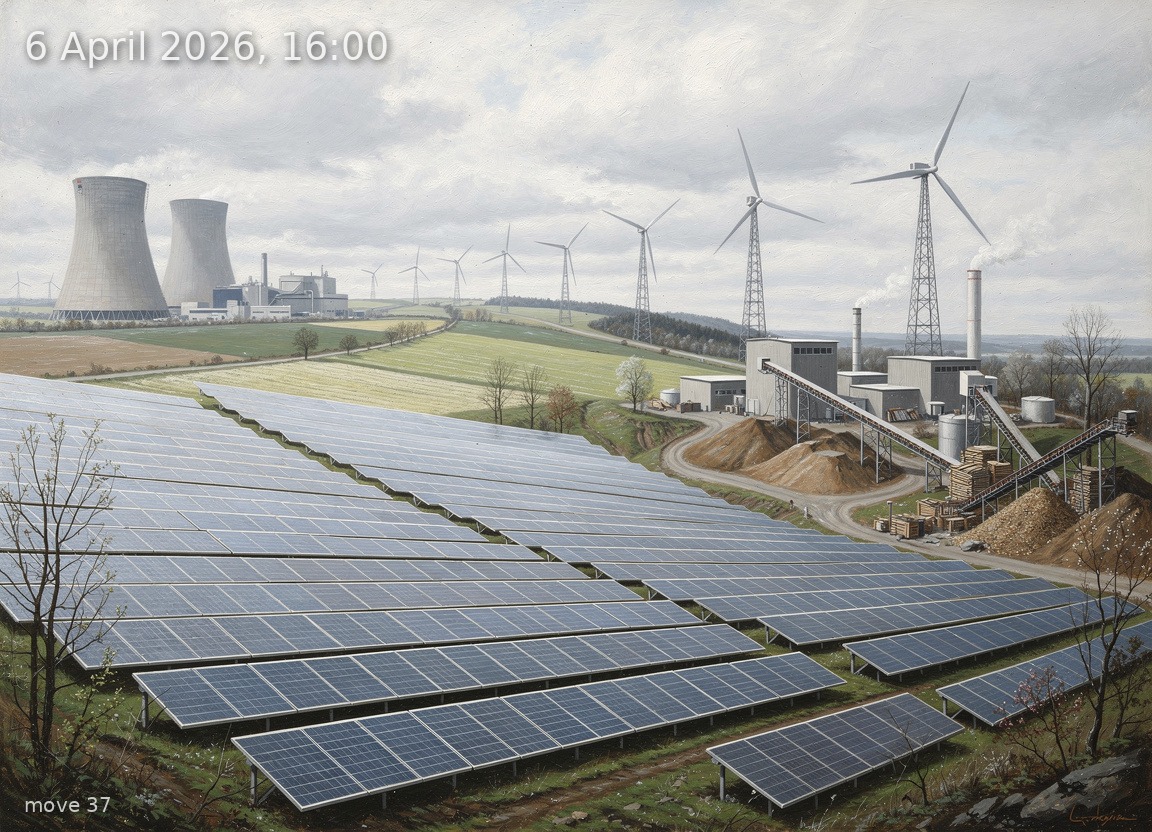
Solar at 29 GW drives a 8 GW net export and negative prices on a mild, overcast April afternoon.
Back
Generation mix
Wind onshore 17%
Wind offshore 2%
Solar 60%
Biomass 8%
Hydro 3%
Natural gas 4%
Hard coal 1%
Brown coal 4%
91%
Renewable share
9.2 GW
Wind (on + offshore)
29.0 GW
Solar
47.9 GW
Total generation
+8.0 GW
Net export
-28.7 €/MWh
Day-ahead price
13.2°C / 11 km/h
Temp / Wind speed
Open-Meteo, Kassel (51.3°N 9.5°E)
100% / 410.5 W/m²
Cloud cover / Radiation
63
gCO₂/kWh
Image prompt
Solar 29.0 GW dominates the scene as a vast plain of crystalline silicon photovoltaic panels stretching across most of the canvas, their aluminium frames catching diffuse afternoon daylight; wind onshore 8.2 GW appears as a regiment of three-blade turbines with lattice towers marching along a ridge in the middle distance, blades turning gently in moderate wind; biomass 4.1 GW is rendered as a cluster of wood-chip power stations with squat stacks and conveyor belts on the right; brown coal 2.1 GW occupies a modest area at the far left as two hyperbolic cooling towers emitting thin wisps of white steam; natural gas 1.8 GW sits beside them as a compact CCGT plant with a single polished exhaust stack and faint heat shimmer; hydro 1.2 GW appears as a small dam and penstock visible in a valley fold; wind offshore 0.9 GW is suggested by tiny turbines on the far horizon line; hard coal 0.5 GW is a single dark-bricked plant barely visible behind the cooling towers. The sky is fully overcast yet luminous—a bright, flat, pearlescent white-grey blanket typical of 16:00 afternoon daylight in central Germany in early April, with no direct sun disc visible but strong ambient brightness. The landscape is early spring: fields showing fresh pale-green shoots, scattered bare deciduous trees just beginning to bud, temperature around 13°C conveyed by cool blue-green tones in shadows. The negative electricity price is evoked by an atmosphere of serene calm—open, expansive, almost unnervingly peaceful. Highly detailed oil painting in the tradition of 19th-century German Romantic landscape painters such as Caspar David Friedrich and Carl Blechen, with rich layered colour, visible confident brushwork, atmospheric depth and aerial perspective, meticulous engineering detail on every technology element—turbine nacelles, PV cell grid patterns, cooling tower parabolic geometry, CCGT turbine housing—rendered as a masterwork industrial landscape painting. No text, no labels.