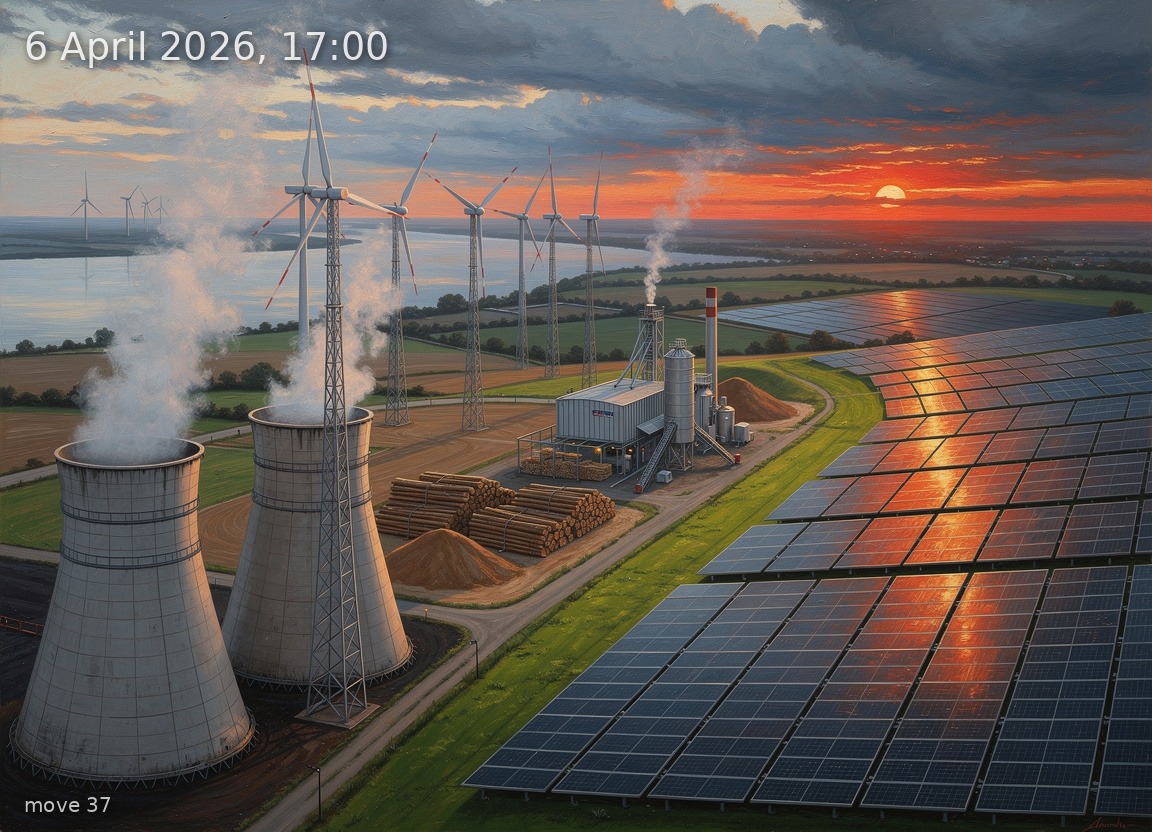
Solar at 20.2 GW and wind at 15.7 GW drive 89% renewables and a negative price at early evening.
Back
Generation mix
Wind onshore 30%
Wind offshore 3%
Solar 44%
Biomass 9%
Hydro 3%
Natural gas 4%
Hard coal 1%
Brown coal 5%
89%
Renewable share
15.7 GW
Wind (on + offshore)
20.2 GW
Solar
46.3 GW
Total generation
+4.6 GW
Net export
-5.6 €/MWh
Day-ahead price
13.2°C / 12 km/h
Temp / Wind speed
Open-Meteo, Kassel (51.3°N 9.5°E)
47% / 310.2 W/m²
Cloud cover / Radiation
72
gCO₂/kWh
Image prompt
Solar 20.2 GW dominates the right half of the scene as vast fields of aluminium-framed crystalline silicon PV panels stretching across gently rolling spring farmland, reflecting the low orange-red sun; wind onshore 14.1 GW fills the centre-left as dozens of tall three-blade turbines on lattice and tubular towers, their rotors turning moderately in 12 km/h wind; wind offshore 1.6 GW appears as a small cluster of turbines on a distant hazy horizon above a river estuary at far left; biomass 4.2 GW is rendered as a mid-ground wood-chip power station with stacked timber, a compact boiler house, and a single low exhaust stack trailing thin white vapour; brown coal 2.3 GW sits in the left foreground as two hyperbolic concrete cooling towers with modest steam plumes rising into the fading sky; natural gas 2.0 GW appears as a compact CCGT plant with a single tall exhaust stack and clean white vapour, positioned just right of the cooling towers; hard coal 0.7 GW is a small conventional power station with a squat chimney barely visible behind the gas plant; hydro 1.3 GW is suggested by a small dam and spillway in a valley at far right, water gleaming. Time of day: 17:00 Berlin dusk — rapidly fading light, the lower horizon glows deep orange-red while the upper sky transitions from dusty blue to deepening indigo; broken clouds at 47% coverage catch the last warm light underneath, their tops already dimming to grey. Spring vegetation: fresh bright-green grass, early-leafing birch and beech trees. The negative electricity price is reflected in a calm, spacious, open atmosphere — no oppressive haze, air feels clean and expansive. Style: highly detailed oil painting in the tradition of 19th-century German Romantic landscape painters such as Caspar David Friedrich and Carl Blechen — rich saturated colour, visible confident brushwork, atmospheric depth with subtle aerial perspective, dramatic Romantic light contrasting the warm glow of sunset with the cool advancing twilight. Every technology rendered with meticulous engineering detail: turbine nacelles, three-blade rotors, panel wiring, cooling-tower ribbing, industrial piping. The scene feels like a museum-quality masterwork painting of the modern industrial landscape. No text, no labels.