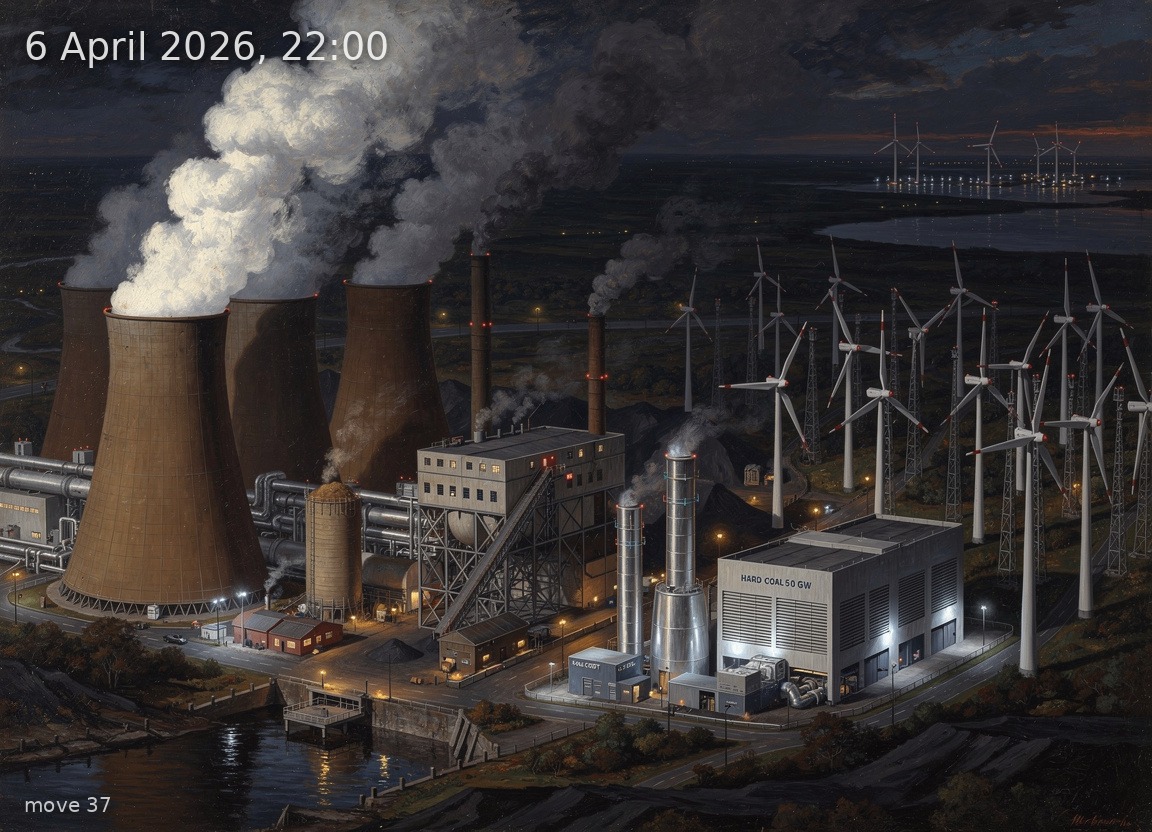
Wind leads at 15.4 GW but zero solar and firm demand push coal and gas output, lifting prices to 113.8 EUR/MWh.
Back
Generation mix
Wind onshore 35%
Wind offshore 7%
Biomass 12%
Hydro 4%
Natural gas 12%
Hard coal 13%
Brown coal 18%
56%
Renewable share
15.4 GW
Wind (on + offshore)
0.0 GW
Solar
37.4 GW
Total generation
-7.8 GW
Net import
113.8 €/MWh
Day-ahead price
5.7°C / 5 km/h
Temp / Wind speed
Open-Meteo, Kassel (51.3°N 9.5°E)
67% / 0.0 W/m²
Cloud cover / Radiation
310
gCO₂/kWh
Image prompt
Brown coal 6.9 GW dominates the left quarter as a massive lignite power station with four hyperbolic cooling towers emitting thick white steam plumes into a dark night sky; hard coal 5.0 GW sits just right of centre as a large coal-fired plant with rectangular boiler houses, conveyor belts, and tall chimneys trailing grey smoke; natural gas 4.4 GW appears as a compact CCGT facility with polished steel exhaust stacks and a single smaller cooling tower glowing faintly under floodlights; wind onshore 12.9 GW fills the entire right third and background as dozens of tall three-blade turbines on lattice and tubular towers, their red aviation warning lights blinking in the darkness, rotors turning at moderate speed; wind offshore 2.5 GW is suggested by a distant cluster of turbines on the far-right horizon above a dark estuary; biomass 4.3 GW appears as a mid-sized industrial facility with a wood-chip silo and low smokestack near the centre-left; hydro 1.3 GW is a small dam structure with illuminated spillway in the lower foreground. The sky is completely dark, deep navy to black, no twilight, no glow on the horizon — only artificial light sources: sodium-orange streetlamps lining an access road, industrial floodlights casting harsh white pools on concrete cooling basins, glowing control-room windows. The atmosphere feels heavy and oppressive, reflecting the high electricity price — low haze hangs between the plants, diffusing the industrial lights into amber halos. Early spring vegetation is barely visible: bare branches on a few trees, patches of damp brown-green grass along a canal in the foreground, temperature near 6 °C suggesting cold dampness. Partial cloud cover at 67% is implied by the absence of stars across most of the sky, with a few faint star clusters breaking through gaps. Painted in the style of a highly detailed 19th-century German Romantic oil painting — rich, dark palette of indigo, umber, ochre, and titanium white; visible impasto brushwork on steam plumes and light reflections; atmospheric depth achieved through careful tonal gradation from bright foreground industry to dim distant turbines; meticulous engineering accuracy on every nacelle, rotor blade, cooling tower profile, and smokestack. No text, no labels.