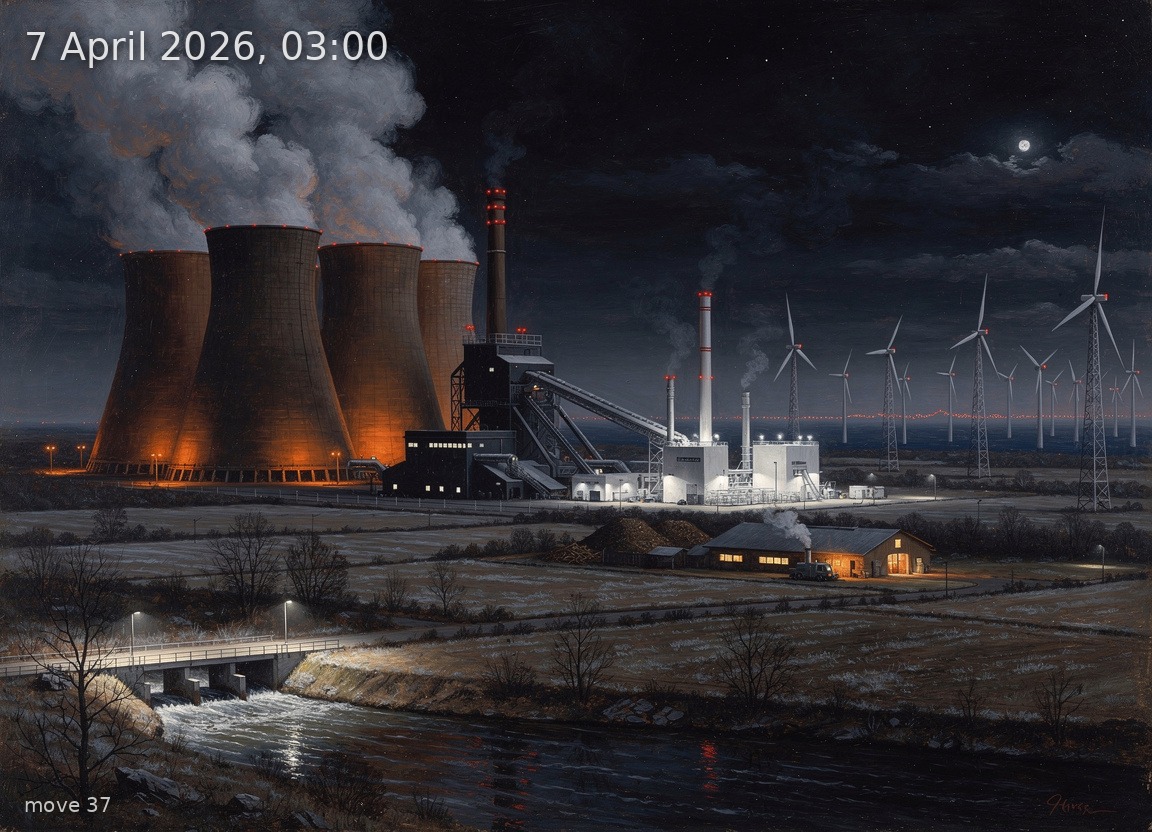
Wind leads at 13.3 GW but coal and gas fill 15.5 GW as cold overnight demand drives 5.6 GW net imports.
Back
Generation mix
Wind onshore 32%
Wind offshore 7%
Biomass 12%
Hydro 4%
Natural gas 13%
Hard coal 12%
Brown coal 20%
55%
Renewable share
13.3 GW
Wind (on + offshore)
0.0 GW
Solar
34.1 GW
Total generation
-5.6 GW
Net import
102.3 €/MWh
Day-ahead price
0.7°C / 3 km/h
Temp / Wind speed
Open-Meteo, Kassel (51.3°N 9.5°E)
55% / 0.0 W/m²
Cloud cover / Radiation
322
gCO₂/kWh
Image prompt
Brown coal 7.0 GW dominates the left quarter as a cluster of massive hyperbolic cooling towers with thick white steam plumes rising into the black sky, their concrete surfaces lit by orange sodium lamps; hard coal 4.2 GW appears just right of centre as a dark industrial power station with conveyor belts, a tall chimney stack, and red aviation warning lights blinking; natural gas 4.3 GW occupies the centre-right as two compact CCGT units with slender exhaust stacks venting thin wisps of steam, lit by harsh white facility lighting; wind onshore 11.0 GW fills the right third and extends into the background as dozens of three-blade turbines on lattice and tubular towers, their red nacelle lights dotting the darkness in receding rows, blades turning slowly; wind offshore 2.3 GW is suggested on the far right horizon as a faint cluster of red blinking lights over an implied sea; biomass 4.0 GW appears as a modest wood-chip-fed plant in the mid-ground with a gently smoking stack and a warm amber glow from its facility windows; hydro 1.3 GW is a small dam structure in the lower left foreground with water gleaming under a single floodlight. The sky is completely black to deep navy, no moon visible, partial cloud cover at 55 percent subtly obscured by the darkness, stars peeking through gaps. The ground shows early-spring barren fields with patches of frost catching the artificial light, sparse leafless trees, temperature near freezing. The atmosphere feels heavy and oppressive — thick, still air pressing down, conveying the high electricity price. The entire scene is rendered as a highly detailed oil painting in the tradition of 19th-century German Romantic landscape painters such as Caspar David Friedrich and Carl Blechen — rich, dark colour palette of deep indigo, burnt umber, and sulphurous orange, visible impasto brushwork, dramatic chiaroscuro from artificial lighting against the void of night, atmospheric depth achieved through layered industrial haze. Each technology rendered with meticulous engineering accuracy: three-blade rotor profiles, aluminium nacelle housings, hyperbolic concrete cooling tower geometry, CCGT heat-recovery housings. No text, no labels.