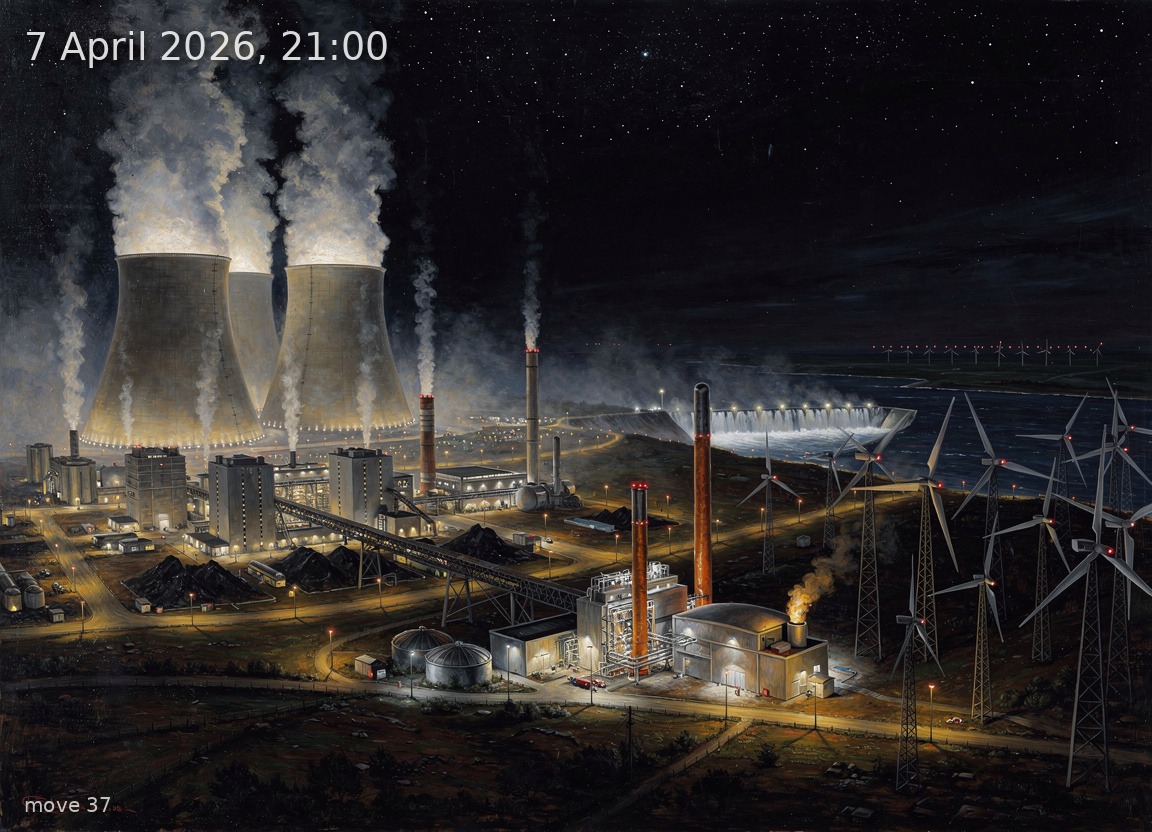
Coal, gas, and wind anchor 39 GW of domestic generation while 17 GW of net imports cover strong evening demand.
Back
Generation mix
Wind onshore 26%
Wind offshore 3%
Biomass 11%
Hydro 3%
Natural gas 19%
Hard coal 16%
Brown coal 21%
44%
Renewable share
11.4 GW
Wind (on + offshore)
0.0 GW
Solar
39.2 GW
Total generation
-16.9 GW
Net import
144.0 €/MWh
Day-ahead price
10.5°C / 4 km/h
Temp / Wind speed
Open-Meteo, Kassel (51.3°N 9.5°E)
0% / 0.0 W/m²
Cloud cover / Radiation
386
gCO₂/kWh
Image prompt
Brown coal 8.1 GW dominates the left quarter as a cluster of massive hyperbolic cooling towers with thick white-grey steam plumes rising into the night; hard coal 6.4 GW sits just right of centre as a dense industrial complex with conveyor belts, stockpiles, and tall chimneys emitting faint amber-lit exhaust; natural gas 7.5 GW occupies the centre-right as compact CCGT power stations with sleek single exhaust stacks, their gas flares casting orange reflections on metallic surfaces; onshore wind 10.3 GW spans the right third of the composition as a deep field of tall three-blade turbines on lattice towers receding into darkness, red aviation warning lights blinking on each nacelle; offshore wind 1.1 GW appears as a handful of distant turbines on the far-right horizon over a dark sea; biomass 4.5 GW is represented by a medium-sized biogas facility with rounded digesters and a small chimney with a warm yellow glow; hydro 1.3 GW appears as a modest dam spillway in the far background with floodlights illuminating cascading water. The sky is completely dark, deep navy-black, no twilight, no sky glow — a clear starry April night with zero cloud cover. The atmosphere feels heavy and oppressive, reflecting the high electricity price — haze and industrial steam hang low, trapping the amber glow of sodium streetlights and facility lighting. Spring vegetation is just emerging: pale green buds on deciduous trees, fresh grass visible under artificial light. Light surface wind barely stirs the scene. The entire composition is rendered as a highly detailed oil painting in the tradition of 19th-century German Romantic landscape painters — rich, saturated colour applied with visible textured brushwork, dramatic chiaroscuro between the deep black sky and the warm industrial glow below, atmospheric depth conveying distance across the German plain. Each technology is painted with meticulous engineering accuracy: turbine nacelles with three-blade rotors, aluminium-clad CCGT units, lignite cooling towers with parabolic profiles. No text, no labels.