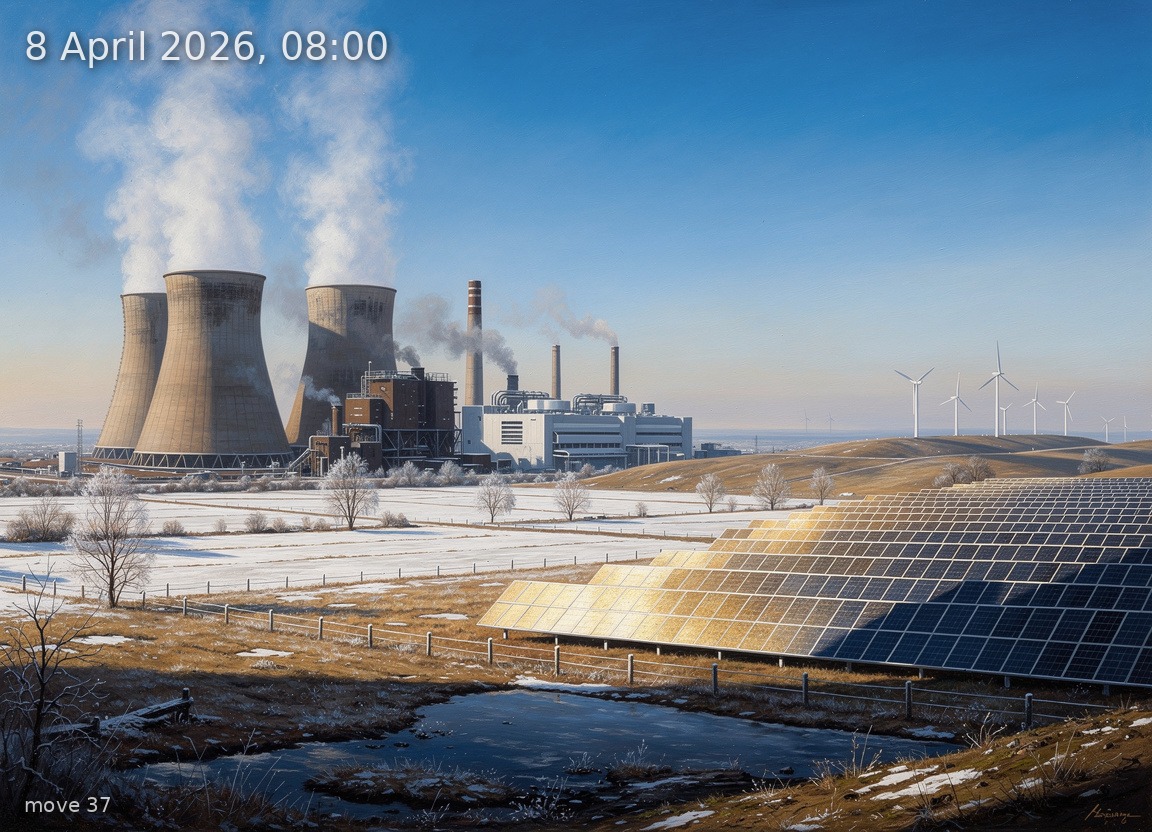
Cold, calm morning drives high thermal output alongside rising solar as Germany imports 12.8 GW to meet demand.
Back
Generation mix
Wind onshore 10%
Wind offshore 4%
Solar 34%
Biomass 9%
Hydro 3%
Natural gas 13%
Hard coal 11%
Brown coal 16%
59%
Renewable share
6.8 GW
Wind (on + offshore)
17.4 GW
Solar
50.6 GW
Total generation
-12.8 GW
Net import
138.5 €/MWh
Day-ahead price
-0.4°C / 3 km/h
Temp / Wind speed
Open-Meteo, Kassel (51.3°N 9.5°E)
0% / 22.0 W/m²
Cloud cover / Radiation
282
gCO₂/kWh
Image prompt
Brown coal 8.2 GW dominates the left quarter as a cluster of massive hyperbolic cooling towers with thick white steam plumes rising into still air; hard coal 5.7 GW sits just right of them as darker, squarer industrial stacks with grey smoke; natural gas 6.6 GW occupies the centre-left as compact CCGT units with slender single exhaust stacks emitting thin vapour; solar 17.4 GW fills the entire right third and extends into the middle distance as vast fields of aluminium-framed crystalline silicon panels angled toward a low eastern sun, their surfaces gleaming with golden-white reflections; wind onshore 5.0 GW appears as a modest row of three-blade turbines on a ridge in the centre-right background, rotors barely turning in negligible wind; wind offshore 1.8 GW is suggested by two or three distant turbines on the far horizon; biomass 4.5 GW appears as a mid-sized industrial plant with a wood-chip conveyor and a single smokestack near the coal facilities; hydro 1.4 GW is a small dam and spillway visible in a valley on the far right. The sky is absolutely cloudless, a crisp pale blue deepening to cobalt overhead, lit by early-morning April sunlight coming from low in the east casting long shadows across frozen fields. The landscape is flat northern German plain with bare deciduous trees and patches of frost on brown grass—early spring, sub-zero temperature evident in rime on fence posts and frozen puddles. The atmosphere feels heavy and expensive: a faint haze of industrial emissions hangs low across the thermal plants, and the sheer density of infrastructure conveys pressure on the system. Highly detailed oil painting in the tradition of 19th-century German Romantic landscape painters—Caspar David Friedrich's atmospheric depth merged with Adolph Menzel's industrial precision—rich colour palette of steel blues, warm golds, industrial greys, and coal blacks, visible confident brushwork, luminous sky gradients, meticulous engineering detail on every turbine nacelle, every cooling tower's parabolic curve, every PV panel's grid lines. No text, no labels.