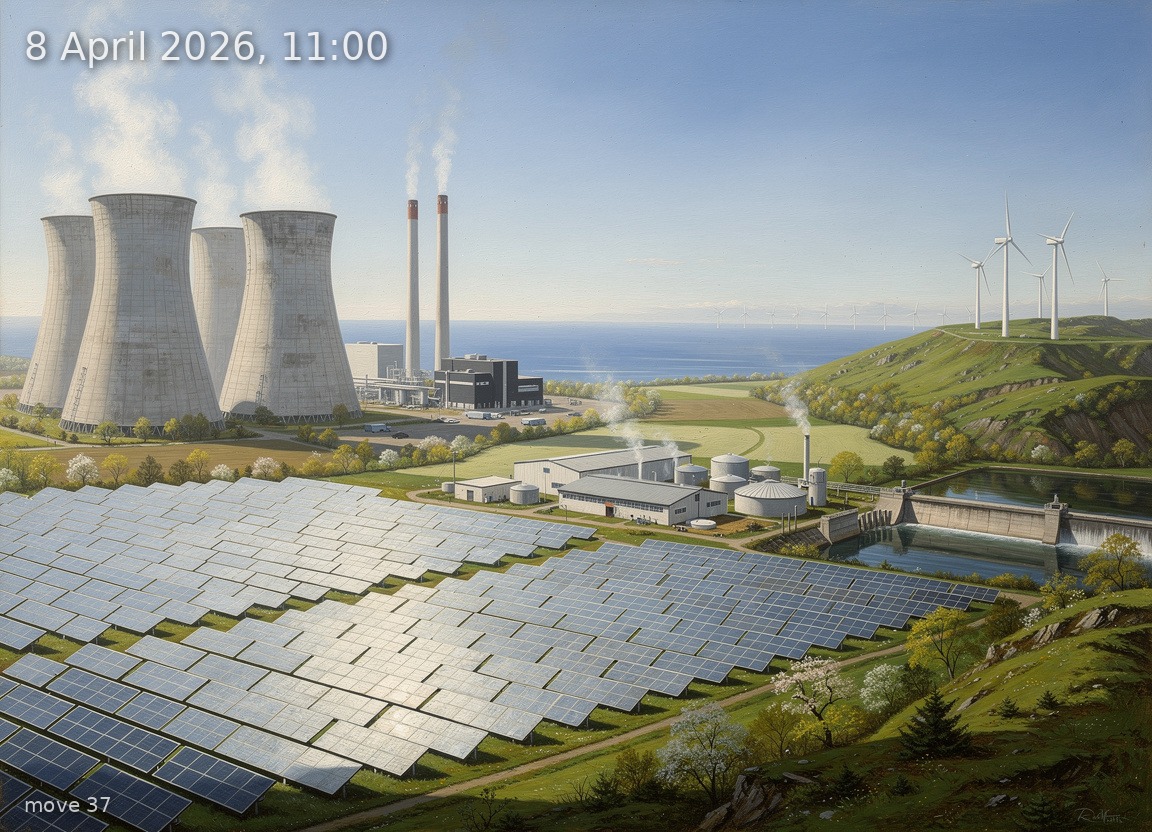
Solar at 51 GW drives 88% renewables, pushing prices negative as 7.3 GW net exports flow out.
Back
Generation mix
Wind onshore 2%
Wind offshore 3%
Solar 75%
Biomass 6%
Hydro 2%
Natural gas 4%
Hard coal 2%
Brown coal 6%
88%
Renewable share
3.3 GW
Wind (on + offshore)
51.1 GW
Solar
67.9 GW
Total generation
+7.3 GW
Net export
-0.1 €/MWh
Day-ahead price
10.5°C / 1 km/h
Temp / Wind speed
Open-Meteo, Kassel (51.3°N 9.5°E)
0% / 395.2 W/m²
Cloud cover / Radiation
81
gCO₂/kWh
Image prompt
Solar 51.1 GW dominates the scene: an immense sun-drenched valley stretching across the entire canvas, blanketed with endless rows of aluminium-framed crystalline silicon photovoltaic panels glinting under a completely cloudless, brilliant spring sky at late morning (11:00 Berlin time), with the sun high and casting short shadows. Brown coal 3.9 GW occupies the far left as a cluster of massive hyperbolic cooling towers emitting thin, wispy steam plumes rising into the still air. Natural gas 2.6 GW appears just left of centre as a pair of compact CCGT power plants with sleek single exhaust stacks releasing faint heat shimmer. Hard coal 1.4 GW is rendered as a smaller coal plant with a square chimney and modest smoke, tucked behind the gas units. Biomass 4.2 GW sits in the centre-right middle ground as a collection of low industrial buildings with rounded digesters and short stacks releasing pale vapour. Wind onshore 1.5 GW appears as a small group of three-blade turbines on a distant ridge at the right, their rotors nearly still in the calm air. Wind offshore 1.9 GW is suggested by a sliver of North Sea visible on the far-right horizon, with a handful of offshore turbine silhouettes standing motionless in flat water. Hydro 1.5 GW is depicted as a modest dam and reservoir nestled in a fold of green hills at the far right. The spring landscape shows fresh pale-green deciduous foliage, cool 10°C-appropriate early spring vegetation with some bare branches still visible, wildflowers emerging. The sky is vast, luminous, and calm—a serene open atmosphere reflecting the near-zero electricity price. Light is bright, warm, and even, with crisp atmospheric depth and haze softening the distant thermal plants. Style: highly detailed oil painting in the tradition of Caspar David Friedrich and Carl Blechen—rich colour palette of spring greens, warm golds, pale industrial greys, visible confident brushwork, atmospheric perspective giving immense depth, meticulous engineering detail on every turbine nacelle, every PV panel frame, every cooling tower's parabolic curve and reinforced concrete texture. No text, no labels.