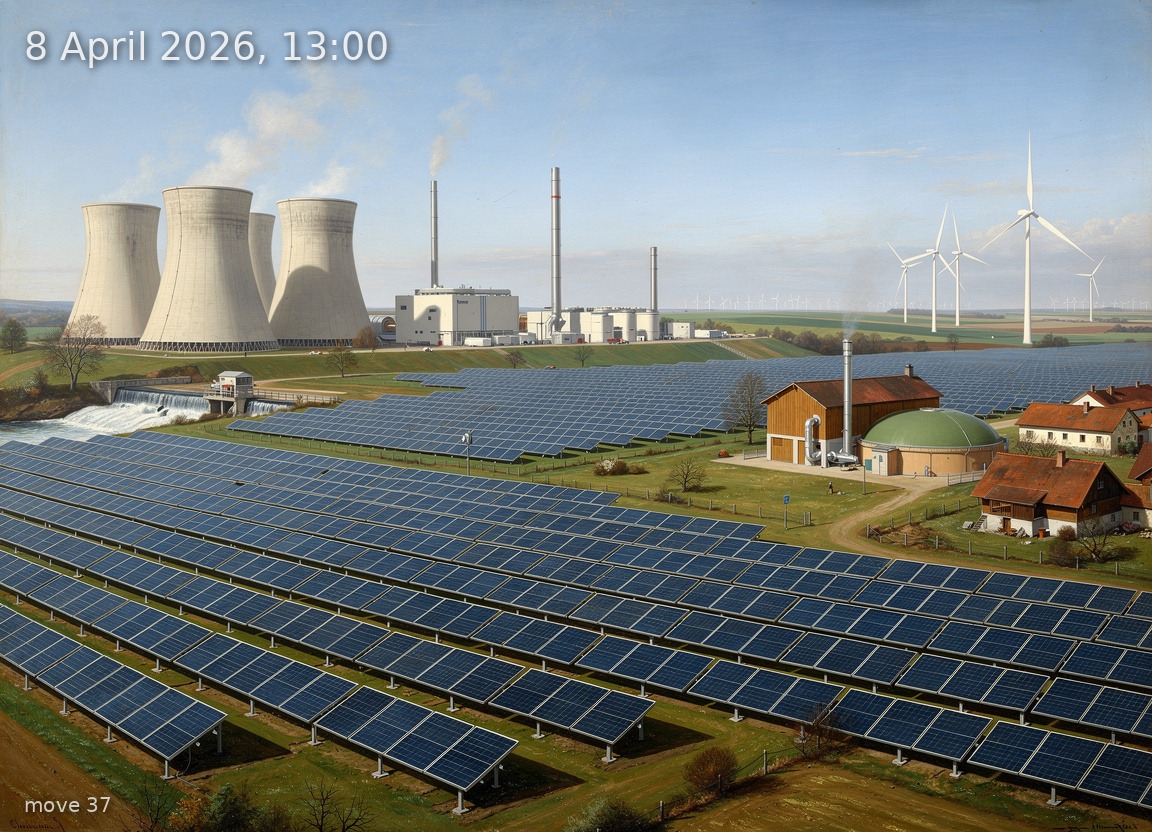
Massive 52 GW solar output drives 17 GW net exports and deeply negative prices on a clear spring afternoon.
Back
Generation mix
Wind onshore 3%
Wind offshore 2%
Solar 76%
Biomass 6%
Hydro 2%
Natural gas 4%
Hard coal 2%
Brown coal 5%
89%
Renewable share
4.1 GW
Wind (on + offshore)
52.3 GW
Solar
69.0 GW
Total generation
+17.4 GW
Net export
-32.8 €/MWh
Day-ahead price
14.9°C / 3 km/h
Temp / Wind speed
Open-Meteo, Kassel (51.3°N 9.5°E)
29% / 574.5 W/m²
Cloud cover / Radiation
74
gCO₂/kWh
Image prompt
Solar 52.3 GW dominates the scene as an immense expanse of crystalline silicon photovoltaic panels stretching across rolling central German farmland, covering roughly three-quarters of the composition, their aluminium frames glinting under bright midday spring sunshine. Brown coal 3.6 GW appears at the far left as a cluster of hyperbolic cooling towers with thin lazy steam plumes rising into the pale blue sky. Natural gas 2.5 GW sits beside them as compact CCGT units with slender exhaust stacks emitting faint heat shimmer. Wind onshore 2.4 GW shows as a small group of three-blade turbines on a distant ridge, rotors barely turning in the near-calm air. Wind offshore 1.7 GW is suggested by tiny turbines visible on a hazy horizon line where flat land meets the sky. Biomass 4.0 GW appears as a timber-clad biogas facility with a rounded green digester dome and a modest chimney amid farm buildings. Hydro 1.2 GW is rendered as a small weir and run-of-river powerhouse nestled along a gentle stream in the mid-ground. Hard coal 1.2 GW shows as a single dark industrial stack with minimal emissions at the left edge. The sky is approximately 29 percent covered by scattered fair-weather cumulus clouds, the rest brilliant spring blue, with strong direct sunlight casting crisp shadows. The atmosphere is calm and open, reflecting the deeply negative electricity price — no oppressive haze, just serene brightness. Early spring vegetation: fresh pale-green buds on deciduous trees, yellow rapeseed beginning to bloom in adjacent fields, temperature around 15°C suggested by light jackets on two tiny figures walking a path between panel rows. The scene is composed in the style of a highly detailed 19th-century German Romantic oil painting — rich saturated colour, visible confident brushwork, luminous atmospheric depth reminiscent of Caspar David Friedrich meeting industrial modernity — yet every technology is rendered with meticulous engineering accuracy: three-blade rotor nacelles, panel wiring conduits, cooling tower parabolic curves, CCGT heat-recovery housings. No text, no labels.