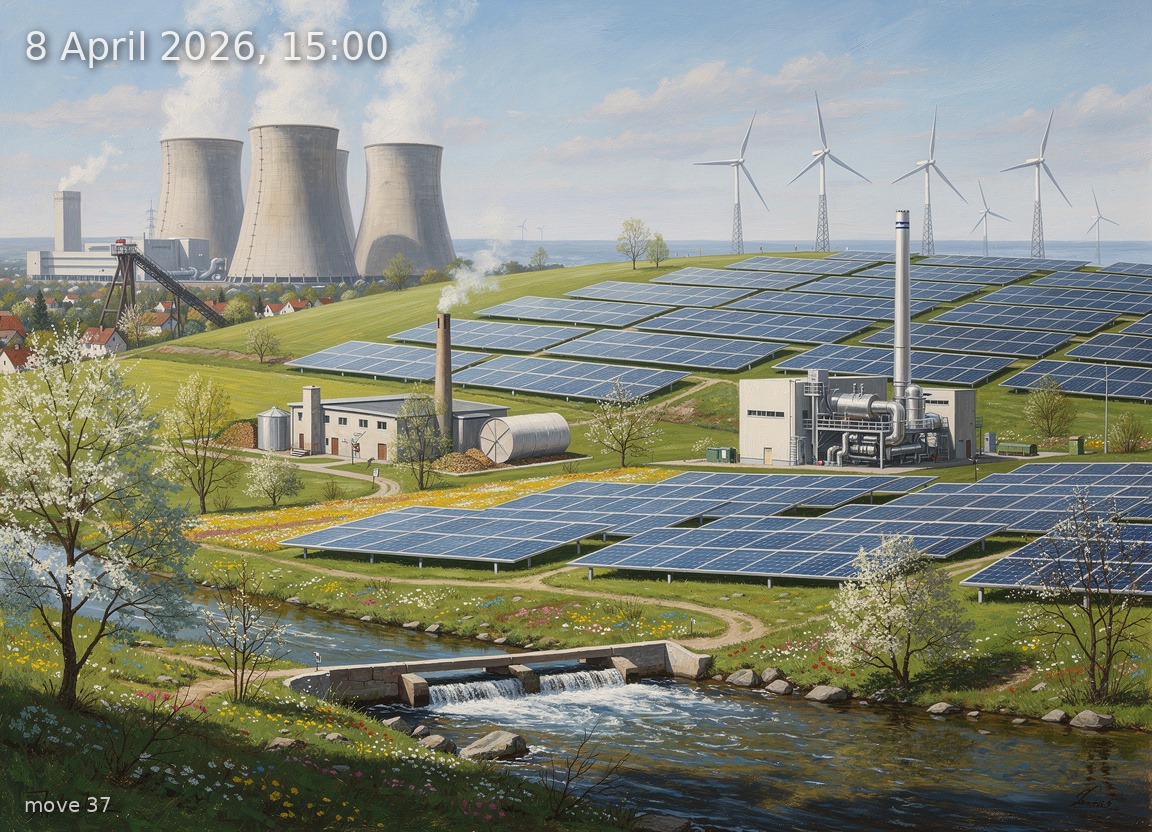
Solar at 44.9 GW drives 88% renewable share and negative prices, with 10.4 GW net export.
Back
Generation mix
Wind onshore 6%
Wind offshore 4%
Solar 70%
Biomass 6%
Hydro 2%
Natural gas 4%
Hard coal 2%
Brown coal 6%
88%
Renewable share
6.6 GW
Wind (on + offshore)
44.9 GW
Solar
64.1 GW
Total generation
+10.4 GW
Net export
-13.2 €/MWh
Day-ahead price
16.2°C / 5 km/h
Temp / Wind speed
Open-Meteo, Kassel (51.3°N 9.5°E)
30% / 579.5 W/m²
Cloud cover / Radiation
81
gCO₂/kWh
Image prompt
Solar 44.9 GW dominates the entire scene as vast crystalline silicon PV arrays stretching across rolling green April fields and rooftops, occupying roughly 70% of the canvas under brilliant afternoon sun; brown coal 3.7 GW appears in the left background as a cluster of hyperbolic cooling towers with thin white steam plumes rising against clear sky; wind onshore 3.9 GW stands as a scattered row of three-blade turbines with lattice towers on gentle hills at mid-right, blades barely turning in near-calm air; wind offshore 2.6 GW is glimpsed as distant turbines on a hazy horizon line at far right; biomass 4.1 GW is a modest combined-heat-and-power plant with a squat rectangular stack and woodchip storage silo at centre-left; natural gas 2.5 GW appears as a compact modern CCGT facility with a single slender exhaust stack and minimal emissions at centre-right; hard coal 1.2 GW is a single medium plant with a conveyor belt and square stack at far left behind the lignite towers; hydro 1.2 GW shows as a small run-of-river weir with spillway in the foreground stream. Lighting is full bright afternoon daylight at 3 PM in April, sun high in the western quadrant casting warm shadows, sky 30% scattered cumulus with large blue openings, atmosphere calm and luminous suggesting negative electricity prices—open, serene, almost excessively bright. Spring vegetation: fresh bright-green grass, budding deciduous trees, wildflowers in meadow strips between solar rows. Temperature 16°C gives a mild pleasant feel with no heat haze. Style: highly detailed oil painting in the tradition of 19th-century German Romantic landscape masters like Caspar David Friedrich and Carl Blechen—rich layered colour, visible confident brushwork, atmospheric perspective with depth from foreground stream to distant offshore turbines, dramatic yet serene composition balancing industrial infrastructure with pastoral spring landscape. Meticulous engineering detail on every technology: aluminium-framed PV modules with visible cell grids, turbine nacelles and hub assemblies, hyperbolic concrete cooling tower geometry with condensation plumes, CCGT heat-recovery units. No text, no labels, no people prominent.