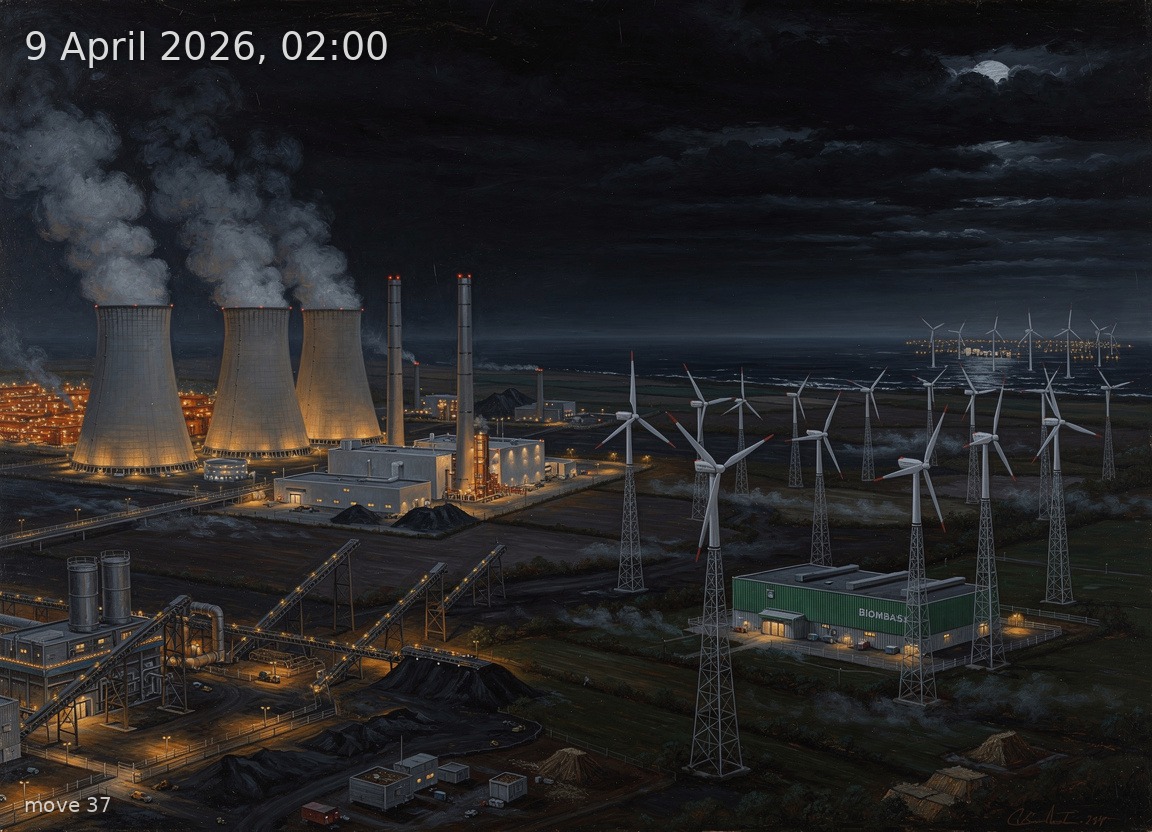
Wind leads at 22 GW, backed by 19 GW of coal and gas under full cloud cover at 2 AM.
Back
Generation mix
Wind onshore 36%
Wind offshore 12%
Biomass 9%
Hydro 3%
Natural gas 13%
Hard coal 10%
Brown coal 17%
60%
Renewable share
22.2 GW
Wind (on + offshore)
0.0 GW
Solar
46.3 GW
Total generation
+1.3 GW
Net export
101.1 €/MWh
Day-ahead price
6.6°C / 3 km/h
Temp / Wind speed
Open-Meteo, Kassel (51.3°N 9.5°E)
100% / 0.0 W/m²
Cloud cover / Radiation
281
gCO₂/kWh
Image prompt
Wind onshore 16.6 GW dominates the right half of the canvas as dozens of three-blade turbines on lattice towers receding across dark rolling farmland, their red aviation warning lights blinking in the blackness. Wind offshore 5.5 GW appears in the far-right background as a cluster of turbines standing in a barely visible North Sea horizon, nacelle lights reflecting off dark water. Brown coal 8.0 GW occupies the left foreground as three massive hyperbolic cooling towers emitting thick white-grey steam plumes rising into the black sky, lit from below by the amber glow of a sprawling lignite plant with conveyors and coal bunkers. Natural gas 6.0 GW fills the left-centre as two compact CCGT units with tall single exhaust stacks and clean steel casings, their stacks tipped with small controlled flames, sodium-orange floodlights illuminating the facility. Hard coal 4.7 GW sits behind the gas plant as a darker, grittier complex with a single large smokestack and coal stockpile, lit by dim industrial lighting. Biomass 4.1 GW appears as a modest wood-chip-fed power station with a green-tinged corrugated metal facade and a gently steaming stack, positioned centre-right between the wind field and the fossil plants. Hydro 1.3 GW is a small concrete dam and powerhouse nestled in a valley in the far centre background, a thin white cascade visible under a single floodlight. The sky is completely black to deep navy with 100% overcast — no stars, no moon, no twilight glow — a heavy oppressive cloud ceiling pressing down, barely distinguishable from the darkness below. The temperature is a cool 6.6°C early April night: bare trees with only the faintest bud hints, damp ground, patches of mist gathering in low terrain between the turbines. The overall atmosphere is heavy and brooding, reflecting the high electricity price — an industrial tension permeating the air. Style: highly detailed oil painting in the tradition of 19th-century German Romantic landscape painters — rich, dark palette of deep blues, blacks, amber, and warm industrial oranges; visible impasto brushwork; atmospheric depth with layers of mist and steam; meticulous engineering accuracy on every turbine nacelle, cooling tower profile, and exhaust stack. No text, no labels.