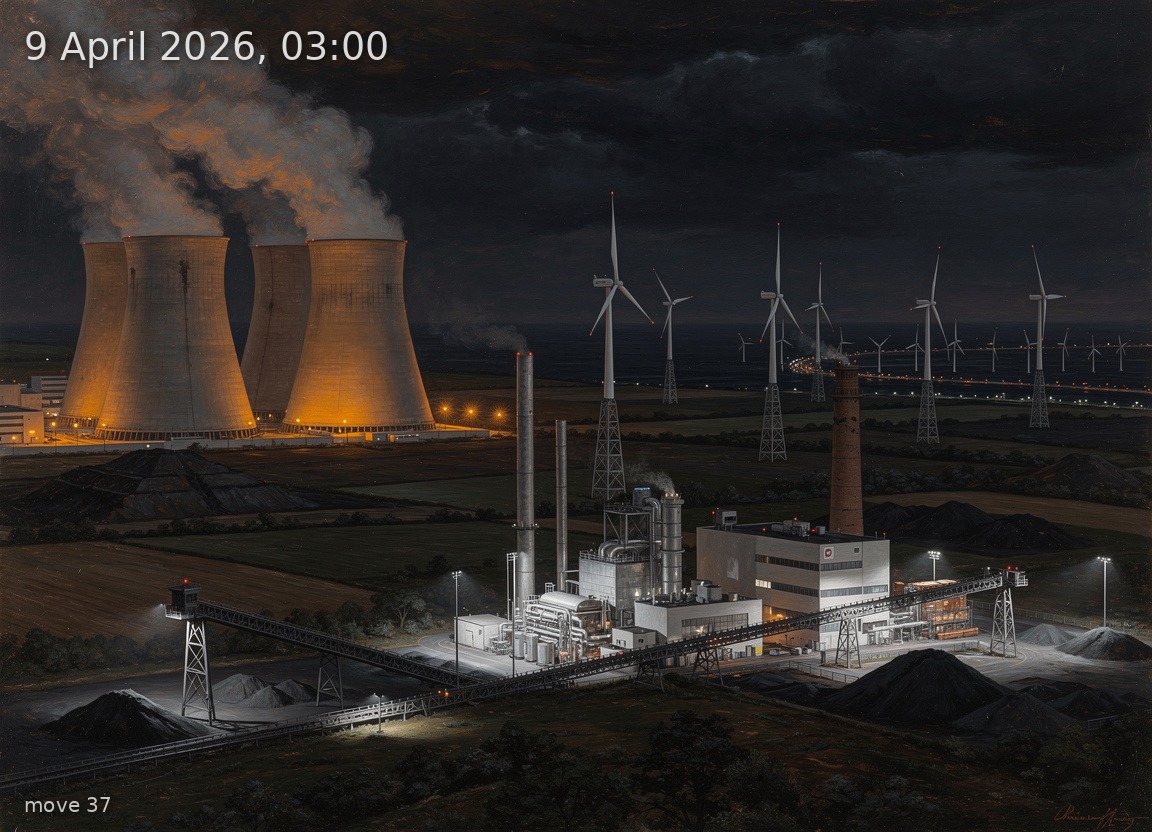
Wind leads at 21.1 GW but 19 GW of coal and gas hold the overnight balance at elevated prices.
Back
Generation mix
Wind onshore 35%
Wind offshore 12%
Biomass 9%
Hydro 3%
Natural gas 14%
Hard coal 10%
Brown coal 18%
58%
Renewable share
21.1 GW
Wind (on + offshore)
0.0 GW
Solar
45.5 GW
Total generation
+0.0 GW
Net export
101.9 €/MWh
Day-ahead price
5.1°C / 3 km/h
Temp / Wind speed
Open-Meteo, Kassel (51.3°N 9.5°E)
93% / 0.0 W/m²
Cloud cover / Radiation
288
gCO₂/kWh
Image prompt
Wind onshore 15.8 GW dominates the right half of the scene as dozens of towering three-blade turbines with white nacelles and lattice towers stretching across rolling dark farmland, their red aviation warning lights blinking against the black sky. Wind offshore 5.3 GW appears in the far right background as a cluster of turbines standing in a barely-visible dark sea, their lights forming a constellation on the horizon. Brown coal 8.0 GW occupies the left foreground as a massive lignite power station with four hyperbolic concrete cooling towers emitting thick steam plumes lit from below by orange sodium lamps, with conveyor belts of dark lignite visible. Natural gas 6.3 GW fills the centre-left as a compact CCGT plant with tall slender exhaust stacks and a single smaller cooling tower, its metal surfaces reflecting industrial floodlighting. Hard coal 4.7 GW sits just right of centre as a coal-fired plant with a large rectangular boiler house, a tall brick chimney, and coal stockpiles dimly illuminated. Biomass 4.1 GW appears as a mid-sized industrial facility with cylindrical silos and a modest stack, warmly lit, nestled between the coal and wind zones. Hydro 1.3 GW is represented as a small dam and powerhouse in a valley at the far left edge, with a spillway faintly catching the glow of facility lights. Solar is completely absent — no panels, no sunshine. The sky is pitch black to deep navy, completely overcast at 93% cloud cover blocking all stars, giving the atmosphere a heavy, oppressive, claustrophobic quality reflecting the high 101.9 EUR/MWh price. The temperature is a chilly 5.1°C in early April: bare trees with only the faintest buds, dormant brown grass, patches of lingering frost on the ground catching artificial light. Ground-level air is nearly still. The only light sources are sodium-orange and white industrial floodlights, red turbine beacons, and the incandescent glow from furnace openings. Style: highly detailed oil painting in the tradition of 19th-century German Romantic landscape painters — Caspar David Friedrich's brooding darkness merged with Adolph Menzel's meticulous industrial realism — rich deep colour palette of blacks, navies, burnt oranges, and warm whites, visible impasto brushwork, profound atmospheric depth, technically precise engineering details on every installation. No text, no labels.