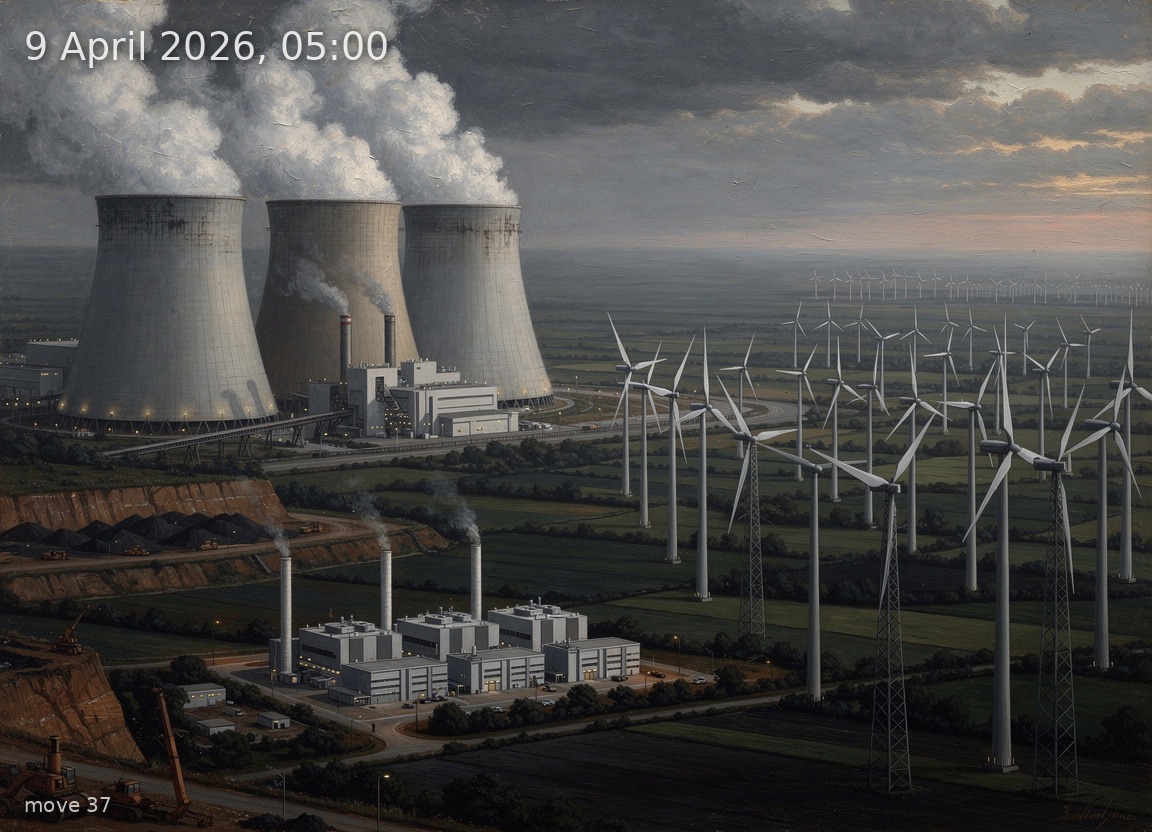
Wind leads at 20.3 GW but coal and gas fill the pre-dawn gap, with 4.4 GW of net imports needed.
Back
Generation mix
Wind onshore 32%
Wind offshore 11%
Biomass 9%
Hydro 3%
Natural gas 17%
Hard coal 9%
Brown coal 17%
56%
Renewable share
20.3 GW
Wind (on + offshore)
0.0 GW
Solar
46.2 GW
Total generation
-4.4 GW
Net import
115.9 €/MWh
Day-ahead price
2.4°C / 4 km/h
Temp / Wind speed
Open-Meteo, Kassel (51.3°N 9.5°E)
85% / 0.0 W/m²
Cloud cover / Radiation
298
gCO₂/kWh
Image prompt
Wind onshore 15.0 GW dominates the right half of the canvas as dozens of three-blade turbines on tall lattice-and-tubular towers receding across dark rolling fields; wind offshore 5.3 GW appears in the far right distance as a cluster of turbines standing in a barely visible grey sea on the horizon. Brown coal 8.0 GW occupies the left foreground as massive hyperbolic cooling towers emitting thick white-grey steam plumes, with conveyor belts and open-pit mine edges faintly visible. Natural gas 8.0 GW fills the centre-left as a row of compact CCGT power plants with tall single exhaust stacks venting thin vapour. Hard coal 4.3 GW appears behind the gas plant as a smaller coal-fired station with rectangular boiler houses and a single tall chimney. Biomass 4.2 GW is rendered as a modest wood-chip-fed CHP plant with a squat cylindrical silo and low steam vent, situated between the coal and wind zones. Hydro 1.3 GW is a small run-of-river weir and powerhouse tucked into a stream valley in the lower centre. Solar is completely absent — no panels anywhere. The sky is pre-dawn at 05:00 Berlin time: deep blue-grey darkness overhead, the faintest pale band of cold indigo light barely emerging along the eastern horizon, no direct sunlight, no orange glow. The atmosphere is heavy and oppressive reflecting the high electricity price — low thick overcast at 85% cloud cover presses down on the scene, moisture visible in the cold 2.4 °C air as faint ground fog threading between the turbine bases. Vegetation is early spring — bare branches on scattered deciduous trees, pale dormant grass with traces of frost. Sodium streetlights cast amber pools along a road threading through the middle ground. Cooling tower steam catches faint artificial light from the industrial facilities, glowing softly against the dark canopy. Style: highly detailed oil painting in the tradition of 19th-century German Romantic landscape painters — Caspar David Friedrich's atmospheric depth merged with industrial realism — rich impasto brushwork, dramatic chiaroscuro, meticulous engineering detail on every turbine nacelle, every cooling tower's parabolic curve, every CCGT exhaust stack. No text, no labels.