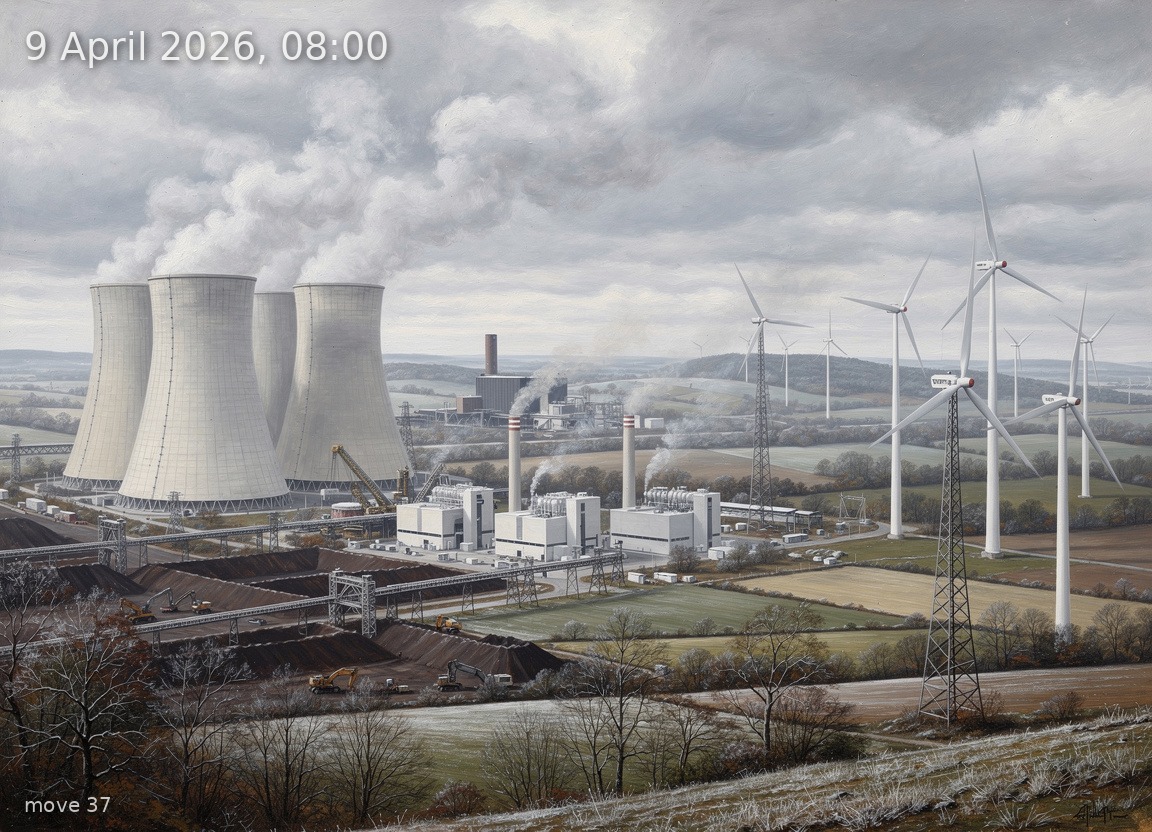
Wind and solar lead at 65% renewable share, but coal and gas fill a 32.8 GW residual load under heavy overcast.
Back
Generation mix
Wind onshore 20%
Wind offshore 10%
Solar 24%
Biomass 8%
Hydro 3%
Natural gas 14%
Hard coal 7%
Brown coal 14%
65%
Renewable share
16.8 GW
Wind (on + offshore)
13.7 GW
Solar
56.1 GW
Total generation
-7.2 GW
Net import
128.1 €/MWh
Day-ahead price
2.0°C / 3 km/h
Temp / Wind speed
Open-Meteo, Kassel (51.3°N 9.5°E)
98% / 13.8 W/m²
Cloud cover / Radiation
236
gCO₂/kWh
Image prompt
Brown coal 7.9 GW dominates the left quarter as a cluster of massive hyperbolic cooling towers with thick white-grey steam plumes merging into the overcast sky, surrounded by conveyor belts and lignite stockpiles; natural gas 7.8 GW fills the left-centre as a row of compact CCGT power blocks with tall single exhaust stacks emitting thin vapour trails; hard coal 4.0 GW appears behind them as a smaller conventional plant with a square chimney and coal bunker; wind onshore 11.0 GW spans the right half of the composition as dozens of tall three-blade turbines on lattice and tubular towers stretching across rolling fields, blades turning slowly in the faint breeze; wind offshore 5.7 GW is visible in the far-right background as a line of turbines rising from a grey North Sea horizon; solar 13.7 GW appears as vast arrays of aluminium-framed crystalline silicon panels covering flat farmland in the centre-right foreground, their surfaces reflecting only diffuse grey light — no direct sun visible; biomass 4.5 GW is represented as a mid-sized industrial plant with a wood-chip storage dome and a modest smokestack near the centre; hydro 1.5 GW appears as a small run-of-river weir with a powerhouse at the base of a gentle hill in the right foreground. The sky is entirely overcast at 98% cloud cover, a thick uniform ceiling of grey-white stratus pressing low over the landscape, creating a heavy oppressive atmosphere reflecting the 128.1 EUR/MWh price. Full daylight at 08:00 in April but completely diffuse — no shadows, no sun disc, flat illumination. Temperature is 2°C: bare deciduous trees with only the faintest bud swelling, frost lingering on grass and panel frames, breath-vapour-cold air. Central German terrain of gentle hills and open agricultural plains. Rendered as a highly detailed oil painting in the tradition of 19th-century German Romantic landscape painters — Caspar David Friedrich's atmospheric depth merged with Adolph Menzel's industrial precision — rich muted earth tones, visible confident brushwork, careful aerial perspective fading the offshore turbines into haze, meticulous engineering detail on every turbine nacelle, every cooling tower's parabolic curve, every PV cell grid pattern. No text, no labels.