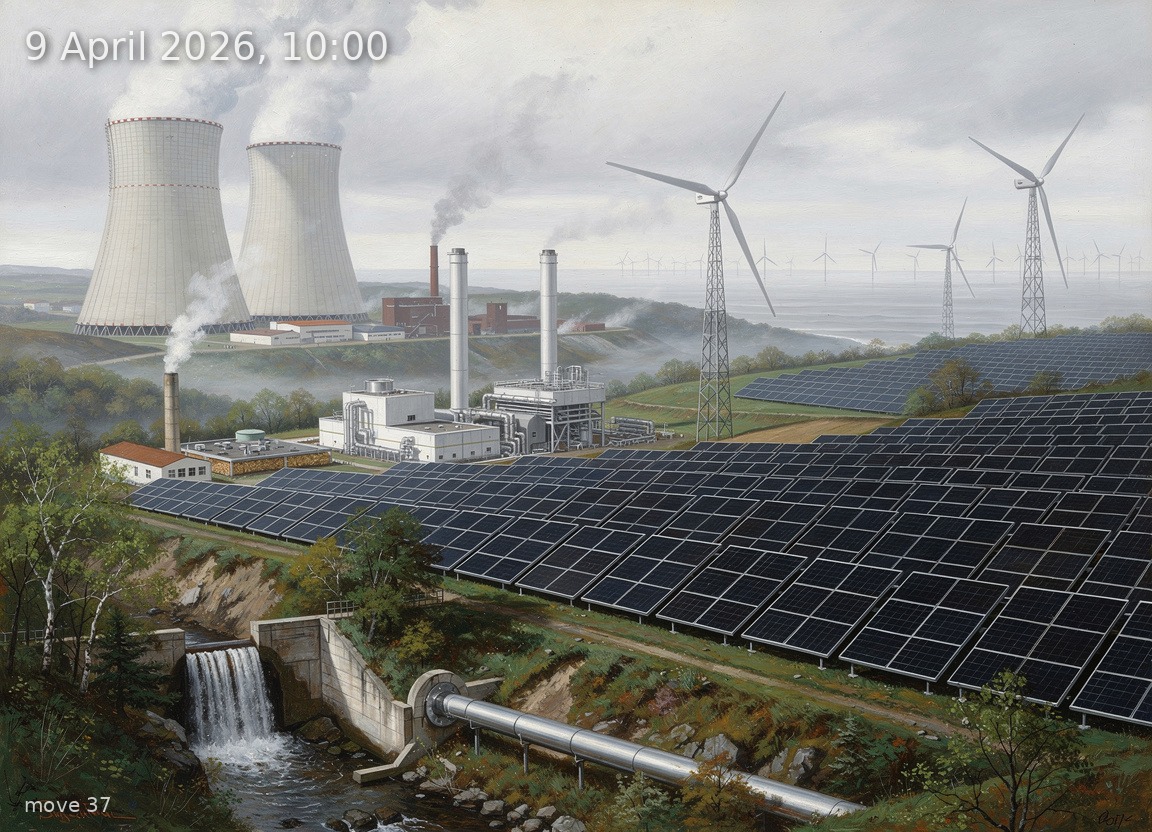
Solar at 38 GW leads under overcast skies, with wind and modest thermal backup keeping a balanced grid.
Back
Generation mix
Wind onshore 12%
Wind offshore 9%
Solar 58%
Biomass 6%
Hydro 2%
Natural gas 5%
Hard coal 2%
Brown coal 6%
88%
Renewable share
13.6 GW
Wind (on + offshore)
38.0 GW
Solar
65.4 GW
Total generation
+2.7 GW
Net export
55.0 €/MWh
Day-ahead price
7.6°C / 0 km/h
Temp / Wind speed
Open-Meteo, Kassel (51.3°N 9.5°E)
100% / 36.5 W/m²
Cloud cover / Radiation
86
gCO₂/kWh
Image prompt
Solar 38.0 GW dominates the scene as vast rolling fields of aluminium-framed crystalline silicon PV panels stretching across the entire centre and right of the composition, covering gentle spring hillsides; wind onshore 8.0 GW appears as clusters of tall three-blade turbines with lattice towers on the mid-ground ridgeline, their blades nearly still in the calm air; wind offshore 5.6 GW is visible in the far distance as a line of offshore turbines on a hazy grey sea horizon; brown coal 4.1 GW occupies the far left as a pair of massive hyperbolic cooling towers with thick white steam plumes rising into the overcast; biomass 4.2 GW sits as a modest wood-chip-fed power station with a low rectangular stack beside the lignite plant; natural gas 3.0 GW appears as a compact CCGT plant with twin cylindrical exhaust stacks and thin heat shimmer; hydro 1.5 GW is represented by a small concrete dam and penstock on a forested stream in the left foreground; hard coal 1.1 GW is a single smaller stack behind the gas plant, with a wisp of dark exhaust. Full daylight at 10:00 but entirely overcast — a uniform flat white-grey sky with no sun disk visible, diffuse shadowless light falling across the landscape. Early April vegetation: bare-branched deciduous trees just beginning to show the faintest green buds, pale dry grass, patches of early wildflowers. Temperature near 8°C gives a cool damp feel with faint ground mist in the valleys. The air is still, no motion in the grass or turbine blades. The moderate electricity price is conveyed through a muted but not oppressive sky — heavy cloud but with brightness behind it. Style: highly detailed oil painting in the tradition of 19th-century German Romantic landscape painters such as Caspar David Friedrich and Carl Blechen — rich layered colour, visible confident brushwork, atmospheric aerial perspective with depth receding from the dam in the foreground through the solar fields and turbines to the industrial stacks and distant offshore horizon. Meticulous engineering detail on every technology: correct nacelle shapes, three-blade rotor geometry, panel grid lines, cooling tower hyperbolic profiles with reinforcing ribs, CCGT exhaust geometry. The painting conveys the quiet industrial grandeur of a renewable-heavy grid on a still overcast morning. No text, no labels.