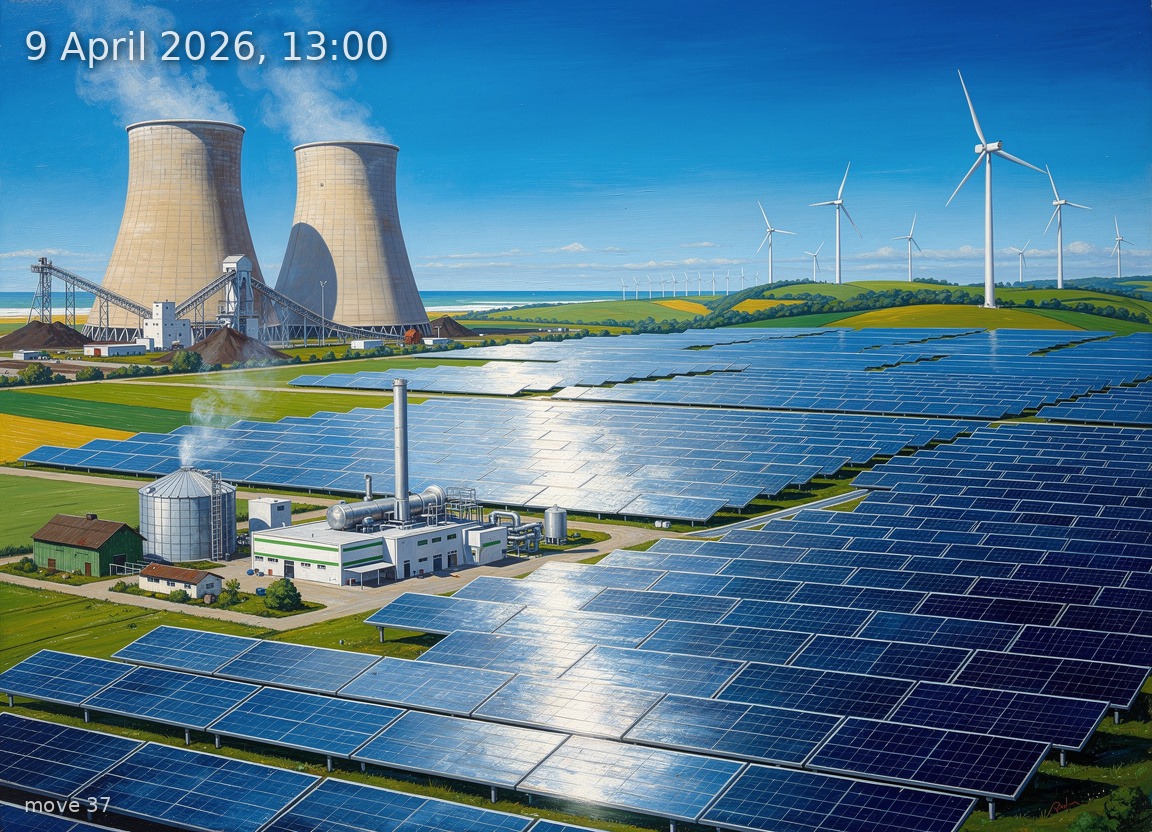
Solar at 46.8 GW and 12 GW of wind drive 90% renewables, pushing prices negative amid 12.5 GW net export.
Back
Generation mix
Wind onshore 11%
Wind offshore 6%
Solar 66%
Biomass 6%
Hydro 2%
Natural gas 4%
Hard coal 1%
Brown coal 5%
90%
Renewable share
12.0 GW
Wind (on + offshore)
46.8 GW
Solar
71.3 GW
Total generation
+12.5 GW
Net export
-7.9 €/MWh
Day-ahead price
14.8°C / 10 km/h
Temp / Wind speed
Open-Meteo, Kassel (51.3°N 9.5°E)
0% / 426.8 W/m²
Cloud cover / Radiation
68
gCO₂/kWh
Image prompt
Solar 46.8 GW dominates the scene, filling the entire centre and right as vast fields of aluminium-framed crystalline silicon photovoltaic panels stretching across gently rolling spring farmland, their glass surfaces blazing with reflected noon sunlight; wind onshore 7.9 GW appears as clusters of tall three-blade turbines with white tubular towers and visible nacelles on distant green hills to the right, blades turning slowly in light breeze; wind offshore 4.1 GW is suggested by a row of turbines on the far horizon above a faint coastal line; brown coal 3.6 GW occupies the far left as two large hyperbolic concrete cooling towers emitting thin wisps of white steam against the blue sky, with conveyor belts and a lignite bunker visible at their base; biomass 4.0 GW appears as a mid-sized industrial plant with a rounded silo and a single modest stack releasing pale exhaust, nestled among the solar arrays at the left-centre; natural gas 2.7 GW is rendered as a compact combined-cycle gas turbine facility with a tall slender exhaust stack and a smaller heat-recovery unit, positioned between the cooling towers and the biomass plant; hard coal 0.9 GW is a small, nearly idle coal plant with a single stack and minimal emission visible at the far left edge; hydro 1.4 GW is a small concrete run-of-river weir with white water cascading over it in the lower-left foreground along a gentle river. The sky is completely clear, zero clouds, deep cerulean blue, the April sun at high noon casting short sharp shadows; spring vegetation is bright fresh green with blossoming fruit trees along field borders; temperature is mild at 15°C — no heat haze. The calm open sky conveys the negative electricity price, spacious and unburdened. Style: highly detailed oil painting in the tradition of 19th-century German Romantic landscape painters such as Caspar David Friedrich and Carl Blechen — rich saturated colour, visible confident brushwork, atmospheric depth and luminous light, yet every technological element rendered with meticulous engineering accuracy: three-blade rotor geometry, PV cell grid patterns, cooling tower parabolic curves, CCGT exhaust geometry. The composition feels like a grand masterwork depicting Germany's industrial-pastoral landscape on a radiant spring day. No text, no labels, no human figures.