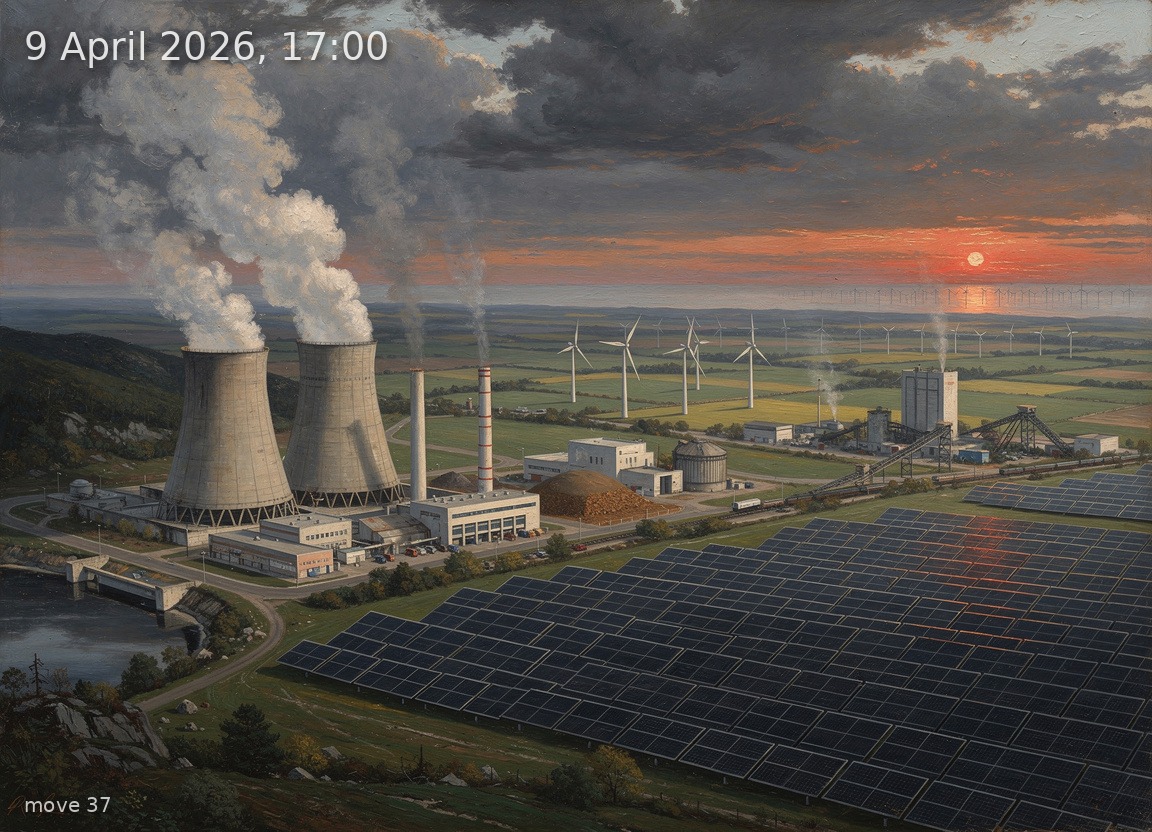
Solar leads at 21.9 GW with 16.6 GW wind; lignite and gas fill the early-evening residual load.
Back
Generation mix
Wind onshore 20%
Wind offshore 9%
Solar 39%
Biomass 8%
Hydro 2%
Natural gas 9%
Hard coal 4%
Brown coal 9%
78%
Renewable share
16.5 GW
Wind (on + offshore)
21.9 GW
Solar
56.1 GW
Total generation
+1.4 GW
Net export
82.5 €/MWh
Day-ahead price
16.8°C / 5 km/h
Temp / Wind speed
Open-Meteo, Kassel (51.3°N 9.5°E)
84% / 182.0 W/m²
Cloud cover / Radiation
145
gCO₂/kWh
Image prompt
Solar 21.9 GW dominates the right half of the scene as vast fields of aluminium-framed crystalline silicon PV panels stretching across gently rolling spring farmland, their surfaces reflecting muted amber light; wind onshore 11.3 GW appears as dozens of three-blade turbines with white tubular towers receding into the middle distance across green fields; wind offshore 5.3 GW is visible on the far horizon as a cluster of turbines rising from a hazy sea line; brown coal 5.1 GW occupies the left foreground as a lignite power station with two massive hyperbolic cooling towers emitting thick white steam plumes; natural gas 4.9 GW sits just right of the coal plant as a compact CCGT facility with tall single exhaust stacks and thinner grey flue streams; biomass 4.3 GW appears as a smaller industrial plant with a rounded woodchip silo and a modest smokestack; hard coal 2.1 GW is a distant coal-fired station with a single rectangular cooling tower and conveyor infrastructure; hydro 1.4 GW is suggested by a small dam and reservoir visible in a valley at the far left. The sky is a dusk scene at 17:00 in April — the sun is very low on the western horizon casting a fading orange-red glow along the lower sky, while the upper sky darkens to deep slate-blue and violet, heavy with 84% overcast cloud cover creating an oppressive, brooding atmosphere befitting the 82.50 EUR/MWh price. Spring vegetation is emerging — pale green grass, budding deciduous trees at 16.8°C — and the air is nearly still at 5.4 km/h, with turbine blades barely turning. Style: highly detailed oil painting in the tradition of 19th-century German Romantic landscape painters such as Caspar David Friedrich and Carl Blechen, with rich impasto brushwork, dramatic chiaroscuro from the dying light against industrial steam, atmospheric depth and aerial perspective across the wide German plain. Meticulous engineering accuracy on every turbine nacelle, PV module busbar, cooling tower shell, and gas stack. No text, no labels.