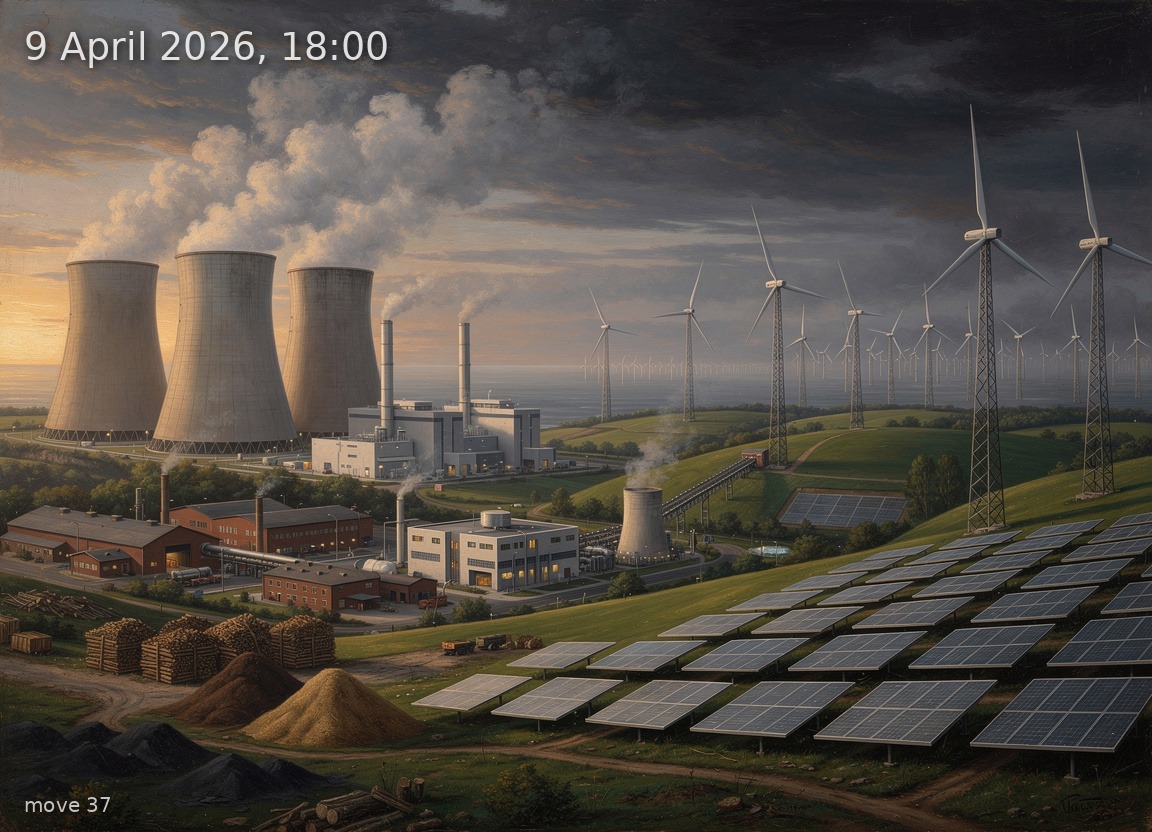
Wind and fading solar lead at 66% renewable share, but 10.5 GW coal and 7 GW net imports firm the evening ramp.
Back
Generation mix
Wind onshore 24%
Wind offshore 12%
Solar 19%
Biomass 9%
Hydro 3%
Natural gas 12%
Hard coal 7%
Brown coal 14%
66%
Renewable share
17.8 GW
Wind (on + offshore)
9.4 GW
Solar
49.8 GW
Total generation
-7.1 GW
Net import
115.4 €/MWh
Day-ahead price
16.6°C / 6 km/h
Temp / Wind speed
Open-Meteo, Kassel (51.3°N 9.5°E)
90% / 165.2 W/m²
Cloud cover / Radiation
229
gCO₂/kWh
Image prompt
Wind onshore 11.7 GW dominates the right half of the scene as dozens of three-blade turbines on lattice towers stretching across rolling green April hills; wind offshore 6.1 GW appears in the far background right as a cluster of turbines rising from a grey North Sea horizon; solar 9.4 GW fills the centre-right foreground as vast fields of aluminium-framed crystalline silicon PV panels catching the last low-angle amber light; brown coal 6.8 GW occupies the left third as three massive hyperbolic cooling towers emitting thick white-grey steam plumes against the darkening sky; natural gas 6.2 GW sits centre-left as two compact CCGT power blocks with tall single exhaust stacks and thin heat shimmer; hard coal 3.7 GW appears as a smaller conventional plant with a single square cooling tower and conveyor belt, slightly behind the lignite station; biomass 4.5 GW is represented by a cluster of medium-sized industrial buildings with short stacks and woodchip piles in the left-centre middle ground; hydro 1.3 GW is a small dam and powerhouse nestled in a valley at the far left edge. The sky is 90% overcast with heavy stratiform cloud in deep grey and slate-blue tones, but a narrow band of intense orange-red dusk glow hugs the western horizon at left, casting long warm shadows across the landscape — it is 18:00 in Berlin, the sun nearly gone. The atmosphere feels heavy and oppressive, reflecting the high electricity price: humid air, thick cloud pressing down, industrial haze mixing with steam. Spring vegetation is fresh green but muted under the overcast. Light wind barely stirs the young leaves. Painted in the style of a highly detailed 19th-century German Romantic oil painting — rich impasto brushwork, atmospheric depth reminiscent of Caspar David Friedrich crossed with industrial realism, luminous horizon glow contrasting with brooding cloud mass, meticulous engineering detail on every turbine nacelle, every panel frame, every cooling tower's parabolic curve. No text, no labels.