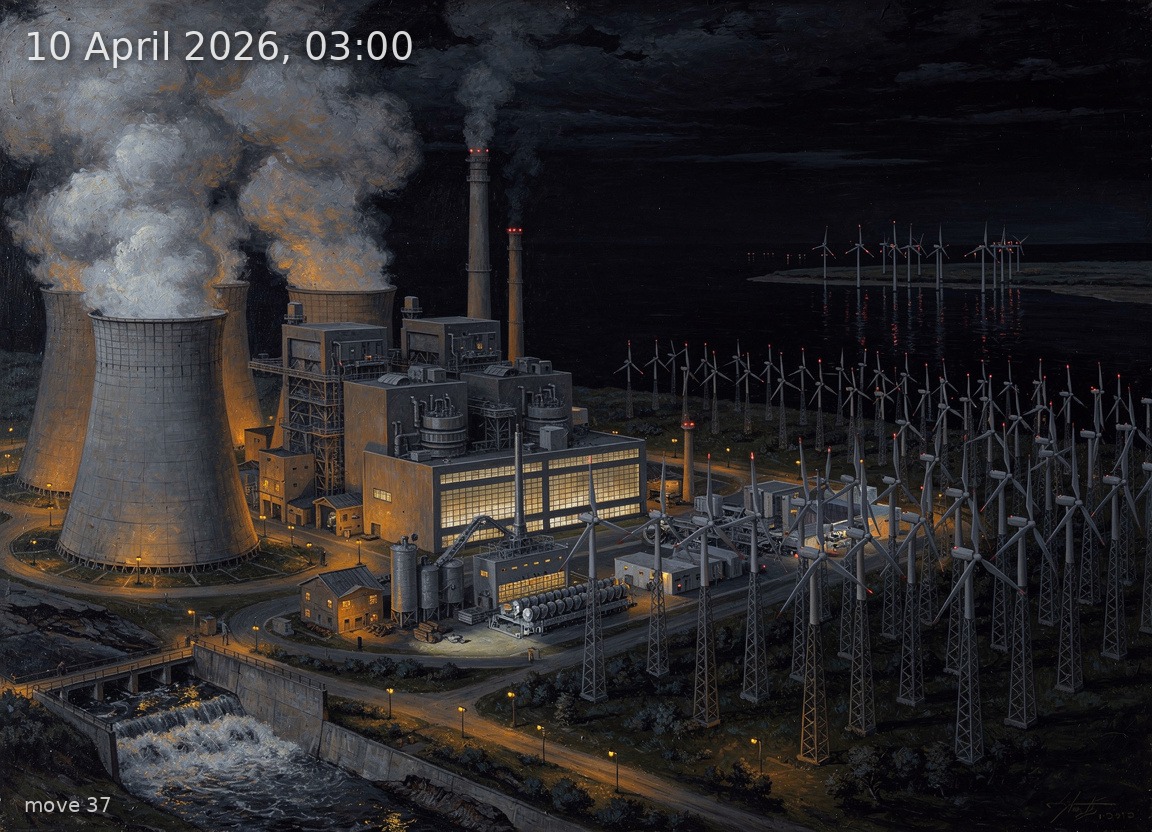
Strong overnight wind drives 70% renewables while coal and gas hold baseload, producing 3.9 GW net exports.
Back
Generation mix
Wind onshore 48%
Wind offshore 12%
Biomass 8%
Hydro 3%
Natural gas 9%
Hard coal 10%
Brown coal 10%
70%
Renewable share
29.6 GW
Wind (on + offshore)
0.0 GW
Solar
49.7 GW
Total generation
+3.9 GW
Net export
78.5 €/MWh
Day-ahead price
8.7°C / 0 km/h
Temp / Wind speed
Open-Meteo, Kassel (51.3°N 9.5°E)
100% / 0.0 W/m²
Cloud cover / Radiation
206
gCO₂/kWh
Image prompt
Wind onshore 23.8 GW dominates the scene as vast ranks of three-blade turbines on lattice towers stretching across the entire right half and into the deep background, their red aviation warning lights blinking in the darkness; wind offshore 5.9 GW appears as a distant cluster of larger turbines on the far-right horizon above a faintly gleaming river or lake surface; hard coal 5.2 GW occupies the centre-left as a large power station with rectangular boiler houses, tall chimneys trailing faint grey smoke upward; brown coal 5.1 GW fills the left foreground as massive hyperbolic cooling towers emitting thick white steam plumes lit from below by orange sodium lights; natural gas 4.5 GW sits between the coal plants as compact CCGT units with slender single exhaust stacks and a faint heat shimmer; biomass 4.0 GW appears as a modest wood-chip facility with a shorter stack and warm interior glow visible through industrial windows in the left middle ground; hydro 1.3 GW is a small weir structure with rushing water barely visible at the bottom-left edge. The sky is completely black — it is 3 AM with 100% cloud cover, so no stars, no moon, no twilight glow whatsoever, only a deep impenetrable darkness above. The entire scene is lit solely by artificial light: orange sodium streetlamps along access roads, red blinking turbine lights receding into the distance, harsh white floodlights on the coal and gas facilities, and the faint amber glow from plant windows. The atmosphere feels heavy and oppressive, reflecting the 78.5 EUR/MWh price — low clouds trapping industrial steam, a thick humid pall hanging over the landscape. Spring vegetation is just emerging, bare-branched trees with early buds, wet grass glistening under floodlights, temperature around 9°C suggesting a damp chill. The wind turbine blades are nearly still in the foreground — local wind is calm at 0.4 km/h despite massive national wind output. Painted in the style of a highly detailed 19th-century German Romantic oil painting — rich impasto brushwork, deep Prussian blues and warm industrial oranges, atmospheric chiaroscuro, the grandeur of Caspar David Friedrich meeting the industrial sublime — with meticulous engineering accuracy in every nacelle, cooling tower, and smokestack. No text, no labels.