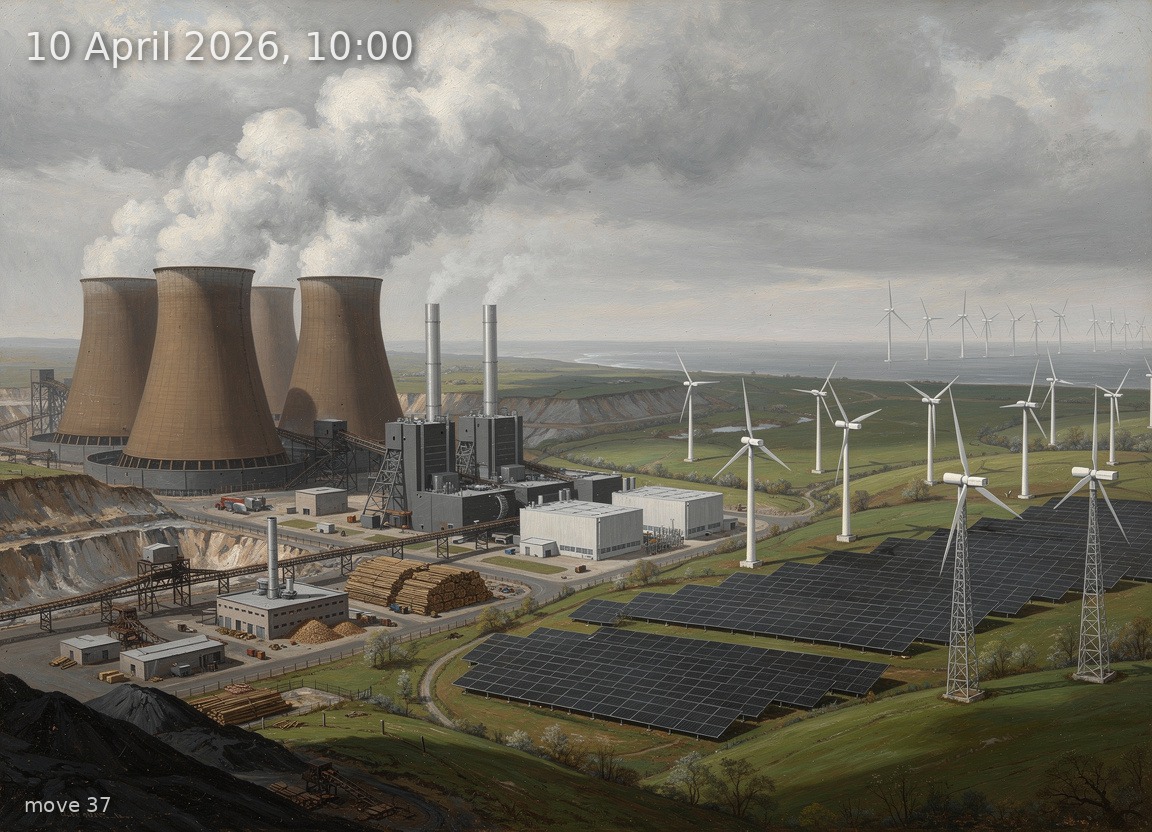
Wind leads at 17.6 GW but full overcast limits solar; coal and gas fill the gap alongside 12 GW net imports.
Back
Generation mix
Wind onshore 24%
Wind offshore 10%
Solar 21%
Biomass 8%
Hydro 3%
Natural gas 11%
Hard coal 9%
Brown coal 15%
65%
Renewable share
17.7 GW
Wind (on + offshore)
10.9 GW
Solar
52.8 GW
Total generation
-12.0 GW
Net import
109.8 €/MWh
Day-ahead price
8.6°C / 12 km/h
Temp / Wind speed
Open-Meteo, Kassel (51.3°N 9.5°E)
100% / 4.2 W/m²
Cloud cover / Radiation
247
gCO₂/kWh
Image prompt
Brown coal 8.0 GW dominates the left quarter as a cluster of massive hyperbolic cooling towers with thick white-grey steam plumes merging into the overcast, surrounded by conveyor belts and open-pit terracing; hard coal 4.8 GW sits just right of centre-left as a pair of coal-fired stations with tall rectangular stacks and coal bunkers; natural gas 5.8 GW occupies the centre as two compact CCGT plants with slender cylindrical exhaust stacks emitting thin heat shimmer; wind onshore 12.5 GW fills the right third of the scene as dozens of three-blade turbines on lattice and tubular towers stretching across rolling green spring fields, blades rotating in moderate wind; wind offshore 5.1 GW appears on the far-right horizon as a line of larger turbines rising from a distant grey sea; solar 10.9 GW is represented by broad arrays of aluminium-framed crystalline silicon PV panels in the mid-ground right-centre, but they are muted and dark under the dense cloud layer, reflecting only grey sky; biomass 4.2 GW appears as a mid-sized wood-chip plant with a modest smokestack and timber storage yard, nestled between the coal stations and wind farms; hydro 1.4 GW is a small concrete run-of-river dam on a river cutting through the foreground. The sky is entirely overcast at 100% cloud cover — a flat, heavy, oppressive canopy of uniform grey-white stratus pressing low, with no blue or sun visible, consistent with an elevated day-ahead price of 109.8 EUR/MWh. It is 10:00 AM in April so the light is full diffuse daylight — bright but completely shadowless, even, slightly cool-toned. Temperature is 8.6°C: early spring — grass is green but trees show only the earliest pale-green buds, patches of brown still visible on hillsides. Wind at 12.3 km/h creates gentle motion in grass and modest rotation of turbine blades. The atmosphere feels weighty, industrial, and vast. Rendered as a highly detailed oil painting in the tradition of 19th-century German Romantic landscape painters — rich layered colour in subdued tones, visible confident brushwork, atmospheric depth receding into misty grey distance, meticulous engineering detail on every turbine nacelle, every cooling tower's parabolic curve, every PV module's cell pattern. The composition evokes Caspar David Friedrich's sense of scale and human smallness before nature and industry. No text, no labels.