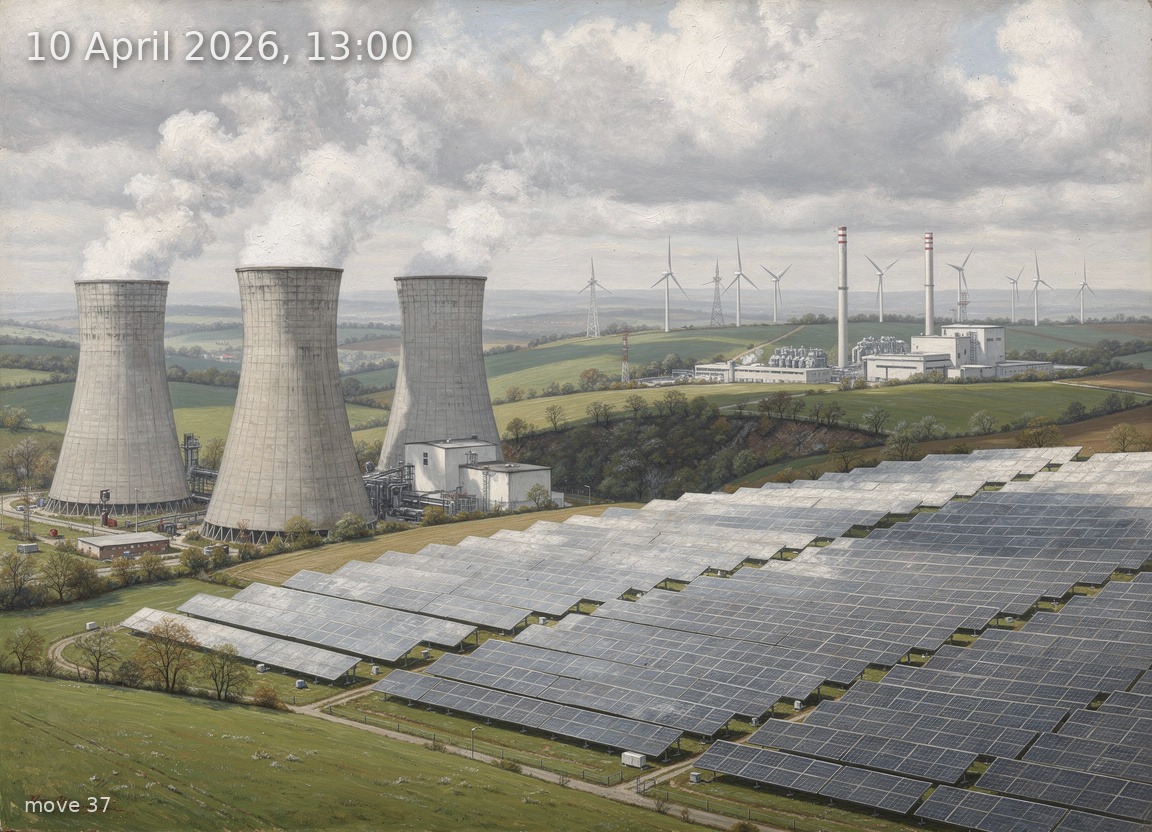
Solar leads at 24 GW with coal and gas filling the residual load as Germany imports 4 GW.
Back
Generation mix
Wind onshore 10%
Wind offshore 4%
Solar 44%
Biomass 7%
Hydro 2%
Natural gas 9%
Hard coal 9%
Brown coal 14%
68%
Renewable share
8.0 GW
Wind (on + offshore)
24.2 GW
Solar
55.0 GW
Total generation
-4.0 GW
Net import
88.9 €/MWh
Day-ahead price
10.6°C / 12 km/h
Temp / Wind speed
Open-Meteo, Kassel (51.3°N 9.5°E)
100% / 349.5 W/m²
Cloud cover / Radiation
226
gCO₂/kWh
Image prompt
Solar 24.2 GW dominates the right half of the scene as vast fields of aluminium-framed crystalline silicon photovoltaic panels stretching across rolling central German farmland, angled southward under a bright but completely overcast white-grey sky at 1 PM; brown coal 7.9 GW occupies the left foreground as a massive lignite power station with four towering hyperbolic concrete cooling towers emitting thick white steam plumes that merge with the low cloud ceiling; wind onshore 5.7 GW appears as a line of modern three-blade turbines on lattice and tubular towers along a ridge in the centre-left middle distance, blades turning slowly in light wind; natural gas 4.9 GW is rendered as a compact CCGT plant with twin exhaust stacks and a small dry cooling unit positioned centre-right behind the solar fields; hard coal 4.7 GW shows as a second thermal station to the far left with a tall brick chimney and coal conveyors, slightly smaller than the lignite plant; wind offshore 2.3 GW is suggested by a thin strip of grey North Sea horizon visible through a gap in the terrain at far centre, with small white turbine silhouettes on the water; biomass 4.0 GW appears as a wood-clad combined heat and power facility with a modest stack and a pile of woodchips near the right foreground edge; hydro 1.3 GW is a small run-of-river weir with a powerhouse tucked into a stream valley in the lower right corner. The sky is uniformly overcast with a heavy, oppressive blanket of stratocumulus reflecting the high electricity price — no blue sky visible — yet the daylight is bright and flat, shadowless, with a cool 10 °C spring feel: early spring grass is pale green, trees just beginning to bud, no full foliage yet. Style: highly detailed oil painting in the tradition of 19th-century German Romantic landscape painters such as Caspar David Friedrich and Carl Blechen — rich, layered colour with visible impasto brushwork, atmospheric aerial perspective fading the distant turbines into haze, dramatic scale contrast between the immense cooling towers and the human-scale solar arrays, meticulous engineering accuracy on every nacelle, panel frame, conveyor belt, and cooling tower rib. No text, no labels.