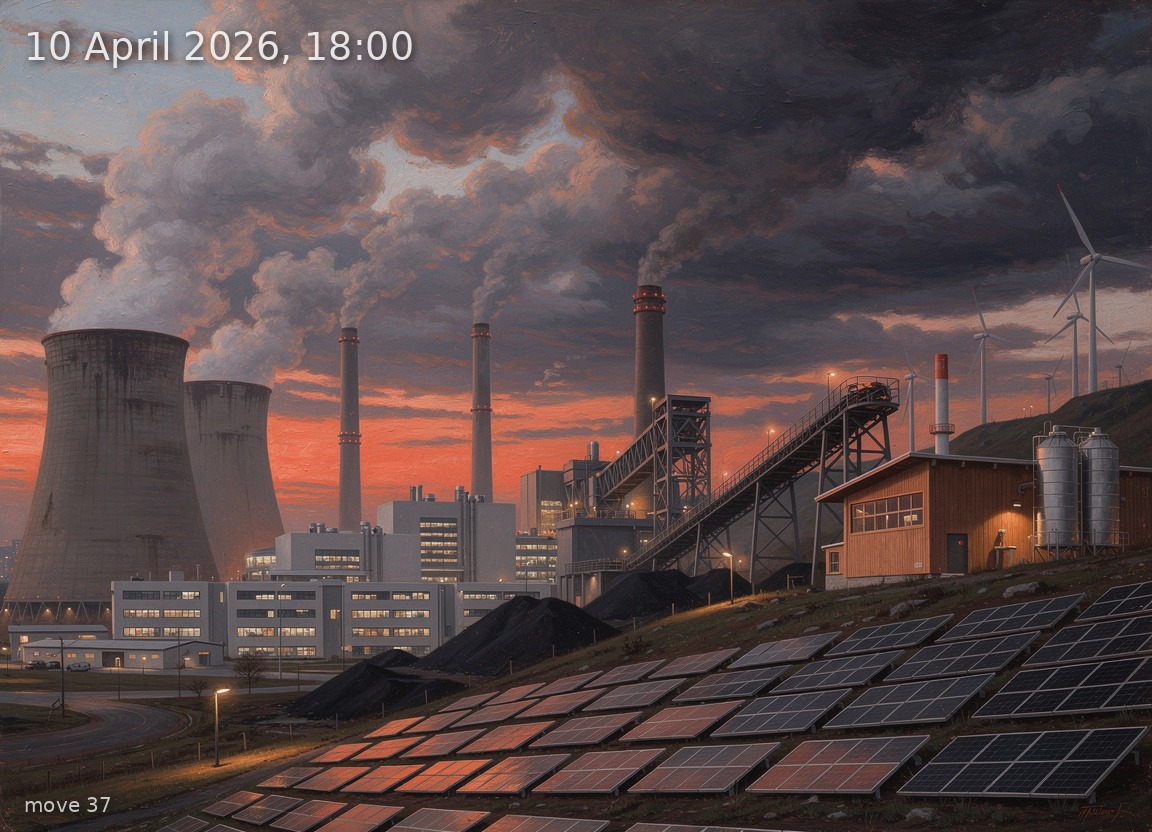
Gas, brown coal, and hard coal dominate as solar fades at dusk and 17.5 GW of net imports fill the gap.
Back
Generation mix
Wind onshore 8%
Wind offshore 3%
Solar 17%
Biomass 12%
Hydro 4%
Natural gas 23%
Hard coal 14%
Brown coal 20%
43%
Renewable share
4.2 GW
Wind (on + offshore)
6.6 GW
Solar
39.1 GW
Total generation
-17.5 GW
Net import
155.3 €/MWh
Day-ahead price
11.6°C / 10 km/h
Temp / Wind speed
Open-Meteo, Kassel (51.3°N 9.5°E)
76% / 126.8 W/m²
Cloud cover / Radiation
382
gCO₂/kWh
Image prompt
Brown coal 8.0 GW dominates the left quarter as a cluster of massive hyperbolic cooling towers with billowing white-grey steam plumes rising into the sky; natural gas 8.9 GW fills the centre-left as a row of compact CCGT power blocks with tall single exhaust stacks venting thin heat haze; hard coal 5.3 GW appears centre-right as a heavy industrial plant with conveyor belts, stockpiles of black coal, and a broad smokestack; solar 6.6 GW occupies a hillside in the right-centre as rows of aluminium-framed crystalline silicon panels catching the last orange-red light; biomass 4.5 GW sits as a timber-clad combined heat and power facility with a modest chimney and stacked wood pellet silos near the right; wind onshore 3.2 GW appears as a small group of three-blade turbines on a ridge in the far right background, blades turning slowly in light wind; wind offshore 1.0 GW is suggested by two distant turbines on the horizon line; hydro 1.4 GW is a small concrete run-of-river dam with white water cascading through its spillway in the far right foreground. Time of day is 18:00 in April dusk: the lower horizon glows deep orange-red fading to salmon, the upper sky transitions from slate blue to near-dark navy, with 76% cloud cover as heavy stratocumulus layers catching the dying light in copper and purple tones. The atmosphere is heavy and oppressive, hinting at the high electricity price — a brooding, weighty sky pressing down on the industrial landscape. Spring vegetation is emerging: pale green buds on deciduous trees, fresh grass in the foreground, temperature around 12°C suggesting cool damp air with slight mist near the river. Transmission lines with high-voltage pylons stretch across the middle ground symbolising the massive import flows. Highly detailed oil painting in the tradition of 19th-century German Romantic landscape painters — Caspar David Friedrich meets industrial sublime — rich impasto brushwork, dramatic chiaroscuro between glowing furnace light and darkening sky, atmospheric depth with layered planes receding into haze, meticulous engineering detail on every turbine nacelle, cooling tower, and PV panel frame. No text, no labels.