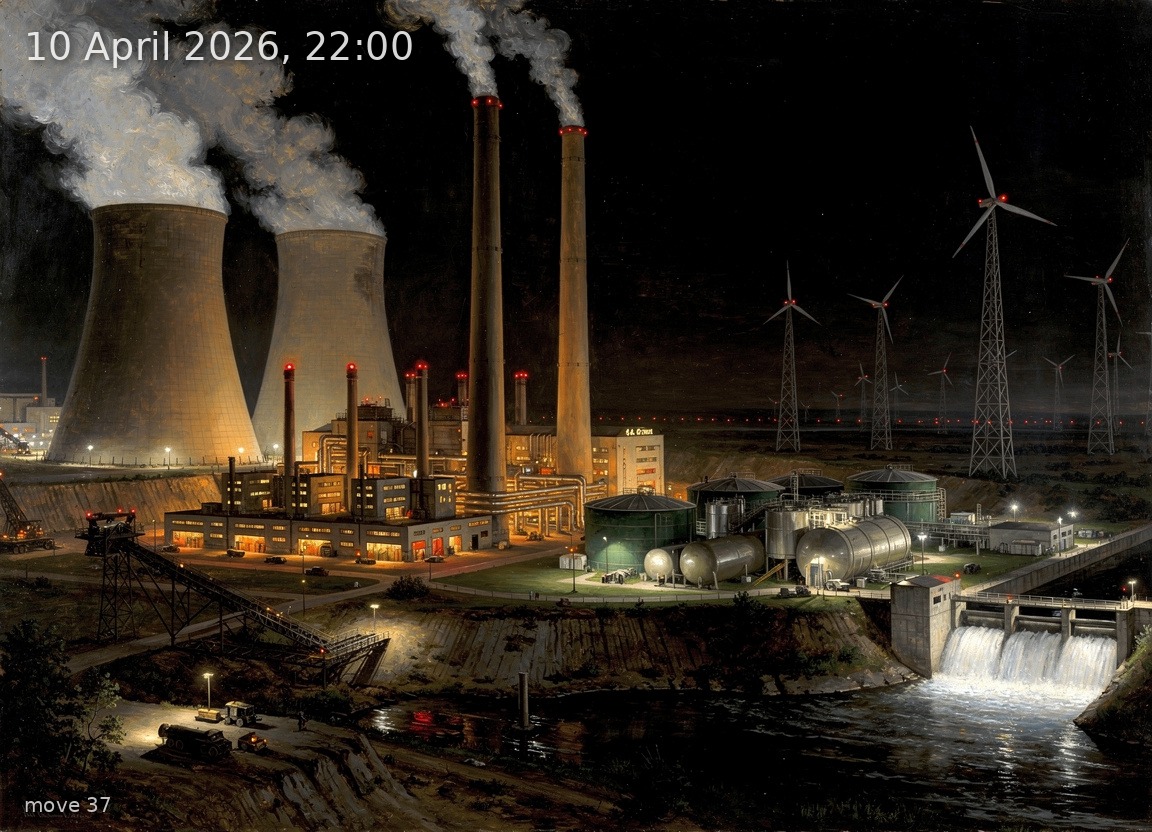
Gas, brown coal, and hard coal dominate a still, overcast April night requiring 17.8 GW of net imports.
Back
Generation mix
Wind onshore 9%
Wind offshore 2%
Solar 0%
Biomass 14%
Hydro 5%
Natural gas 29%
Hard coal 16%
Brown coal 26%
29%
Renewable share
3.1 GW
Wind (on + offshore)
0.0 GW
Solar
30.9 GW
Total generation
-17.9 GW
Net import
149.3 €/MWh
Day-ahead price
5.1°C / 5 km/h
Temp / Wind speed
Open-Meteo, Kassel (51.3°N 9.5°E)
100% / 0.0 W/m²
Cloud cover / Radiation
475
gCO₂/kWh
Image prompt
Natural gas 8.8 GW dominates the centre of the composition as a sprawling combined-cycle gas turbine complex with tall singular exhaust stacks emitting pale heat shimmer and lit by sodium-orange industrial floodlights; brown coal 8.0 GW occupies the left third as massive hyperbolic cooling towers releasing thick white steam plumes into the black sky, with conveyor belts and open-pit infrastructure faintly visible; hard coal 5.1 GW appears centre-left as a cluster of smaller coal-fired boiler houses with twin chimneys and red aviation warning lights; biomass 4.4 GW is rendered as a mid-ground industrial biogas facility with cylindrical digesters and green-tinted working lights; wind onshore 2.6 GW stands in the right background as a sparse line of three-blade turbines on lattice towers, rotors barely turning in the still air, nacelle lights blinking red; hydro 1.4 GW appears as a small dam structure in the far right with illuminated spillway; wind offshore 0.5 GW is a faint suggestion of turbine lights on the far horizon. The sky is completely black with total 100% cloud cover — no stars, no moon, no twilight glow, only a heavy oppressive overcast pressing down. The landscape is flat central German terrain with bare early-spring vegetation, grass barely greening, leafless trees, temperature near 5°C suggested by frost on metal surfaces and visible breath-like steam. All illumination comes from artificial sources: sodium streetlights casting amber pools, industrial floodlights, red warning beacons, glowing furnace mouths. The atmosphere is dense and heavy, conveying the high electricity price through an oppressive, brooding weight in the air. Rendered as a highly detailed oil painting in the tradition of 19th-century German Romantic landscape painting — rich impasto brushwork, deep chiaroscuro contrasts between shadow and industrial glow, atmospheric depth receding into murky darkness, meticulous engineering accuracy in every turbine nacelle, cooling tower curvature, and exhaust stack detail. No text, no labels.