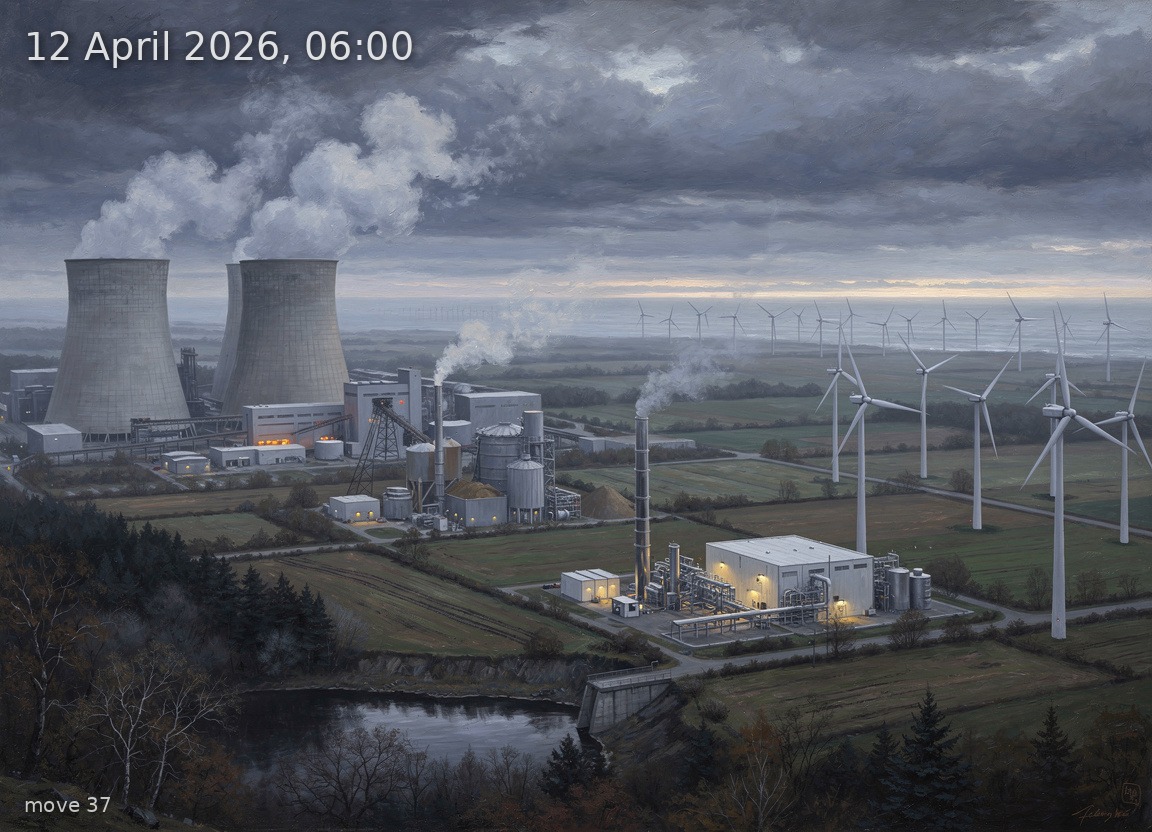
Wind leads at 16 GW but full overcast, no solar, and 7.4 GW net imports drive prices near 99 EUR/MWh.
Back
Generation mix
Wind onshore 38%
Wind offshore 14%
Solar 0%
Biomass 15%
Hydro 4%
Natural gas 10%
Hard coal 2%
Brown coal 16%
71%
Renewable share
16.0 GW
Wind (on + offshore)
0.1 GW
Solar
30.7 GW
Total generation
-7.5 GW
Net import
98.7 €/MWh
Day-ahead price
6.0°C / 3 km/h
Temp / Wind speed
Open-Meteo, Kassel (51.3°N 9.5°E)
100% / 0.0 W/m²
Cloud cover / Radiation
201
gCO₂/kWh
Image prompt
Wind onshore 11.6 GW dominates the right half of the scene as dozens of tall three-blade turbines with white tubular towers and nacelles, receding across rolling green-brown early-spring farmland; wind offshore 4.4 GW appears in the far-right background as a row of turbines on the grey North Sea horizon. Brown coal 5.0 GW occupies the left foreground as a massive lignite power station with three hyperbolic concrete cooling towers emitting thick white steam plumes. Biomass 4.5 GW appears as a mid-sized industrial plant with woodchip silos and a single stack venting pale exhaust, positioned left of centre. Natural gas 3.1 GW sits at centre as a compact CCGT facility with a slim steel exhaust stack and visible heat-recovery unit. Hydro 1.3 GW is suggested by a small dam and reservoir tucked into a wooded valley at centre-left. Hard coal 0.7 GW appears as a smaller coal plant with a single square chimney at the far left edge. Solar is entirely absent—no panels visible. The sky is deep blue-grey pre-dawn light at 06:00 in April, completely overcast with heavy low stratus clouds at 100% cover, no sun, no direct radiation; only the faintest pale luminescence along the eastern horizon hints that dawn is approaching. The atmosphere feels heavy, oppressive, and close, reflecting a high electricity price. Temperature is 6 °C: lingering frost edges on grass, bare deciduous trees with only the earliest swollen buds, patches of mist in the lowlands. Surface wind is nearly calm—turbine blades turn slowly in the foreground while distant blades spin faster, suggesting stronger winds aloft and at coastal sites. Sodium-orange streetlights glow along a road in the middle distance; windows of the industrial facilities cast warm light onto wet pavement. High-voltage transmission pylons with bundled conductors stride across the landscape, connecting the generation sources. Style: highly detailed oil painting in the tradition of Caspar David Friedrich and Carl Blechen—rich, moody colour palette of slate grey, Prussian blue, umber, and muted green; visible thick brushwork; atmospheric depth with sfumato mist layers; meticulous engineering accuracy on every turbine nacelle, cooling tower profile, and lattice pylon. No text, no labels.