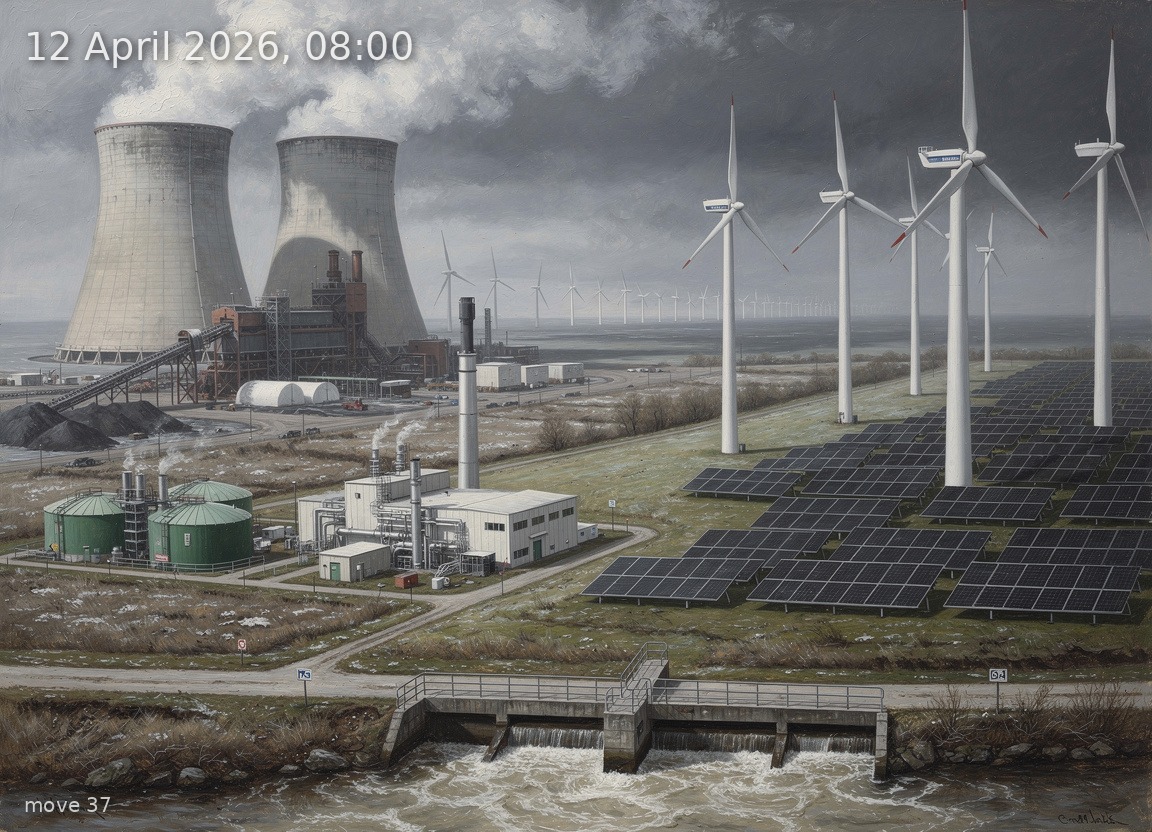
Wind leads at 12.4 GW but heavy cloud and 11.4 GW net imports define a tight April morning.
Back
Generation mix
Wind onshore 23%
Wind offshore 16%
Solar 17%
Biomass 14%
Hydro 4%
Natural gas 9%
Hard coal 2%
Brown coal 14%
75%
Renewable share
12.4 GW
Wind (on + offshore)
5.5 GW
Solar
31.8 GW
Total generation
-11.5 GW
Net import
76.1 €/MWh
Day-ahead price
6.0°C / 2 km/h
Temp / Wind speed
Open-Meteo, Kassel (51.3°N 9.5°E)
90% / 1.2 W/m²
Cloud cover / Radiation
176
gCO₂/kWh
Image prompt
Wind onshore 7.3 GW dominates the right third of the scene as a deep field of tall three-blade turbines with white tubular towers receding into misty distance across a flat northern German plain; wind offshore 5.1 GW appears in the far right background as a line of larger turbines standing in a grey North Sea glimpsed through haze. Solar 5.5 GW occupies the centre-right as rows of aluminium-framed crystalline silicon PV panels on a gently sloping meadow, their surfaces dull and reflecting only grey sky, no glint of sun. Brown coal 4.5 GW fills the left portion as two massive hyperbolic concrete cooling towers with thick white steam plumes drifting eastward, beside a lignite power station with conveyor belts and coal bunkers. Biomass 4.5 GW sits centre-left as a cluster of industrial biogas facilities with cylindrical green digesters and short exhaust stacks emitting thin vapour. Natural gas 2.8 GW appears as a compact CCGT plant with a single tall exhaust stack and streamlined turbine hall just left of centre. Hydro 1.4 GW is a small concrete run-of-river dam with spillway visible in a river cutting through the foreground. Hard coal 0.7 GW is a single modest coal plant with a square chimney at the far left edge, partially obscured by mist. The sky is heavy, oppressive, 90% overcast with low stratiform clouds in shades of pewter and slate grey; it is 08:00 full daylight but entirely diffuse, no sun disc visible, no shadows on the ground. Temperature is 6°C: early spring, bare birch and beech trees with only the faintest green buds, brown-grey dormant grass, patches of frost lingering in shaded hollows. The atmosphere feels weighty and pressured, consistent with a high electricity price. Rendered as a highly detailed oil painting in the tradition of 19th-century German Romantic landscape art — Caspar David Friedrich meets industrial realism — with rich impasto brushwork, deep atmospheric perspective, meticulous engineering detail on every turbine nacelle, cooling tower, and panel frame, warm ochre and umber earth tones contrasting cold blue-grey sky, dramatic sense of scale between nature and industry. No text, no labels.